


The judge in a trial of five Muslim men accused of plotting a terrorist attack in Australia cautioned jurors yesterday that Islam was not on trial and urged them to put aside any bias.
Prosecutors have said the suspects were devotees of a radical cleric sympathetic to al-Qaeda leader Osama bin Laden, and that they made a pact to launch a terrorist attack because they felt their religion was under threat. The men have pleaded not guilty.
New South Wales state Supreme Court judge Justice Anthony Whealy asked the 15 jurors to put aside any prejudice, noting that the public has been bombarded with media coverage of radical Islam and its links to terrorism in the last few years.
“You must be strict to bring to bear absolute impartiality,” Whealy told them as the trial opened today. “It would be wrong for you to assume ... the guilt or innocence of the accused simply because of your views on the way the Muslim lifestyle is dealt with in the media.”
“It’s an obvious truism for me to tell you that the Muslim religion is not on trial here,” he said.
The suspects, who were arrested in a series of raids in 2005, have pleaded not guilty to conspiring to commit acts in preparation for a terrorist attack. They each potentially face life in prison if convicted.
Prosecutors have alleged the men downloaded bomb-making instructions off the Internet and stockpiled chemicals to make lethal explosives.
Their trial is expected to last up to one year.
The five Muslim extremists planned terrorist acts in Australia in pursuit of “violent jihad,” the court heard as their trial began.
The Sydney men obtained or sought weapons and explosive materials and possessed extremist material venerating the work of al-Qaeda leader Osama bin Laden, prosecutor Richard Maidment told a Supreme Court jury.
He said the evidence would show the men were working together between July 2004 and their arrest in November 2005 “to prepare for the commission of one or more terrorist acts in Australia.”
The accused — Khaled Cheikho, Moustafa Cheikho, Mohamed Ali Elomar, Abdul Rakib Hasan and Mohammed Omar Jamal — have pleaded not guilty.
If convicted, the men — aged from 24 to 43 — face a maximum sentence of life imprisonment.
Raids on their homes found “large quantities of literature which supported indiscriminate killing, mass murder and martyrdom in pursuit of violent jihad,” Maidment said.
They had pictures and videos showing the hijacked aircraft smashing into the World Trade Center in New York on Sept. 11, 2001, as well as beheadings and death on the battlefield, he said.
Maidment described all five as devout Muslims who believed Islam was under attack throughout the world and that there was a religious obligation to come to its defense.
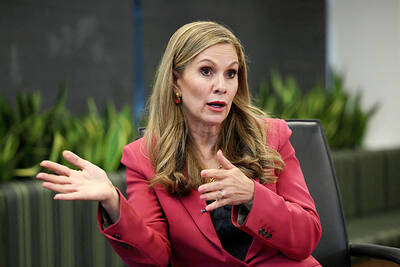
Australians were downloading virtual private networks (VPNs) in droves, while one of the world’s largest porn distributors said it was blocking users from its platforms as the country yesterday rolled out sweeping online age restriction. Australia in December became the first country to impose a nationwide ban on teenagers using social media. A separate law now requires artificial intelligence (AI)-powered chatbot services to keep certain content — including pornography, extreme violence and self-harm and eating disorder material — from minors or face fines of up to A$49.5 million (US$34.6 million). The country also joined Britain, France and dozens of US states requiring
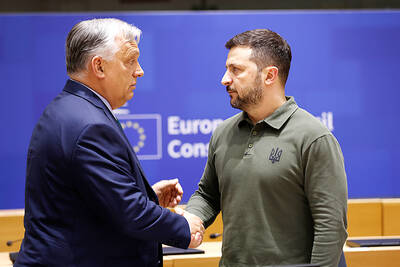
Hungarian authorities temporarily detained seven Ukrainian citizens and seized two armored cars carrying tens of millions of euros in cash across Hungary on suspicion of money laundering, officials said on Friday. The Ukrainians were released on Friday, following their detention on Thursday, but Hungarian officials held onto the cash, prompting Ukraine to accuse Hungary’s Russia-friendly government of illegally seizing the money. “We will not tolerate this state banditism,” Ukrainian Minister of Foreign Affairs Andrii Sybiha said. The seven detained Ukrainians were employees of the Ukrainian state-owned Oschadbank, who were traveling in the two armored cars that were carrying the money between Austria and
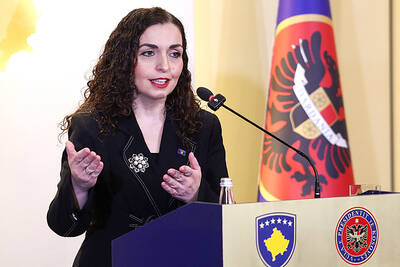
Kosovar President Vjosa Osmani on Friday after dissolving the Kosovar parliament said a snap election should be held as soon as possible to avoid another prolonged political crisis in the Balkan country at a time of global turmoil. Osmani said it is important for Kosovo to wrap up the upcoming election process and form functional institutions for political stability as the war rages in the Middle East. “Precisely because the geopolitical situation is that complex, it is important to finish this electoral process which is coming up,” she said. “It is very hard now to imagine what will happen next.” Kosovo, which declared

MORE BANS: Australia last year required sites to remove accounts held by under-16s, with a few countries pushing for similar action at an EU level and India considering its own ban Indonesia on Friday said it would ban social media access for children under 16, citing threats from online pornography, cyberbullying, online fraud and Internet addiction. “Accounts belonging to children under 16 on high-risk platforms will start to be deactivated, beginning with YouTube, TikTok, Facebook, Instagram, Threads, X, Bigo Live and Roblox,” Indonesian Minister of Communications and Digital Meutya Hafid said. “The government is stepping in so that parents no longer have to fight alone against the giants of the algorithm. Implementation will begin on March 28, 2026,” she said. The social media ban would be introduced in stages “until all platforms fulfill their


 RSS
RSS