


Mohammed Momin Khawaja, the first Canadian tried under the nation’s anti-terrorism law, was found guilty on Wednesday of several charges related to a foiled plot against several British targets.
The Ottawa software developer of Pakistani descent was found to have “knowingly participated” and “knowingly facilitated” a terrorist group’s plan to attack a popular London nightclub, a shopping mall and a natural gas network.
However, he may not have known about the plot itself, Justice Douglas Rutherford said in his 52-page decision.
Khawaja, 29, was arrested in March 2004 and was accused of developing bomb detonators, possession of explosives, financing terrorism and training as a terrorist in Pakistan.
Khawaja’s defense lawyer had argued Khawaja meant all of this in support of an insurgency in Afghanistan against coalition forces, not against British targets.
The judge ruled the prosecution did not prove Khawaja’s “guilty knowledge of the fertilizer bomb plot” in London.
“There is no direct evidence that Khawaja knew of the ammonium nitrate fertilizer [obtained by his co-conspirators] or the consideration of domestic targets” in Britain, he said.
However, Khawaja’s description to one of his co-conspirators about how the bomb detonator he built for them worked “leaves no doubt that Momim Khawaja knew he was building a device to trigger explosions,” the judge said.
And so, “I have no reasonable doubt in concluding that in doing the things the evidence clearly establishes that he did, Momin Khawaja was knowingly participating in and supporting a terrorist group,” the judge concluded.
Khawaja’s defense lawyer Lawrence Greenspon claimed a partial victory in that “he was acquitted of the London bombing.”
He did not indicate whether he would appeal the verdict.
Wesley Wark, a visiting professor at the University of Ottawa and a specialist in intelligence and national security issues, however, said: “It does not matter that Momin Khawaja did not know the full details of what his London co-conspirators intended to do.”
“He was convicted for the fact that he aligned himself with the London group and he facilitated its preparation to conduct terrorism,” he said.
Canada’s anti-terrorism law was written to reflect the fact that not all members of terrorist groups are privy to all plot details, he said.
The prosecution was considered a key test of Canada’s anti-terrorism legislation, enacted after the Sept. 11, 2001, attacks in the US, and tweaked last year after a portion of it was thrown out by a judge because it attempted to define terrorism by what motivated it, and so wrongly attempted to police people’s thoughts, religious beliefs or opinions.
Still, the trial was allowed to continue while parliament worked on a fix.
“The anti-terrorism act provisions themselves were on trial in the Khawaja case,” Wark said.
“They have been controversial provisions,” he said. But “I think the very clear conclusion to be drawn from the Khawaja case is that the antiterrorism act works.”
Khawaja was the first to be arrested under the act and pleaded not guilty.
The devout Muslim was born in Canada of Pakistani immigrant parents and once worked as a computer expert at Canada’s Foreign Affairs Department.
The prosecution had argued he sought out the fanatic group of British Muslims, also of Pakistani descent, and designed for them a remote detonator to set off a fertilizer bomb.
The detonator was found in Khawaja’s Ottawa house along with an arsenal of guns during a police raid in 2004, the court heard.
The prosecution also laid out emails, and descriptions of video and wiretap surveillance that purportedly tied him to the bomb plot.
In one email sent from a Foreign Affairs ministry computer, according to prosecutors, Khawaja discussed using a courier to send the detonator to his contacts in London.
In 2003, Khawaja also traveled to northern Pakistan for weapons training, and made his secondary residence in Pakistan available to his new “bros” (brothers).
Sentencing is set for November 18.
Khawaja faces possible life in prison.
Five of his co-conspirators were convicted in Britain last year, and sentenced to life in prison. Two others were acquitted.
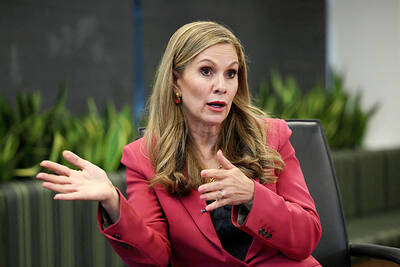
Australians were downloading virtual private networks (VPNs) in droves, while one of the world’s largest porn distributors said it was blocking users from its platforms as the country yesterday rolled out sweeping online age restriction. Australia in December became the first country to impose a nationwide ban on teenagers using social media. A separate law now requires artificial intelligence (AI)-powered chatbot services to keep certain content — including pornography, extreme violence and self-harm and eating disorder material — from minors or face fines of up to A$49.5 million (US$34.6 million). The country also joined Britain, France and dozens of US states requiring
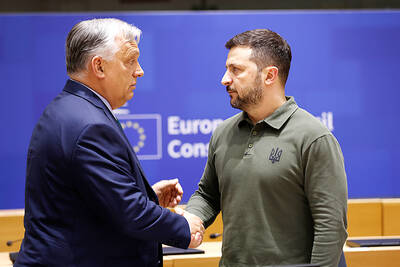
Hungarian authorities temporarily detained seven Ukrainian citizens and seized two armored cars carrying tens of millions of euros in cash across Hungary on suspicion of money laundering, officials said on Friday. The Ukrainians were released on Friday, following their detention on Thursday, but Hungarian officials held onto the cash, prompting Ukraine to accuse Hungary’s Russia-friendly government of illegally seizing the money. “We will not tolerate this state banditism,” Ukrainian Minister of Foreign Affairs Andrii Sybiha said. The seven detained Ukrainians were employees of the Ukrainian state-owned Oschadbank, who were traveling in the two armored cars that were carrying the money between Austria and
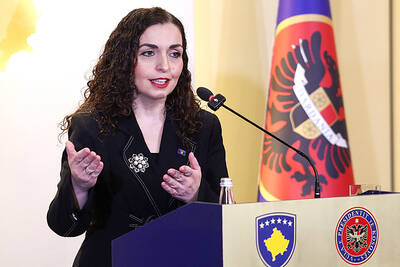
Kosovar President Vjosa Osmani on Friday after dissolving the Kosovar parliament said a snap election should be held as soon as possible to avoid another prolonged political crisis in the Balkan country at a time of global turmoil. Osmani said it is important for Kosovo to wrap up the upcoming election process and form functional institutions for political stability as the war rages in the Middle East. “Precisely because the geopolitical situation is that complex, it is important to finish this electoral process which is coming up,” she said. “It is very hard now to imagine what will happen next.” Kosovo, which declared

MORE BANS: Australia last year required sites to remove accounts held by under-16s, with a few countries pushing for similar action at an EU level and India considering its own ban Indonesia on Friday said it would ban social media access for children under 16, citing threats from online pornography, cyberbullying, online fraud and Internet addiction. “Accounts belonging to children under 16 on high-risk platforms will start to be deactivated, beginning with YouTube, TikTok, Facebook, Instagram, Threads, X, Bigo Live and Roblox,” Indonesian Minister of Communications and Digital Meutya Hafid said. “The government is stepping in so that parents no longer have to fight alone against the giants of the algorithm. Implementation will begin on March 28, 2026,” she said. The social media ban would be introduced in stages “until all platforms fulfill their


 RSS
RSS