


Voters may not say it out loud, but pollsters back it up: Racism is a lingering, significant factor in the race that could elect the first black president.
Democratic presidential candidate Senator Barack Obama has consistently portrayed himself as the candidate of all Americans, not a champion of the African-American minority, even as he plays up how proud he is of his heritage as the son of a white woman from Kansas and a black father from Kenya.
The Illinois senator, 47, earlier this year said racism was an issue the US could not allow itself to ignore.
But in the White House race it has been deliberately and carefully addressed in a limited way. That does not come as a surprise to many analysts.
“Race is a factor for those who would vote for and against him,” said Gary Weaver, an American University professor who leads its Intercultural Management Institute.
“I think that there are some white Americans who will not vote for a black person. It is unlikely they would admit this publicly, but they might admit this in anonymous surveys,” Weaver said. “On the phone, racists will often deny that they are influenced by race because it is socially unacceptable. When they enter the poll booths, these people may very well vote against Obama.”
STANFORD STUDY
A recent Stanford University study concluded that Obama could lose six points on election day because of his color — a troubling price to pay for prejudice.
The US is more than 70 percent white. About 13 percent of Americans are black, census data show, mainly descendents of slaves from West Africa, although that is not Obama’s case.
In cities and towns across the US, however, Americans increasingly describe themselves as multiracial.
In California, for example, there is no one majority, but rather a mix of hefty minority groups of Asians, Hispanics, whites and blacks.
SEGREGATION CONTINUES
While many whites speak positively about blacks, the two often do not interact much and there are lingering bad feelings, the Stanford poll showed.
African-Americans are statistically overrepresented among US poor. In US prisons, there are six times more blacks than whites. One African-American man in 15 is behind bars.
“A very small minority of Americans would admit they are racists ... perhaps the few thousand who are Neo-Nazis or KKK members,” said Weaver, referring to the white supremacist movement, the Ku Klux Klan.
Weaver, who is white and married an African-American woman 38 years ago, shortly after mixed-race unions were legalized, said “the biggest gap is between older white people and young people in America.
“Young people are in support of Obama by large percentages and, if they vote, they will determine the election. Historically, the percentage of young people who vote has been lower than older white people. But, in the primaries they voted in large numbers,” he said.
“They went to schools that were integrated and learned that the US is supposed to be a multicultural, pluralistic society where everyone is equal. Thus, they view Obama as the obvious representative of this society,” he said.
FROM POLLS TO REALITY
For Paul Herrnson, director of the Center for American Politics and Citizenship at the University of Maryland, it is difficult to know how racial discrimination against a candidate could show up.
“Race could be an obstacle, although it is not a major issue for many Americans. It remains an issue for some, especially rural white Southerners,” he said.
Still, Herrnson said, “recent studies suggest that the numbers who say one thing in public and do another in private [are] declining.”
REPARATIONS
Although the US government has made reparations to groups harmed on the basis of race — such as ethnic Japanese held in detention camps in the US during World War II — it has not done so to the descendents of African slaves.
Some argue against the idea, saying slavery was not the fault of the current leadership; others argue the government perpetuated slavery and denied millions civil rights for centuries, with long-lasting social and economic ramifications.
And in a sign of the lingering tensions, officials at a US Christian college in Oregon are investigating after a cardboard effigy of Obama was hung from a tree, recalling past infamous lynchings of African-Americans.
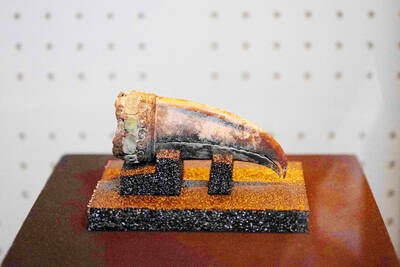
Archeologists in Peru on Thursday said they found the 5,000-year-old remains of a noblewoman at the sacred city of Caral, revealing the important role played by women in the oldest center of civilization in the Americas. “What has been discovered corresponds to a woman who apparently had elevated status, an elite woman,” archeologist David Palomino said. The mummy was found in Aspero, a sacred site within the city of Caral that was a garbage dump for more than 30 years until becoming an archeological site in the 1990s. Palomino said the carefully preserved remains, dating to 3,000BC, contained skin, part of the
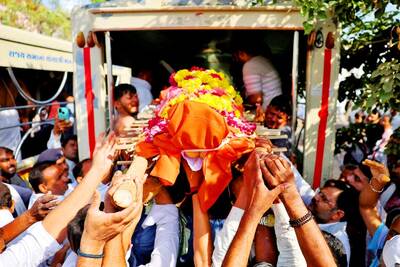
‘WATER WARFARE’: A Pakistani official called India’s suspension of a 65-year-old treaty on the sharing of waters from the Indus River ‘a cowardly, illegal move’ Pakistan yesterday canceled visas for Indian nationals, closed its airspace for all Indian-owned or operated airlines, and suspended all trade with India, including to and from any third country. The retaliatory measures follow India’s decision to suspend visas for Pakistani nationals in the aftermath of a deadly attack by shooters in Kashmir that killed 26 people, mostly tourists. The rare attack on civilians shocked and outraged India and prompted calls for action against their country’s archenemy, Pakistan. New Delhi did not publicly produce evidence connecting the attack to its neighbor, but said it had “cross-border” links to Pakistan. Pakistan denied any connection to

TRUMP EFFECT: The win capped one of the most dramatic turnarounds in Canadian political history after the Conservatives had led the Liberals by more than 20 points Canadian Prime Minister Mark Carney yesterday pledged to win US President Donald Trump’s trade war after winning Canada’s election and leading his Liberal Party to another term in power. Following a campaign dominated by Trump’s tariffs and annexation threats, Carney promised to chart “a new path forward” in a world “fundamentally changed” by a US that is newly hostile to free trade. “We are over the shock of the American betrayal, but we should never forget the lessons,” said Carney, who led the central banks of Canada and the UK before entering politics earlier this year. “We will win this trade war and
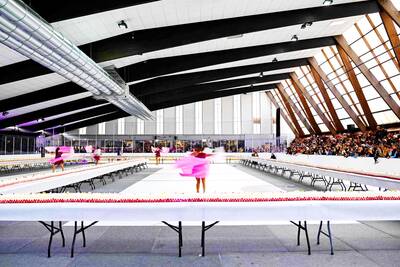
Armed with 4,000 eggs and a truckload of sugar and cream, French pastry chefs on Wednesday completed a 121.8m-long strawberry cake that they have claimed is the world’s longest ever made. Youssef El Gatou brought together 20 chefs to make the 1.2 tonne masterpiece that took a week to complete and was set out on tables in an ice rink in the Paris suburb town of Argenteuil for residents to inspect. The effort overtook a 100.48m-long strawberry cake made in the Italian town of San Mauro Torinese in 2019. El Gatou’s cake also used 350kg of strawberries, 150kg of sugar and 415kg of


 RSS
RSS