


Russia called on Monday for a new European-Atlantic security treaty embracing all countries and security organizations including NATO, the EU and post-Soviet bodies that would restore strategic parity.
Russian Foreign Minister Sergey Lavrov said the parity, which has long been the basis of strategic stability across the Atlantic, is becoming unbalanced because NATO has eclipsed the Cold War collective security system that has become dominated by the US.
Lavrov said in a speech on Saturday to the UN General Assembly that work on the new treaty could be started at a pan-European summit and include governments and organizations in the region.
He referred to it as “a kind of Helsinki-2,” a follow-up to the 1975 Helsinki Treaty.
That treaty between all European nations, together with the US and Canada, evolved into the present-day Organization for Security and Cooperation in Europe (OSCE), the largest conflict-prevention and security organization on the continent.
Elaborating on the proposal, first put forward in June by Russian President Dmitry Medvedev, Lavrov told a news conference that the OSCE principles, especially “the need to avoid any means to strengthen your own security at the expense of the security of others,” are no longer being followed.
He cited several examples of “strategic stability being strained” including Washington’s withdrawal from the Anti-Ballistic Missile Treaty, the US decision to install anti-missile systems in Poland and the Czech Republic and the establishment of US bases in Bulgaria and Romania.
Lavrov said that “negotiations [for a strategic arms limitation treaty] are not so far heading anywhere because our US colleagues do not want to keep limits on the delivery vehicles and on nuclear warheads at storage. They only want to keep some limits on the operationally deployed nuclear warheads.”
EU MONITORS
Meanwhile, EU ceasefire monitors will for now not operate inside a security zone south of Georgia’s breakaway South Ossetia region but talks on access are continuing, Russia’s military said yesterday.
“From tomorrow, representatives of the European Union will begin conducting monitoring up to the southern borders of the security zone,” Vitaly Manushko, head of the temporary press center for the Russian peacekeeping force around South Ossetia, told reporters.
Under a French-brokered ceasefire deal, Russian troops stationed in Georgia since a brief war in August are to pull back from undisputed Georgian territory by Oct. 10, and allow EU monitors to take over duties patrolling the security zone.
Manushko said Russian and EU officials, meeting in the Georgian village of Karaleti yesterday, had not finalized a technical and logistical agreement that would have allowed the EU monitors to enter the security zone from today.
SUICIDE BOMB
In related news, a suicide car bomber blew himself up yesterday in Russia’s southern republic of Ingushetia in an apparent attempt to kill the region’s Interior Minister, police said.
Three bystanders and a motorist were wounded in the region’s main city of Nazran when the bomber blew up his Lada saloon as Interior Minister Mussa Medov and his bodyguards pulled alongside in their armored Mercedes, police said.
Medov and his bodyguards were not hurt, although their vehicle was severely damaged and a 2m crater was left in the road surface.
“It’s difficult right now to determine the comparative force of the explosion, but I’m certain it was no less than 2kg of explosive material,” an investigator at the blast site said.
Ingushetia is a poor, chiefly Muslim republic in a turbulent North Caucasus region where Moscow is struggling to contain an insurgency by Islamist militants who kill officials in ambushes and bombings.

Crowds in Bangladesh are flocking to snap photographs with an unlikely social media star — an albino buffalo with flowing blond hair nicknamed “Donald Trump” that is due to be sacrificed within days. Owner Zia Uddin Mridha, 38, said his brother named the 700kg bull over its flowing helmet of hair resembling the signature look of the US president. “My younger brother picked this name because of the buffalo’s extraordinary hair,” he said at his farm in Narayanganj, just outside the capital, Dhaka. Mridha said that a constant stream of curious visitors — social media fans, onlookers and children — have come throughout
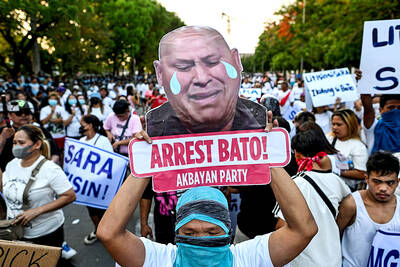
The Philippines said it has asked the country’s Supreme Court to allow it to arrest former Philippine president Rodrigo Duterte’s chief drug war enforcer to stand trial in an international tribunal. The International Criminal Court (ICC) last week unsealed an arrest warrant against Philippine Senator Ronald dela Rosa, accusing him along with Duterte and other “coperpetrators” of the “crime against humanity of murder.” Dela Rosa briefly sought refuge in the Philippine Senate last week while asking the Philippine Supreme Court to stop an ongoing attempt by government agents to arrest him. “By his own conduct, he has placed himself outside the protection of

It began as a satirical online project. Now millions of young people in India are flocking to it as an outlet for their frustration. A parody political party called the Cockroach Janta Party, with the insect as its symbol, has exploded across India’s social media by turning absurdist humor into protest. Memes and short videos mocking corruption, joblessness and political dysfunction have flooded social media sites, where millions of users are embracing the cockroach — known for its ability to survive harsh conditions — as a tongue-in-cheek symbol of endurance. The online movement’s rise has been unusually rapid. The Cockroach Janta Party (CJP)
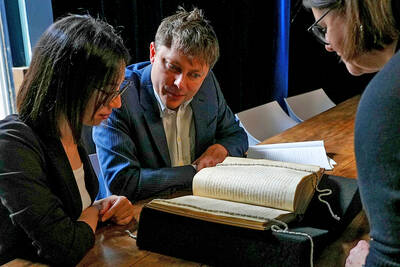
The researchers in Ireland looked at their computer screen, marveling at a medieval book tracked down in a Roman library. They flipped through its digitized pages and found their sought-after treasure: the oldest surviving English poem. “We were extremely surprised. We were speechless. We couldn’t believe our eyes when we first saw that,” said Elisabetta Magnanti, a visiting research fellow at Trinity College Dublin’s school of English. The poem was also within the main body of Latin text, she said, calling it “extraordinary.” Composed in Old English by a Northumbrian agricultural worker in the 7th century, Caedmon’s Hymn appears within some copies of


 RSS
RSS