


Barack Obama and John McCain, in a show of unity over the economic crisis, were to both attend a meeting yesterday with US President George W. Bush to discuss a proposed bailout even as they clashed on whether the crisis should delay their first debate.
The meeting, called by Bush and also to be attended by key congressional leaders, will address a US$700 billion plan the administration has proposed to bail out a struggling financial industry.
In a joint statement yesterday, the two candidates called the proposal flawed but said the effort to protect the US economy must not fail. The plan, without which Bush warned the US may fall into “a long and painful recession,” has met with stiff Congressional opposition from both Democrats and members of Bush’s own party, the Republicans.
In a surprise announcement on Wednesday, McCain called for the candidates’ first debate — slated to be held today in Mississippi — to be delayed in order to address the financial crisis that has roiled US markets and led the Bush administration to push for the unprecedented government bailout. McCain also said he would be suspending his campaign to deal with the crisis.
Obama, who seemed taken aback by McCain’s suggestion, rejected the call for a delay, saying that whoever wins the Nov. 4 election would be required “to deal with more than one thing at once.”
McCain’s announcement left the question of whether the first of three presidential debates to be held this fall will go forward, at a time when US voters face increasing economic uncertainty.
In their joint statement, McCain and Obama said now is the time to “rise above politics for the good of the country. We cannot risk an economic catastrophe.”
But it was apparent that politics would play a role in any ongoing discussion of the economic crisis and whether to hold today’s debate.
The candidates’ conflicting positions arose after they spoke privately about how to facilitate congressional negotiations on the Bush administration’s bailout proposal.
But McCain beat Obama to the punch with the first public statement, saying the Bush plan to prop up the financial community seemed headed for defeat and a bipartisan solution was needed urgently.
“It has become clear that no consensus has developed to support the administration’s proposal,” McCain said. “I do not believe that the plan on the table will pass as it currently stands, and we are running out of time.”
But Democratic Congressman Barney Frank, chairman of the House committee shepherding the bailout plan, said all sides were getting close to a deal and accused McCain of “trying to take credit for something that’s already happening without him.”
McCain said he had spoken to Bush, a fellow Republican, and asked him to convene a leadership meeting in Washington that would include him and Obama.
Bush, who rarely calls legislative leaders to push priority projects, took the unusual step of calling Obama personally about the meeting, presidential spokeswoman Dana Perino said.
Obama spokesman Bill Burton said the senator would attend and “will continue to work in a bipartisan spirit and do whatever is necessary to come up with a final solution.”
But Obama said earlier in the day that the debate shouldn’t be delayed, adding that the US voters needed to hear the candidates’ views “now more than ever.”
“It’s my belief that this is exactly the time when the American people need to hear from the person who, in approximately 40 days, will be responsible for dealing with this mess,” Obama said.
McCain said he was putting the good of the country ahead of politics, but his announcement was clearly a political move. It was an attempt to outmaneuver Obama on an issue — the economy — that has been hurting McCain as his rival continued to gain in polls.
While McCain said he would “suspend” his campaign, including advertising and fundraising, it simply will move to Washington where the four-term senator will remain in the spotlight, regardless.
Obama repeatedly stressed at his news conference that he called McCain first to propose that they issue a joint statement in support of a package to help fix the economy as soon as possible. He said McCain called back several hours later, as Obama was leaving a rally in Florida, and agreed to the idea of a statement but also said he wanted to postpone the debate and hold joint meetings in Washington.
Obama said he suggested they first issue a joint statement showing bipartisanship.
“When I got back to the hotel, he had gone on television to announce what he was going to do,” Obama said.
Stephen Wayne, professor of government at Georgetown University in Washington, said he understood McCain’s attempt to put off the debate — which was intended to focus on foreign policy — because the US economic crisis was likely to “swallow up McCain’s strength on international relations.”
“I don’t know what would be gained in stopping his campaign,” Wayne said.
In rejecting a debate delay, Obama also declined to join McCain in suspending campaign activities, and noted both he and his opponent had jets that could get them to Washington very quickly if their presence were needed. He said he had been in daily contact with congressional leaders and Treasury Secretary Henry Paulson, and didn’t see an immediate need for his presence.
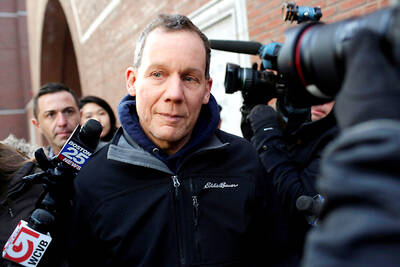
An American scientist convicted of lying to US authorities about payments from China while he was at Harvard University has rebuilt his research lab in Shenzhen, China, to pursue technology the Chinese government has identified as a national priority: embedding electronics into the human brain. Charles Lieber, 67, is among the world’s leading researchers in brain-computer interfaces. The technology has shown promise in treating conditions such as amyotrophic lateral sclerosis and restoring movement in paralyzed people. It also has potential military applications: Scientists at the Chinese People’s Liberation Army have investigated brain interfaces as a way to engineer super soldiers by boosting
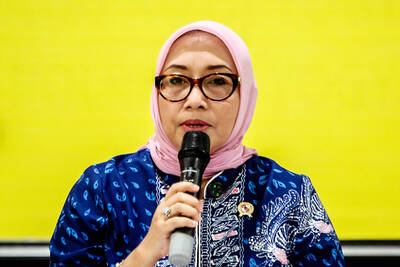
Indonesian police have arrested 13 people after shocking images of alleged abuse against small children at a daycare center went viral, sparking outrage across the nation, officials said on Monday. Police on Friday last week raided Little Aresha, a daycare center in Yogyakarta on Java island, following a report from a former employee. CCTV footage circulating on social media showed children, most younger than two, lying on the floor wearing only diapers, their hands and feet bound with rags. The police have confirmed that the footage is authentic. Police said they also found 20 children crammed into a room just 3m by 3m. “So
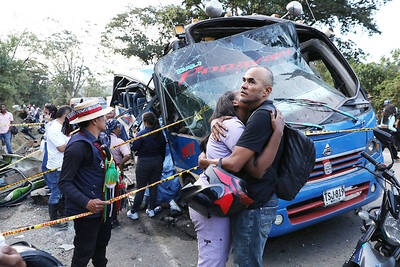
A highway bomb attack in a restive region of southwestern Colombia on Saturday killed 14 people and injured at least 38, the latest spate of violence ahead of next month’s presidential election. Authorities blamed the attack in the Cauca department — a conflict-ridden, coca-growing region — on dissidents of the now-disbanded FARC guerrilla army, who have been sowing violence across the country. “Those who carried out this attack ... are terrorists, fascists and drug traffickers,” Colombian President Gustavo Petro said on social media. “I want our very best soldiers to confront them,” he added. The leftist leader blamed the bombing
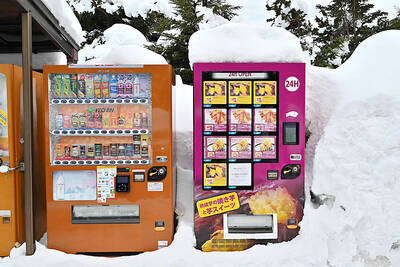
From post offices and parks to stations and even the summit of Mount Fuji, Japan’s vending machines are ubiquitous, but with the rapid pace of inflation cooling demand for their drinks, operators are being forced to rethink the business. Last month beverage giant DyDo Group Holdings announced it would remove about 20,000 vending machines — about 7 percent of their stock nationwide — by January next year, to “reconstruct a profitable network.” Pokka Sapporo Food & Beverage, based in Nagoya, also said last month it would sell its 40,000-machine operation to Osaka-based Lifedrink Co. “The strength of the vending machine


 RSS
RSS