


Talks aimed at settling a long-running conflict in Bolivia between President Evo Morales and rebel governors that blew up into deadly unrest last week were under way yesterday, as soldiers battled to restore order.
The meeting between Vice President Alvaro Garcia and Tarija state Governor Mario Cossio, who was also representing the four other governors in the opposition coalition, started late on Sunday.
A summit between South American presidents concerned over the strife in Bolivia was also to be held in Chile yesterday.
Both sides in Bolivia waved an olive branch after six days of street violence that left at least 18 people dead and 100 wounded in the northern state of Pando.
Troops sent to that state, which was put under martial law by Morales on Friday, were facing off with armed anti-government protesters in the main city of Cobija.
They were also hunting the state governor, Leopoldo Fernandez, to arrest him for rejecting the martial law order, and for allegedly having a hand in the deaths of 16 of those killed. The government said the dead, mostly peasants who supported Morales, had been gunned down in an ambush.
Opposition leaders in the state of Santa Cruz said on Sunday they had ordered an end to roadblocks that had been set up in protest against the government, and which had caused a penury of fuel in the state, as a gesture of “goodwill for dialogue.”
Garcia responded by saying the government was “amply predisposed” to negotiate.
The governors have rejected socialist reforms Morales is seeking to impose, including rewriting the Constitution to break up big land holdings to give parcels to poor Bolivian Indians and to redistribute the country’s revenues from lucrative gas fields.
The conflict has pitted the indigenous majority, which includes Morales, against the white or mixed population inhabiting the eastern lowlands.
Morales has been defiant, vowing as recently as Saturday to “emerge victorious” with his reforms or die trying. He also accused the rebel governors of Santa Cruz, Beni, Pando, Tarija and Chuquisaca of “plotting a fascist, racist coup” against him.
Garcia said Morales would not take part in the negotiations, but would step in at the end to sign any resulting deal.
The internal problems of Bolivia took place against a parallel diplomatic row with the US.
On Sunday, the US ambassador to Bolivia, Philip Goldberg, left the country under an expulsion order by Morales, who had accused him of supporting the opposition and encouraging a division of the country.
Before flying out, he told reporters in La Paz that Bolivia could expect “serious consequences” in return, beyond the expulsion of the Bolivian ambassador, which had already been announced.
Morales, Goldberg said, had “not correctly evaluated” the effects of his order, and he highlighted the US-led fight against cocaine production in Bolivia, which receives US$100 million a year in US aid.
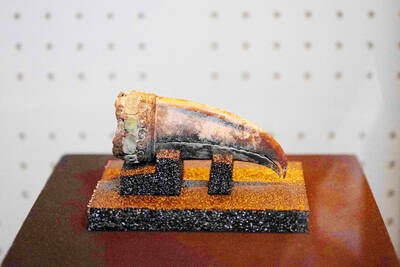
Archeologists in Peru on Thursday said they found the 5,000-year-old remains of a noblewoman at the sacred city of Caral, revealing the important role played by women in the oldest center of civilization in the Americas. “What has been discovered corresponds to a woman who apparently had elevated status, an elite woman,” archeologist David Palomino said. The mummy was found in Aspero, a sacred site within the city of Caral that was a garbage dump for more than 30 years until becoming an archeological site in the 1990s. Palomino said the carefully preserved remains, dating to 3,000BC, contained skin, part of the
‘WATER WARFARE’: A Pakistani official called India’s suspension of a 65-year-old treaty on the sharing of waters from the Indus River ‘a cowardly, illegal move’ Pakistan yesterday canceled visas for Indian nationals, closed its airspace for all Indian-owned or operated airlines, and suspended all trade with India, including to and from any third country. The retaliatory measures follow India’s decision to suspend visas for Pakistani nationals in the aftermath of a deadly attack by shooters in Kashmir that killed 26 people, mostly tourists. The rare attack on civilians shocked and outraged India and prompted calls for action against their country’s archenemy, Pakistan. New Delhi did not publicly produce evidence connecting the attack to its neighbor, but said it had “cross-border” links to Pakistan. Pakistan denied any connection to

TRUMP EFFECT: The win capped one of the most dramatic turnarounds in Canadian political history after the Conservatives had led the Liberals by more than 20 points Canadian Prime Minister Mark Carney yesterday pledged to win US President Donald Trump’s trade war after winning Canada’s election and leading his Liberal Party to another term in power. Following a campaign dominated by Trump’s tariffs and annexation threats, Carney promised to chart “a new path forward” in a world “fundamentally changed” by a US that is newly hostile to free trade. “We are over the shock of the American betrayal, but we should never forget the lessons,” said Carney, who led the central banks of Canada and the UK before entering politics earlier this year. “We will win this trade war and

Armed with 4,000 eggs and a truckload of sugar and cream, French pastry chefs on Wednesday completed a 121.8m-long strawberry cake that they have claimed is the world’s longest ever made. Youssef El Gatou brought together 20 chefs to make the 1.2 tonne masterpiece that took a week to complete and was set out on tables in an ice rink in the Paris suburb town of Argenteuil for residents to inspect. The effort overtook a 100.48m-long strawberry cake made in the Italian town of San Mauro Torinese in 2019. El Gatou’s cake also used 350kg of strawberries, 150kg of sugar and 415kg of


 RSS
RSS