


Taro Aso, an often brash former foreign minister seen as the most likely candidate to replace Japan’s prime minister, said yesterday he believed good relations with China were an important part of Japanese foreign policy and shrugged off criticism that he was too hawkish.
Aso has widely been seen as the front-runner to replace Yasuo Fukuda, who announced his intention to resign last week.
While polls have indicated Aso has garnered enough votes within the ruling party to win its presidency when elections are held in parliament on Sept. 22, he has been criticized by some as being too outspoken.
In a debate with the four other candidates, he brushed off such concerns, jokingly introducing himself as the candidate “who has caused concern that he will make an enemy of China” and then saying such fears were unwarranted.
“We will live together with China,” he said. “Friendship is only a tool, the real goal is the co-prosperity of Japan and China.”
He also vowed to watch his words.
“As a national leader, I will not say anything carelessly, and I’ve been careful,” he said. “Please read transcripts of my remarks when I served as foreign minister. I’ve mostly managed to shut myself up just in time. So please feel at ease.”
Aso stressed the US remains Japan’s most important ally, and said Tokyo must continue to work in close concert with Washington on the international stage.
But he indicated that he would also press ahead with efforts made by Fukuda to bolster ties with Beijing. Relations with China sagged dramatically several years ago over territorial disputes, increased economic rivalry and visits to a war shrine by Japanese leaders.
Aso was foreign minister in 2005, while ties with Beijing were at a low ebb.
That year, a Chinese official described Aso’s remark that China is “beginning to pose a considerable threat” as “irresponsible.”
In 2006, China accused Japan of glorifying its militarist past after Aso reportedly said Taiwan had a high educational level thanks to improvements in literacy and educational standards when it was a Japanese colony.
On other issues, Aso said he would advocate fiscal restraint while pushing reforms to invigorate Japan’s sluggish economy.
“I will not build roads and bridges that are not needed,” he said. “I will trim such public projects.”
Meanwhile, Japan’s popular former prime minister Junichiro Koizumi threw his weight yesterday behind Yuriko Koike, who is trailing in her bid to become the nation’s first female leader, a lawmaker said.
Aso has taken an early lead ahead of the Sept. 22 vote to replace Fukuda.
A new poll showed that Aso also enjoyed a strong edge over the resurgent opposition’s leader Ichiro Ozawa for general elections, which are expected to be held within months.
But Koizumi, Japan’s longest-serving prime minister in recent times, was quoted as coming out on behalf of Koike, a former defense minister who has pledged to carry out free-market reforms from Koizumi’s 2001-2006 tenure.
“We have heard this message from former prime minister Junichiro Koizumi,” Seishiro Eto, a lawmaker who supports Koike, told a party meeting as he held up a sheet of paper.
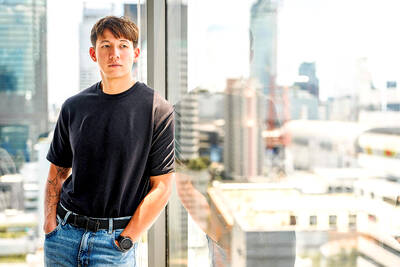
SPEAKING OUT: After Siranudh Scott’s allegations surfaced, celebrities and public figures took to social media to share their own experiences of sexual misconduct and abuse A high-profile alleged sexual abuse case within a wealthy Thai beer brewing family has prompted a wave of painful accounts from survivors of unconnected abuse in the conservative nation. Siranudh Scott, a member of the billionaire Thai family that founded the ubiquitous Singha beer brand, posted an emotional video this month accusing his elder brother Sunit of repeatedly abusing him when he was a teenager. Sunit, who is in his 30s, later denied the allegations in a video posted online, but Singha parent Boonrawd dismissed him from his executive role with the company on Tuesday last week. “I felt I needed to speak

A Hong Kong astronaut is to join a Chinese space mission for the first time as part of a three-person crew launching today, as Beijing edges closer to its goal of landing people on the moon. The Tiangong space station — crewed by teams of three astronauts that are typically rotated every six months — is the crown jewel of China’s space program, boosted by billions in state investment in a bid to catch up with the US and Russia. The Shenzhou-23 mission is to blast off at 11:08pm from the Jiuquan Satellite Launch Center in northwestern China, carrying three astronauts to

UPGRADED ALERT: The risk inside DR Congo is now considered ‘very high,’ while neighboring countries face a ‘high’ threat as the outbreak continues, the WHO said Ebola is spreading faster than responders can track it in eastern Congo, where health workers managed to follow up with barely one in five identified contacts in a single day. Authorities in the Democratic Republic of the Congo (DR Congo) reported 83 confirmed infections, 746 suspected cases and 1,603 identified contacts as of Thursday, but health workers were able to follow up on only 342 contacts that day — about 21 percent of the total under monitoring — data released by the DR Congo Ministry of Public Health on Friday showed. The figures suggest the response is falling behind the outbreak itself,

SEEKING ORDER: Rodrigo Paz said that ‘anyone who wants to destroy the nation will have to deal with this president and the full force of the constitution’ Bolivian President Rodrigo Paz on Wednesday said that the nation was at a “breaking point” after nearly a month of protests that have caused shortages of food, fuel and medicine. Paz, who took office six months ago amid the worst economic crisis there in four decades, is battling a groundswell of fury over his policies. The political capital, La Paz, has been besieged by low-income workers and members of the indigenous majority calling for his resignation. “The country needs order and is reaching breaking point,” the 58-year-old said at a public event in La Paz, renewing his appeal for dialogue. On Tuesday, the Bolivian


 RSS
RSS