


French and Italian scientists said yesterday they could not rule out another cataclysmic explosion by Vesuvius, the volcano that destroyed Pompeii in 79 AD.
Vesuvius has been capricious throughout history, blowing up in explosive clouds of dust and poisonous, superheated gas but at other times erupting more safely, rolling lava slowly down its conical flanks.
It has been dormant since 1944.
But in a paper published by the science journal Nature, the Franco-Italian trio warn that this sleep will not be eternal.
They report that the volcano’s magma chamber, deep beneath the surface, has been steadily rising over the past 20,000 years.
The shallowest reservoir now lies at a depth of 8km to 9km.
The chamber’s depth determines the chemical composition of the magma and also the way in which its energy will be released, they explain.
Lead researcher Bruno Scaillet of the Institute of Earth Sciences in Orleans, France, said it was crucial to identify the composition of the magma lurking at the top of the chamber.
“If this magma is of a more acid composition, a type similar to the one which caused the Pompei eruption, you can expect an extremely explosive, dangerous eruption,” Scaillet said.
In such an event, 700,000 people would be potentially at threat, he said.
“On the other hand, if the magma is of mainly basalt composition, as in the last eruption in 1944, it would be of a flow type, with streams of lava, and that would be far less destructive,” Scaillet said.
Geological signatures show that from about 20,000 years ago to the Pompeii eruption in 79, Vesuvius had a treaclier magma associated with violent eruptions preceded by billowing clouds of suffocating dust and toxic gas, according to the paper.
But from 1631 to 1944, hundreds of safer “lava-flow” eruptions occurred, similar to what is happening at the moment at the Stromboli volcano on Sicily.
Scaillet warned: “Just because there has been this trend for 2,000 years doesn’t mean we can rule out a return to more acid magma” capable of unleashing catastrophic eruptions.
Vesuvius’ silence over the past 64 years could be attributable to a filling-up of the magma chamber, but equally it could mean that the chamber’s ceiling has been sealed over, he said.
If so, the volcano could explode like a bolted-down lid on a pressure cooker.
“We cannot rule out this scenario,” Scaillet said.

A US YouTuber who caused outrage for filming himself kissing a statue commemorating Korean wartime sex slaves has been sentenced to six months in prison, a court in Seoul said yesterday. Johnny Somali, 25, gained notoriety several years ago for recording himself doing a series of provocative stunts in South Korea and Japan, and streaming them on platforms such as YouTube and Twitch. South Korean authorities indicted Somali — whose real name is Ramsey Khalid Ismael — in 2024 on public order violations and obstruction of business, and banned him from leaving the country. “The court has sentenced him to six months in

Former Lima mayor Rafael Lopez Aliaga, a Peruvian presidential hopeful, gathered hundreds of supporters in Lima on Tuesday and gave authorities 24 hours to annul the first round of the country’s election over allegations of fraud. Lopez Aliaga is locked in a tight three-way race with two other candidates for second place in Sunday’s vote. The election runner-up wins a ticket to June’s presidential run-off against front-runner Keiko Fujimori. “I am giving them 24 hours to declare this electoral fraud null and void,” said Lopez Aliaga, surrounded by a crowd of several hundred supporters. “If it is not declared null and void tomorrow,
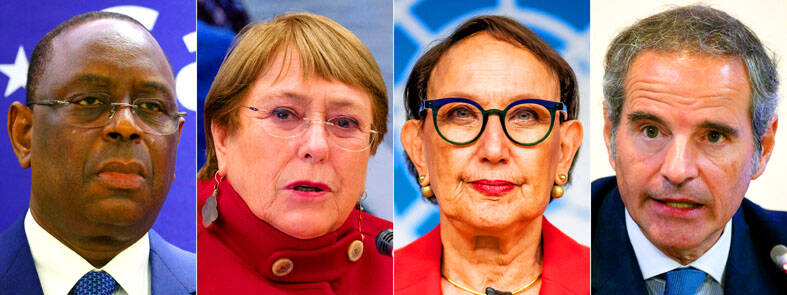
Four contenders are squaring up to succeed Antonio Guterres as secretary-general of the UN, which faces unprecedented global instability, wars and its own crushing budget crisis. Chile’s Michelle Bachelet, Argentina’s Rafael Grossi, Costa Rica’s Rebeca Grynspan and Senegal’s Macky Sall are each to face grillings by 193 member states and non-governmental organizations for three hours today and tomorrow. It is only the second time the UN has held a public question-and-answer, a format created in 2016 to boost transparency. Ultimately the five permanent members of the UN’s top body, the Security Council, hold the power, wielding vetoes over who leads the

A humanoid robot that won a half-marathon race for robots in Beijing on Sunday ran faster than the human world record in a show of China’s technological leaps. The winner from Honor, a Chinese smartphone maker, completed the 21km race in 50 minutes and 26 seconds, said a WeChat post by the Beijing Economic-Technological Development Area, also known as Beijing E-Town, where the race began. That was faster than the human world record holder, Ugandan Jacob Kiplimo, who finished the same distance in about 57 minutes in March at the Lisbon road race. The performance by the robot marked a significant step forward


 RSS
RSS