


South Korean President Lee Myung-bak, a devout Christian, yesterday apologized to the nation’s Buddhists following nationwide protests against alleged religious bias by his administration.
Lee was speaking at a Cabinet meeting which approved regulations banning religious discrimination by public servants.
“It is deeply regrettable that some government officials offended the Buddhist community — even if they did not not mean to — with such words and behavior as could cause misunderstanding about a religious bias,” he said.
Leaders of the country’s 10 million Buddhists — outnumbered by 13.7 million Christians — had threatened more mass protests unless Lee apologized.
The largest Buddhist order, the Jogye, said his remarks represented “a more sincere attitude” by the government. But it repeated demands for the sacking of the national police chief over an alleged insult to its head monk, Jigwan.
The Buddhist protests, rare in a country that guarantees freedom of religion, followed months of street rallies against US beef imports that rocked Lee’s administration.
Buddhists have been uneasy over what they see as a Christian bias since Lee, a Presbyterian church elder, came to power on Feb. 25.
The Jogye lists 23 cases of alleged favoritism, including the appointments of Protestants to major government posts.
An online map published by two ministries, showing Seoul’s churches but not major Buddhist temples, also sparked anger.
In early July seven activists wanted by police following the beef protests took refuge in Seoul’s Jogyesa temple. Tensions grew in late July when police stopped a car carrying Jigwan outside the temple and searched the trunk.
Police chief Eo Cheong-soo, himself a Christian, apologized and disciplined two senior officers. But Buddhists accused police of treating the head monk like a criminal and called for Eo’s resignation.
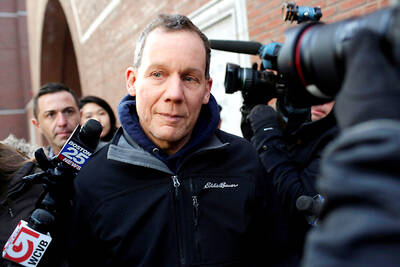
An American scientist convicted of lying to US authorities about payments from China while he was at Harvard University has rebuilt his research lab in Shenzhen, China, to pursue technology the Chinese government has identified as a national priority: embedding electronics into the human brain. Charles Lieber, 67, is among the world’s leading researchers in brain-computer interfaces. The technology has shown promise in treating conditions such as amyotrophic lateral sclerosis and restoring movement in paralyzed people. It also has potential military applications: Scientists at the Chinese People’s Liberation Army have investigated brain interfaces as a way to engineer super soldiers by boosting
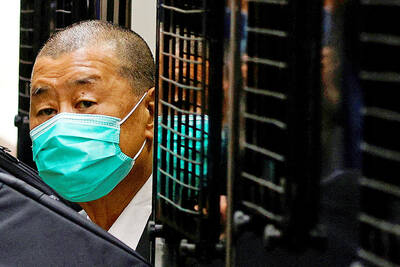
Jailed media entrepreneur Jimmy Lai (黎智英) has been awarded Deutsche Welle’s (DW) freedom of speech award for his contribution to Hong Kong’s pro-democracy movement. The German public broadcaster on Thursday said Lai would be presented in absentia with the 12th iteration of the award on June 23 at the DW Global Media Forum in Bonn. Deutsche Welle director-general Barbara Massing praised the 78-year-old founder of the now-shuttered news outlet Apple Daily for standing “unwaveringly for press freedom in Hong Kong at great personal risk.” “With Apple Daily, he gave journalists a platform for free reporting and a voice to the democracy movement in
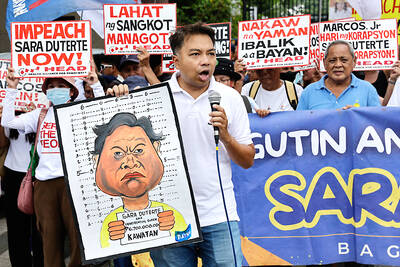
PHILIPPINE COMMITTEE: The head of the committee that made the decision said: ‘If there is nothing to hide, there is no reason to hide, there is no reason to obstruct’ A Philippine congressional committee on Wednesday ruled that there was “probable cause” to impeach Philippine Vice President Sara Duterte after hearing allegations of unexplained wealth, misuse of state funds and threats to have the president assassinated. The unanimous decision of the 53-member committee in the Philippine House of Representatives sends the two impeachment complaints to deliberations and voting by the entire lower chamber, which has more than 300 lawmakers. The complaints centered on Duterte’s alleged illegal use and mishandling of intelligence funds from the vice president’s office, and from her time as education secretary under Philippine President Ferdinand Marcos Jr. Duterte and the
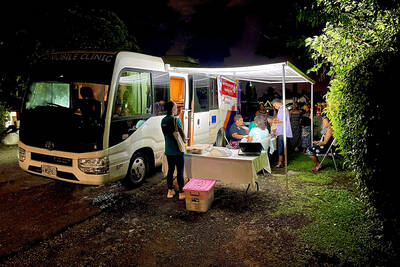
As evening falls in Fiji’s capital, a steady stream of people approaches a makeshift clinic that is a first line of defense against one of the world’s fastest-growing HIV epidemics. In the South Pacific nation — a popular tourist destination of just under a million people — more than 2,000 new HIV cases were recorded last year, a 26 percent increase from 2024. The government has declared an HIV outbreak and described it as a national crisis. “It’s spreading like wildfire,” said Siteri Dinawai, 46, who came to be tested. The Moonlight Clinic, a converted minibus parked in a suburban cul-de-sac in Suva, is


 RSS
RSS