


Paddlings, swats, licks. A quarter of a million US schoolchildren got them last year — and blacks, American Indians and kids with disabilities got a disproportionate share of the punishment, a study by a human rights group showed.
Even little kids can be paddled. Heather Porter, who lives in Crockett, Texas, was startled to hear her little boy, then three, say he had been spanked at school. Porter was never told, despite a policy at the public preschool that parents be notified.
“We were pretty ticked off, to say the least. The reason he got paddled was because he was untying his shoes and playing with the air conditioner thermostat,” Porter said. “He was being a three-year-old.”
For the study, which was scheduled for release yesterday, Human Rights Watch and the American Civil Liberties Union used US Education Department data to show that, while paddling has been declining, racial disparity persists. Researchers also interviewed students, parents and school personnel in Texas and Mississippi, states that account for 40 percent of the 223,190 kids who were paddled at least once in the 2006 to 2007 school year.
Porter could have filled out a form telling the school not to paddle her son, if only she had realized he might be paddled.
Yet many parents find that such forms are ignored, the study said.
Widespread paddling can make it unlikely that forms will be checked. A teacher interviewed by Human Rights Watch, Tiffany Bartlett, said that when she taught in the Mississippi Delta, the policy was to lock the classroom doors when the bell rang, leaving stragglers to be paddled by an administrator patrolling the hallways. Bartlett now is a school teacher in Austin, Texas.
And even if schools make a mistake, they are unlikely to face lawsuits. In places where corporal punishment is allowed, teachers and principals generally have legal immunity from assault laws, the study said.
“One of the things we’ve seen over and over again is that parents have difficulty getting redress, if a child is paddled and severely injured, or paddled in violation of parents’ wishes,” said Alice Farmer, the study’s author.
A majority of states have outlawed it, but corporal punishment remains widespread across the south. Behind Texas and Mississippi were Alabama, Arkansas, Georgia, Tennessee, Oklahoma, Louisiana, Florida and Missouri.
Black American students are more than twice as likely to be paddled. The disparity persists even in places with large black populations, the study found.
Similarly, Native Americans were more than twice as likely to be paddled, the study found.
The study also found that in states where paddling is most common, black girls were paddled more than twice as often as white girls.

VAGUE: The criteria of the amnesty remain unclear, but it would cover political violence from 1999 to today, and those convicted of murder or drug trafficking would not qualify Venezuelan Acting President Delcy Rodriguez on Friday announced an amnesty bill that could lead to the release of hundreds of prisoners, including opposition leaders, journalists and human rights activists detained for political reasons. The measure had long been sought by the US-backed opposition. It is the latest concession Rodriguez has made since taking the reins of the country on Jan. 3 after the brazen seizure of then-Venezuelan president Nicolas Maduro. Rodriguez told a gathering of justices, magistrates, ministers, military brass and other government leaders that the ruling party-controlled Venezuelan National Assembly would take up the bill with urgency. Rodriguez also announced the shutdown

Civil society leaders and members of a left-wing coalition yesterday filed impeachment complaints against Philippine Vice President Sara Duterte, restarting a process sidelined by the Supreme Court last year. Both cases accuse Duterte of misusing public funds during her term as education secretary, while one revives allegations that she threatened to assassinate former ally Philippine President Ferdinand Marcos Jr. The filings come on the same day that a committee in the House of Representatives was to begin hearings into impeachment complaints against Marcos, accused of corruption tied to a spiraling scandal over bogus flood control projects. Under the constitution, an impeachment by the
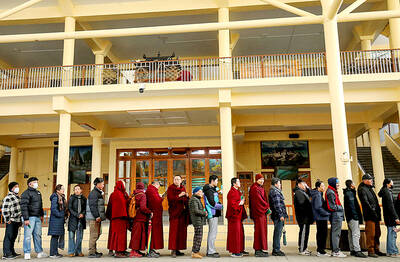
Exiled Tibetans began a unique global election yesterday for a government representing a homeland many have never seen, as part of a democratic exercise voters say carries great weight. From red-robed Buddhist monks in the snowy Himalayas, to political exiles in megacities across South Asia, to refugees in Australia, Europe and North America, voting takes place in 27 countries — but not China. “Elections ... show that the struggle for Tibet’s freedom and independence continues from generation to generation,” said candidate Gyaltsen Chokye, 33, who is based in the Indian hill-town of Dharamsala, headquarters of the government-in-exile, the Central Tibetan Administration (CTA). It
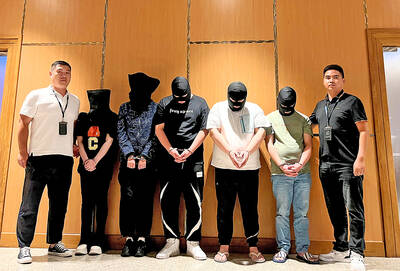
China executed 11 people linked to Myanmar criminal gangs, including “key members” of telecom scam operations, state media reported yesterday, as Beijing toughens its response to the sprawling, transnational industry. Fraud compounds where scammers lure Internet users into fake romantic relationships and cryptocurrency investments have flourished across Southeast Asia, including in Myanmar. Initially largely targeting Chinese speakers, the criminal groups behind the compounds have expanded operations into multiple languages to steal from victims around the world. Those conducting the scams are sometimes willing con artists, and other times trafficked foreign nationals forced to work. In the past few years, Beijing has stepped up cooperation


 RSS
RSS