


In The First Circle, Alexander Solzhenitsyn has political prisoners in Josef Stalin’s gulag tell a story about Moscow’s hellish Butyrka prison. One day, a young captain takes the emaciated inmates of cell 72 to a version of paradise. Barbers spray them with eau de Cologne, laundresses dress them in silk and chefs provide them with their first decent meal in years. When they go back, they find the authorities have painted their cell in bright colors. Previously forbidden books and packets of cigarettes are scattered around the room. In place of the huge slop bucket is a gleaming toilet.
The prisoners cannot understand their good fortune until the guards usher in a “Mrs. R,” an American “lady of great shrewdness and progressive views,” who is clearly meant to be Eleanor Roosevelt. The governor tells her that they are not dissidents but rapists and murderers whom the Communist Party in its magnanimity has decided to rehabilitate rather than execute. She does not ask to inspect any of the other cells and leaves, “convinced of the falsehood of the allegations spread by malicious scaremongers in the West.”
As soon as she has gone, the prisoners’ lice-infested rags and slop bucket return.
The Chinese Communist Party has beautified Beijing for the Olympics. The Organizing Committee for the games has ordered 1 million cars from the road and told factories to shut down so foreigners will believe that one of the most polluted cities on earth can hold “the green Olympics.”
The president of the International Olympic Committee (IOC) gabbled his appreciation. Jacques Rogge, a sports bureaucrat who appears to have learned nothing from the 20th century, lauded China’s “extraordinary” efforts. The statistics proved the authorities had done everything that “was humanely possible,” and the statistics never lie.
Greenpeace, so harsh on democratic countries, was as excessive in its praise. After registering a few reservations, it declared the dictatorship’s work was “tremendous” and “positively unique,” Beijing was providing “important lessons to other Chinese cities.”
The eyebrows of Jonathan Fenby, who has just published The Penguin History of Modern China, shot up at that. When the Games are over, the factories will reopen, he said. The Olympics will have secured a few long-term benefits — more homes and workplaces will burn gas rather than coal — but when set against China’s vast pollution problem these gains will be tiny.
As every serious writer knows, the legitimacy of the dictatorship rests on its ability to deliver ever-rising living standards now that its Marxism is dead. Environmental concerns will always be trumped by the party’s survival instinct.
Thus Chinese President Hu Jintao (胡錦濤) reverses a program to close coal mines. He has to, an official tells Der Spiegel, because China’s inefficient industries “need seven times the resources of Japan, almost six times the resources of the US and almost three times the resources used by India.” Thus, when the leaders of the G8 announce a wish to halve greenhouse gas emissions by 2050, Hu and India’s leaders see a plot by the rich West to handicap Asian rivals and refuse to accept the target.
Because the communism of Stalin and Mao Zedong (毛澤東) is dead, however, the scale of the catastrophe need not be a secret circulated only in samizdat pamphlets.
There are voices within China free to argue that the country is ignoring her own as well as the world’s long-term interests. Vice Minister of the State Environmental Protection Administration Pan Yue (潘岳) warned in 2005 that the economic miracle “will end soon because the environment can no longer keep pace,” and he had the evidence to back up his claim.
China has 16 of the world’s 20 filthiest cities. The Gobi desert is expanding at a rate of 4,921km² a year because of deforestation and over-farming. Approximately 660 cities have less water than they need and 110 of them suffer severe shortages. The Xinhua news agency reports that pollution is poisoning the aquifers. Eighty percent of the sewage dumped into the Yangtze is untreated. Effluent, human and industrial, has driven one-third of the native species of the Yellow River to extinction. About 190 million Chinese are sick from drinking contaminated water, cancer rates are rising and there are about 1,000 demonstrations a week against the effects of pollution.
The gullible admire dictatorships because they think the great leader and his politburo can cut through objections and force the recalcitrant to obey orders, and we have had no shortage of fantasies about the better China that would come if only the party embraced greenery.
In The River Runs Black, a book every environmentalist needs to read, Elizabeth Economy points out that the fantasies can never be realized. Even if the center wanted to change policy, its writ does not run in the provinces. Local officials are in the pocket of or related to factory owners and ignore inconvenient decrees. If the courts, the press or doctors in local hospitals complain, they silence them. Change is impossible without democratic reform — which is as far away as ever.
Solzhenitsyn’s Mrs. R was incapable of believing the worst and preferred to live in a daydream. Stalin’s goons did not need to fool her because she had already fooled herself.
Today it is just about possible to imagine rich, post-industrial societies switching to renewable energy and nuclear power, although optimists should note the US Republicans’ success in using Senator Barack Obama’s refusal to allow offshore oil drilling against him. But it is inconceivable that the emerging powers of China and India will abandon fossil fuels when there are no cheap options.
Rather than despair, not only the IOC and Greenpeace but also Western governments and the EU pretend that the Potemkin Olympic village in Beijing heralds a new China, and miss the blackened rivers and skies beyond.
As the planet warms, I’m damned if I can see an alternative to despair, but I do know that wishful thinking isn’t it.
A gap appears to be emerging between Washington’s foreign policy elites and the broader American public on how the United States should respond to China’s rise. From my vantage working at a think tank in Washington, DC, and through regular travel around the United States, I increasingly experience two distinct discussions. This divergence — between America’s elite hawkishness and public caution — may become one of the least appreciated and most consequential external factors influencing Taiwan’s security environment in the years ahead. Within the American policy community, the dominant view of China has grown unmistakably tough. Many members of Congress, as

After declaring Iran’s military “gone,” US President Donald Trump appealed to the UK, France, Japan and South Korea — as well as China, Iran’s strategic partner — to send minesweepers and naval forces to reopen the Strait of Hormuz. When allies balked, the request turned into a warning: NATO would face “a very bad” future if it refused. The prevailing wisdom is that Trump faces a credibility problem: having spent years insulting allies, he finds they would not rally when he needs them. That is true, but superficial, as though a structural collapse could be caused by wounded feelings. Something
Former Taipei mayor and Taiwan People’s Party (TPP) founding chairman Ko Wen-je (柯文哲) was sentenced to 17 years in prison on Thursday, making headlines across major media. However, another case linked to the TPP — the indictment of Chinese immigrant Xu Chunying (徐春鶯) for alleged violations of the Anti-Infiltration Act (反滲透法) on Tuesday — has also stirred up heated discussions. Born in Shanghai, Xu became a resident of Taiwan through marriage in 1993. Currently the director of the Taiwan New Immigrant Development Association, she was elected to serve as legislator-at-large for the TPP in 2023, but was later charged with involvement
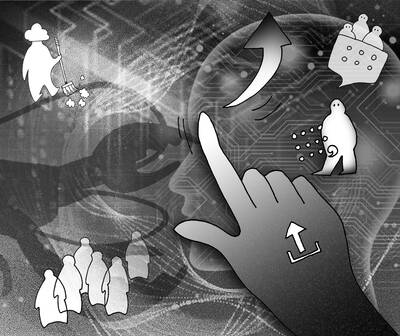
Weeks into the craze, nobody quite knows what to make of the OpenClaw mania sweeping China, marked by viral photos of retirees lining up for installation events and users gathering in red claw hats. The queues and cosplay inspired by the “raising a lobster” trend make for irresistible China clickbait. However, the West is fixating on the least important part of the story. As a consumer craze, OpenClaw — the AI agent designed to do tasks on a user’s behalf — would likely burn out. Without some developer background, it is too glitchy and technically awkward for true mainstream adoption,


 RSS
RSS