


A spate of bomb attacks across Iraq on Sunday targeting a bank, a town hall and military patrols killed at least 14 people, including a US soldier, security and hospital officials said.
The deadliest attack was in the Tarmiyah region just north of the Iraqi capital that killed four Iraqi civilians and the US soldier, a US military statement said.
A bomber activated his suicide belt when a unit of US troops were arriving on the scene after the explosion of a homemade bomb. Fifteen civilians, three Iraqi police and two US soldiers were also wounded in the attack.
The death of the US soldier brought to 4,137 the number of US military personnel killed in Iraq since the March 2003 invasion, according to a toll based on the independent Web site icasualties.org.
In Khilani square in central Baghdad, a car bomb exploded as a military patrol escorting a finance ministry convoy passed by, killing an Iraqi soldier and two civilians, a security official said.
At least nine people were wounded in the attack, among them four soldiers.
At Maidan on the southern outskirts of the capital, an Iraqi soldier was killed and five others were wounded when their patrol was hit by a car bomb, the official said.
Also in the capital, a powerful bomb exploded outside a crowded bank, killing two people and wounding at least 10 others, police and hospital officials said.
The blast occurred as customers queued outside Rafidain Bank in Kamalia neighborhood of east Baghdad mid-morning, the officials said.
At Khanakine, near the Iranian border 200km northeast of Baghdad, three civilians were killed and 20 wounded when a roadside bomb exploded outside the town hall, a military commander said.
Meanwhile, a security official said three projectiles hit Baghdad’s highly fortified Green Zone, seat of the Iraqi government and foreign embassies. He was not able to say whether there were any casualties.
Meanwhile, five women were killed and three men wounded on yesterday when a roadside bomb exploded next to their vehicle in the central Iraqi province of Diyala, a witness and a doctor said.
The attack occurred as they were driving in a pick-up truck near al-Wajihiyah, about 20km east of the restive city of Baqubah, 27-year-old passenger Shaalan Mutni Ahmed said.
“We left this morning and four women were going to the doctor and one was going shopping in al-Wajhiyah. Before we reached the al-Wajhiyah the bomb exploded,” Ahmed said.
Ahmed Alwan, a doctor at the local hospital, said he had received the bodies of four women and that the fifth had died in the emergency room.
Diyala Province, and especially its capital Baqubah has been the scene of violence, especially suicide bombings, many of them carried out by women.
The multi-ethnic region made up of Christians and Muslims has seen ongoing efforts by the US and Iraqi militaries to drive out insurgents, both Sunni al-Qaeda and various Shiite groups, the latest which began on July 29.
Also, a US Army program in which soldiers pay cash to Iraqis to help with expenses, large and small, has spent US$2.8 billion in five years, the Washington Post reported yesterday.
The Post reviewed records of the Commander’s Emergency Response Program (CERP), which was intended for short-term humanitarian relief and reconstruction.
The field manual laying out the guidelines for the program is called “Money as a Weapon System,” pointing up the effectiveness of cold hard cash in winning over the hearts and minds of Iraqi civilians.
The largest sum of CERP money, US$596.8 million, was spent on water and sanitation projects, the Post reported. Three other categories each received more than US$300 million: electricity; protective measures, such as fencing and guards; and transportation and roads.
But the Army also spent lesser sums on smaller acts of largess, including US$48,000 for children’s shoes; US$50,000 for 625 sheep; US$100,000 for dolls; and US$500,000 for action figures designed to look like Iraqi security forces, the Post reported.
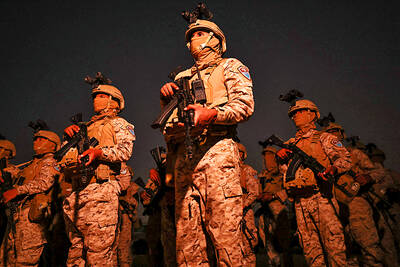
PRECARIOUS RELATIONS: Commentators in Saudi Arabia accuse the UAE of growing too bold, backing forces at odds with Saudi interests in various conflicts A Saudi Arabian media campaign targeting the United Arab Emirates (UAE) has deepened the Gulf’s worst row in years, stoking fears of a damaging fall-out in the financial heart of the Middle East. Fiery accusations of rights abuses and betrayal have circulated for weeks in state-run and social media after a brief conflict in Yemen, where Saudi airstrikes quelled an offensive by UAE-backed separatists. The United Arab Emirates is “investing in chaos and supporting secessionists” from Libya to Yemen and the Horn of Africa, Saudi Arabia’s al-Ekhbariya TV charged in a report this week. Such invective has been unheard of
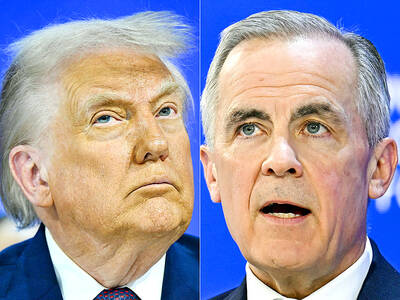
US President Donald Trump on Saturday warned Canada that if it concludes a trade deal with China, he would impose a 100 percent tariff on all goods coming over the border. Relations between the US and its northern neighbor have been rocky since Trump returned to the White House a year ago, with spats over trade and Canadian Prime Minister Mark Carney decrying a “rupture” in the US-led global order. During a visit to Beijing earlier this month, Carney hailed a “new strategic partnership” with China that resulted in a “preliminary, but landmark trade agreement” to reduce tariffs — but

Chinese President Xi Jinping’s (習近平) purge of his most senior general is driven by his effort to both secure “total control” of his military and root out corruption, US Ambassador to China David Perdue said told Bloomberg Television yesterday. The probe into Zhang Youxia (張又俠), Xi’s second-in-command, announced over the weekend, is a “major development,” Perdue said, citing the family connections the vice chair of China’s apex military commission has with Xi. Chinese authorities said Zhang was being investigated for suspected serious discipline and law violations, without disclosing further details. “I take him at his word that there’s a corruption effort under
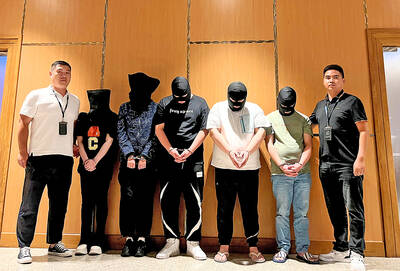
China executed 11 people linked to Myanmar criminal gangs, including “key members” of telecom scam operations, state media reported yesterday, as Beijing toughens its response to the sprawling, transnational industry. Fraud compounds where scammers lure Internet users into fake romantic relationships and cryptocurrency investments have flourished across Southeast Asia, including in Myanmar. Initially largely targeting Chinese speakers, the criminal groups behind the compounds have expanded operations into multiple languages to steal from victims around the world. Those conducting the scams are sometimes willing con artists, and other times trafficked foreign nationals forced to work. In the past few years, Beijing has stepped up cooperation


 RSS
RSS