

The US military blamed al-Qaeda in Iraq (AQI) on Saturday for a suicide car bombing in the northern Iraqi town of Tal Afar, while an Iraqi official said the death toll in the attack had risen to 25.
An Iraqi security official, meanwhile, said the attacker was a Sunni Turkoman who had been detained by the US military but was released four months ago under an Iraqi amnesty law.
The bomber may have avoided detection at a checkpoint leading to the busy market by having a man ride with him in the passenger seat, said the official, who spoke on condition of anonymity because he was not authorized to speak to the media. The passenger got off soon after the car passed the checkpoint, he added, citing witness reports and forensic tests.
Suicide car bombers are known to ride alone in most cases, so having a passenger next to them could help them avoid detection. Tal Afar, a frequent target of suicide bombings over the past five years, bans males from driving alone.
An indefinite curfew was imposed on the predominantly ethnic Turkoman town, the official said, adding the death toll had risen to 25 after four people died from their wounds.
Initial reports said the blast was caused by an explosives-laden car parked near a fruit and vegetable market. But Captain Charles Calio, a US military spokesman, said it was a suicide attack.
“One al-Qaeda in Iraq terrorist died when he detonated a vehicle-borne bomb,” Calio said in an e-mailed statement.
The blast occurred amid heightened tensions among ethnic groups throughout northern Iraq because of a dispute over control of the oil-rich city of Kirkuk. The city is claimed by the Kurds, who want to annex it to their self-ruled region, but its Arab and Turkomen residents want to remain under central government control.
The top US diplomat and military commander in Iraq condemned the attack in Tal Afar, 420km northwest of Baghdad.
Ambassador Ryan Crocker and General David Petraeus said in a joint statement on Saturday that the “senseless” attack would further unite Iraqis to reject al-Qaeda in Iraq and the “indiscriminate” violence it inflicts on civilians.
Northern Iraq has been suffering most from insurgent attacks while the rest of the country has seen the lowest levels of violence in four years. That improvement has been attributed to the dispatch of additional US troops last year, a cease-fire by a Shiite militia and a revolt by Sunni tribesmen and insurgents against the al-Qaeda in Iraq.
The deadly Tal Afar bombing was a grim reminder that al-Qaeda in Iraq and other militant groups remain capable of executing major attacks in Iraq despite the presence of about 145,000 troops and what is widely perceived as improving Iraqi security forces.
Also in northern Iraq, gunmen shot dead a 50-year-old woman outside her home in the al-Maamoun district in Mosul, 360km northwest of Baghdad.
Meanwhile in Baghdad, a roadside bomb killed a US soldier and wounded two others while their unit was on patrol, the US military said on Saturday.
The attack occurred on Friday evening in an undisclosed location in Baghdad, it said in a statement.
The latest death brought the number of US military killed since the March 2003 invasion of Iraq to 4,135.
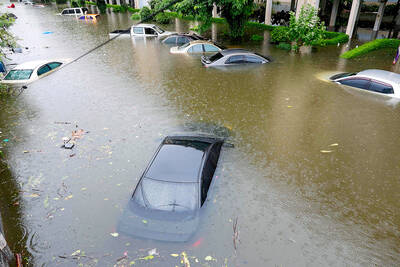
Several areas of Thailand’s capital city Bangkok were inundated by continuous rain from Thursday afternoon to yesterday morning that has disrupted traffic and forced some residents to evacuate. Major canals in Bangkok filled with accumulated rainfall exceeding 20cm, officials said yesterday. Floodwaters spread across the city, particularly in the central and eastern parts, blocking roads and stopping traffic. The Thai Meteorological Department warned that the heavy rain would continue in most parts of the country through today, citing a strong low-pressure system over the central region and strengthening southwest monsoon conditions. More than 84,000 people in 21 provinces nationwide were
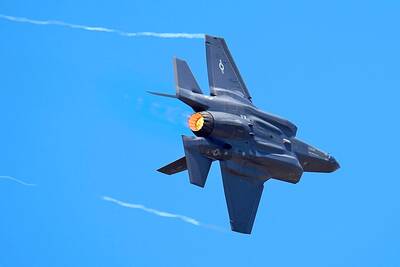
BAD TIMING: The disclosure of the incident, which is under investigation by at least two congressional committees, comes as Xi was to meet with Trump The Pentagon is investigating how parts of the US’ most advanced fighter jet ended up in Hong Kong, with a news outlet on Wednesday reporting that China has obtained the F-35 equipment. The F-35 Joint Program Office said in a statement that it and the US Department of Defense are aware of “a shipment issue” with F-35 components. “We are actively working with US authorities and industry partners to retrieve these components, investigate the incident and place safeguards to avoid a future occurrence,” the office said. UPS was shipping a cockpit canopy and weapons-bay door from an Australian military F-35 that was being
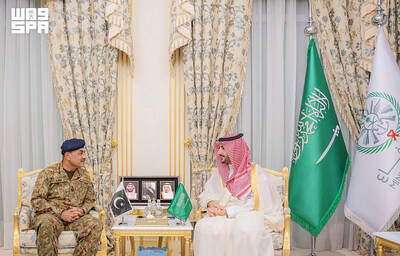
Yemen’s Saudi-led coalition early yesterday said it had intercepted two ballistic missiles and two drones launched by the Iran-backed Houthis toward the kingdom. The coalition said in posts on social media that the missiles were headed towards Khamis Mushait and the drones toward the capital, Riyadh, adding that it was monitoring the missile threat and drones launched at the kingdom, without providing further details. The Saudi Civil Defense had sent alerts overnight for Khamis Mushait and Abha, but not for Riyadh. The Houthis, who control the most populous parts of Yemen and much of the north, have been launching attacks
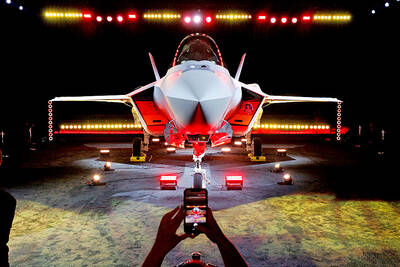
IN DEFENSE: Australia said it takes the protection of classified and export-controlled tech extremely seriously amid concerns over reverse engineering A US House of Representatives committee that oversees defense policy is investigating the diversion of potentially sensitive F-35 jet components this year from Australia to Hong Kong, a spokesperson said. “The committee is aware of this issue and we’ve received multiple briefings on it,” House Committee on Armed Services spokesperson Heather Vaughan said, adding that the group is “continuing to look into the incident and conduct oversight.” The Pentagon’s F-35 program office said in a statement that “we are aware of a shipment issue of unserviceable F-35 components and we are actively working with US authorities and industry partners to retrieve these


 RSS
RSS