


The killing of an al-Qaeda chemical weapons expert in a missile strike two weeks ago on a Pakistani border village has dealt a heavy blow to the group's ambitions to build weapons of mass destruction (WMD), a former CIA case officer said.
Abu Khabab al-Masri was dubbed by terrorism analysts as al-Qaeda’s “mad scientist.” His most notorious work, recorded on videotape, showed dogs being killed in poison gas experiments in Afghanistan when the Taliban ruled.
“If he is out of the picture, al-Qaeda’s weapons of mass destruction capability has been set back, which would make this one of the more effective strikes in recent years,” said Arthur Keller, an ex-CIA case officer in Pakistan.
Keller led the hunt for al-Masri in 2006.
The US offered a US$5 million bounty for the 55-year old Egyptian, and the CIA had been hunting him for years. Al-Qaeda confirmed his death days after the July 28 attack by unmanned drones on a tribesman’s compound in the village of Azam Warsak in South Waziristan.
Al-Masri, whose real name is Midhat Mursi al-Sayid Umar, got his chemical weapons training in the Egyptian army before defecting to the militant Islamic Jihad group, founded by al-Qaeda’s No. 2 leader, Ayman al-Zawahri.
The US government says that since 1999, al-Masri had been distributing manuals for making chemical and biological weapons.
“I believe that al-Qaeda has no shortage of people adept with explosives, and I know that al-Masri promulgated training manuals for poisons,” Keller said, “but I’m not sure how skilled any of Al-Masri’s proteges may be at synthesizing chemical weapons or toxins.”
It’s not easy, he said.
“You need both education and hands-on experience to produce decent-quality chemical weapons or toxins,” Keller said.
Chlorine has been used in bombings by militants in Iraq, but these were locally inspired, a US counterterrorism official said on condition of anonymity, not being authorized to comment publicly on the sensitive issue.
Also, no evidence has surfaced that al-Masri continued the chemical research after moving to Pakistan, although the US government said he was likely carrying out training.
US intelligence agencies tracking al-Masri viewed him as “frightening,” said Brian Glyn Williams, an associate professor of Islamic history at the University of Massachusetts, who has just completed research for the US government on weapons of mass destruction.
“From the US government perspective, he was seen as a major threat. His potential to develop primitive weapons of mass destruction was not taken lightly by US law enforcement and intelligence agencies,” Williams said.
Al-Masri was also suspected of helping to train the suicide bombers who attacked the destroyer USS Cole in Yemen in 2000, killing 17 US sailors. More recently, he trained militants fighting Western troops in Afghanistan.
His death had already been wrongly reported in a 2006 strike.
This time it was confirmed in an al-Qaeda statement that said he and three other senior al-Qaeda figures were killed, along with some of their children.
Al-Masri is the second senior al-Qaeda leader to die in missile strikes in Pakistan this year. In January, Abu Laith al-Libi, a top strategist for the group in Afghanistan, was killed in North Waziristan.
A senior Taliban militant from Afghanistan, Qari Mohammed Yusuf, said al-Masri had returned to South Waziristan from fighting in Afghanistan’s eastern Paktika Province just hours before he was killed.
Al-Masri had spent 40 days in Paktika, which borders South Waziristan, leading a company of non-Afghans in assaults against Afghan and coalition forces, and had lost several fighters, Yusuf said.
He said the Egyptian took his instructions directly from his countryman al-Zawahri, by e-mail or handwritten letters delivered by messenger.
Yusuf has family ties to al-Qaeda and says his two eldest brothers died fighting with al-Zawahri against Northern Alliance soldiers during Taliban rule. Afghan authorities confirm Yusuf is a senior Taliban from northern Afghanistan — not the Taliban spokesman who goes by the same name.
A report by counterterrorism consultant Dan Darling said al-Masri was a scientist in the Egyptian military chemical weapons program, but turned against his government for making peace with Israel in 1979.
He joined al-Zawahri’s Islamic Jihad group, and when it merged with al-Qaeda, became head of Project al-Zabadi, its WMD program, Darling wrote in a report posted in the Long War Journal, a Web site on terrorism.
Only after the US-led invasion of Afghanistan did evidence of al-Masri’s chemical experiments emerge, at al-Qaeda’s Darunta complex 112km east of Kabul.
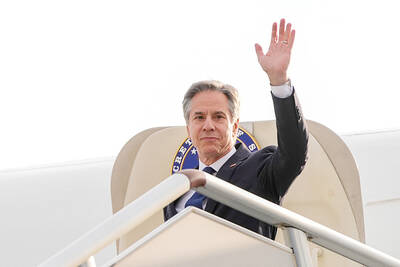
‘IN A DIFFERENT PLACE’: The envoy first visited Shanghai, where he attended a Chinese basketball playoff match, and is to meet top officials in Beijing tomorrow US Secretary of State Antony Blinken yesterday arrived in China on his second visit in a year as the US ramps up pressure on its rival over its support for Russia while also seeking to manage tensions with Beijing. The US diplomat tomorrow is to meet China’s top brass in Beijing, where he is also expected to plead for restraint as Taiwan inaugurates president-elect William Lai (賴清德), and to raise US concerns on Chinese trade practices. However, Blinken is also seeking to stabilize ties, with tensions between the world’s two largest economies easing since his previous visit in June last year. At the
Nearly half of China’s major cities are suffering “moderate to severe” levels of subsidence, putting millions of people at risk of flooding, especially as sea levels rise, according to a study of nationwide satellite data released yesterday. The authors of the paper, published by the journal Science, found that 45 percent of China’s urban land was sinking faster than 3mm per year, with 16 percent at more than 10mm per year, driven not only by declining water tables, but also the sheer weight of the built environment. With China’s urban population already in excess of 900 million people, “even a small portion

UNSETTLING IMAGES: The scene took place in front of TV crews covering the Trump trial, with a CNN anchor calling it an ‘emotional and unbelievably disturbing moment’ A man who doused himself in an accelerant and set himself on fire outside the courthouse where former US president Donald Trump is on trial has died, police said yesterday. The New York City Police Department (NYPD) said the man was declared dead by staff at an area hospital. The man was in Collect Pond Park at about 1:30pm on Friday when he took out pamphlets espousing conspiracy theories, tossed them around, then doused himself in an accelerant and set himself on fire, officials and witnesses said. A large number of police officers were nearby when it happened. Some officers and bystanders rushed

Beijing is continuing to commit genocide and crimes against humanity against Uyghurs and other Muslim minorities in its western Xinjiang province, U.S. Secretary of State Antony Blinken said in a report published on Monday, ahead of his planned visit to China this week. The State Department’s annual human rights report, which documents abuses recorded all over the world during the previous calendar year, repeated language from previous years on the treatment of Muslims in Xinjiang, but the publication raises the issue ahead of delicate talks, including on the war in Ukraine and global trade, between the top U.S. diplomat and Chinese


 RSS
RSS