


Full-scale talks aimed at resolving Zimbabwe’s months-long political crisis are now expected to begin in South Africa today, a report in state media said yesterday.
Zimbabwean Justice Minister Patrick Chinamasa, chief negotiator for President Robert Mugabe’s ZANU-PF party, told the Herald it had been agreed with the opposition to begin the talks only when all the delegates were in place.
“All parties to the dialogue agreed that talks should begin on Thursday,” he told the daily.
The talks had initially been due to begin on Tuesday but Chinamasa said that all the delegates should now arrive in South Africa by the end of yesterday and would then “travel to the venue for the talks, wherever that would be.”
Chinamasa and ZANU-PF’s other senior negotiator Nicholas Goche stayed in Harare on Tuesday to attend a Cabinet meeting while opposition officials also delayed their travel plans.
A source in the opposition Movement for Democratic Change (MDC) said its top negotiator Tendai Biti had flown out of Harare yesterday but it was not known whether the party’s Bulawayo-based chairman Lovemore Moyo had left.
Mugabe, main MDC leader Morgan Tsvangirai and Arthur Mutambara, head of a breakaway opposition faction, penned a memorandum of understanding on Monday to pave the way for talks.
“This is just the first step on a journey whose duration and success is dependent on the sincerity and good faith of all parties involved,” Tsvangirai said in a statement Tuesday.
Although the venue of the talks has been kept under wraps, the negotiations are expected to take place in Pretoria. The rivals have set themselves a tight two-week timeline to wrap up the talks aimed at agreeing on the line-up of a new government.
Mugabe was re-elected in a one-man run-off last month after Tsvangirai pulled out, citing a campaign of intimidation and violence against his supporters that had killed dozens and injured thousands. The vote was widely condemned in the West as a sham, with the EU warning that it would not deal with a government unless headed by Tsvangirai.
EU foreign ministers agreed in Brussels to strengthen sanctions against Mugabe as a means of pressuring him to agree to share power with the opposition — a sign the West plans to keep the pressure on Mugabe.
British Foreign Secretary David Miliband said Monday’s face-to-face meeting between Mugabe and Tsvangirai — their first in 10 years — was only “a first step,” and that EU nations were expecting more proof that Mugabe was willing to sign up to a transitional government with the opposition.
Also See: A screwdriver, not a hammer, could help to heal Zimbabwe
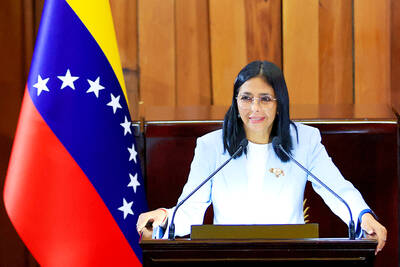
VAGUE: The criteria of the amnesty remain unclear, but it would cover political violence from 1999 to today, and those convicted of murder or drug trafficking would not qualify Venezuelan Acting President Delcy Rodriguez on Friday announced an amnesty bill that could lead to the release of hundreds of prisoners, including opposition leaders, journalists and human rights activists detained for political reasons. The measure had long been sought by the US-backed opposition. It is the latest concession Rodriguez has made since taking the reins of the country on Jan. 3 after the brazen seizure of then-Venezuelan president Nicolas Maduro. Rodriguez told a gathering of justices, magistrates, ministers, military brass and other government leaders that the ruling party-controlled Venezuelan National Assembly would take up the bill with urgency. Rodriguez also announced the shutdown
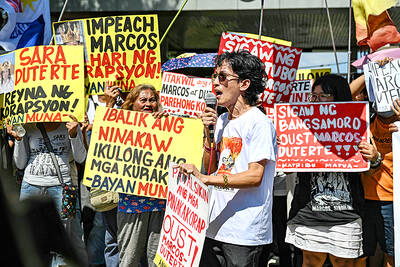
Civil society leaders and members of a left-wing coalition yesterday filed impeachment complaints against Philippine Vice President Sara Duterte, restarting a process sidelined by the Supreme Court last year. Both cases accuse Duterte of misusing public funds during her term as education secretary, while one revives allegations that she threatened to assassinate former ally Philippine President Ferdinand Marcos Jr. The filings come on the same day that a committee in the House of Representatives was to begin hearings into impeachment complaints against Marcos, accused of corruption tied to a spiraling scandal over bogus flood control projects. Under the constitution, an impeachment by the
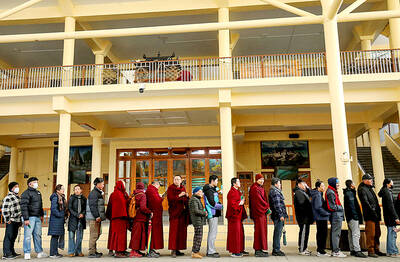
Exiled Tibetans began a unique global election yesterday for a government representing a homeland many have never seen, as part of a democratic exercise voters say carries great weight. From red-robed Buddhist monks in the snowy Himalayas, to political exiles in megacities across South Asia, to refugees in Australia, Europe and North America, voting takes place in 27 countries — but not China. “Elections ... show that the struggle for Tibet’s freedom and independence continues from generation to generation,” said candidate Gyaltsen Chokye, 33, who is based in the Indian hill-town of Dharamsala, headquarters of the government-in-exile, the Central Tibetan Administration (CTA). It

A Virginia man having an affair with the family’s Brazilian au pair on Monday was found guilty of murdering his wife and another man that prosecutors say was lured to the house as a fall guy. Brendan Banfield, a former Internal Revenue Service law enforcement officer, told police he came across Joseph Ryan attacking his wife, Christine Banfield, with a knife on the morning of Feb. 24, 2023. He shot Ryan and then Juliana Magalhaes, the au pair, shot him, too, but officials argued in court that the story was too good to be true, telling jurors that Brendan Banfield set


 RSS
RSS