


Israeli police say they suspect Prime Minister Ehud Olmert of “serious fraud” after questioning him for a third time on Friday as part of a widening corruption investigation.
Olmert, who is facing his fifth investigation since taking office two years ago, has not been charged with a crime and says he has broken no law. He has said he will resign only if he is indicted.
Police have been investigating claims that Olmert breached party funding laws by accepting donations from an American businessman over the past decade, mostly through envelopes filled with cash.
After questioning Olmert for more than two hours yesterday, police said they would look, in particular, at the fact that while he was mayor of Jerusalem and then trade and industry minister he asked for “duplicate funding for his trips abroad on public duty from several public bodies, including the state, with each of them requested to fund the same trip.”
“The travel agency which handled Olmert’s trips produced and sent invoices to each of the funding bodies ... as if each of them was solely funding the trips,” the police statement said.
Police said the funding was “significantly greater” than the cost of the trip.
The remainder was put into a special private bank account in Olmert’s name and used to fund his private trips abroad, including those with his family.
Police said their investigation was at an “advanced” stage.
Olmert was mayor of Jerusalem for 10 years until 2003, when he joined the Cabinet of the then prime minister, Ariel Sharon.
Olmert’s spokesman, Mark Regev, said the prime minister was “convinced of his innocence.”
Morris Talansky, the businessman who has testified that he gave US$150,000 in cash to Olmert over several years, is due to be cross-examined next week.
Olmert’s Kadima party will hold internal leadership elections in September and some are urging Olmert not to stand again.
Opinion polls suggest a new leader will be chosen, probably Tzipi Livni, the foreign minister.

Crowds in Bangladesh are flocking to snap photographs with an unlikely social media star — an albino buffalo with flowing blond hair nicknamed “Donald Trump” that is due to be sacrificed within days. Owner Zia Uddin Mridha, 38, said his brother named the 700kg bull over its flowing helmet of hair resembling the signature look of the US president. “My younger brother picked this name because of the buffalo’s extraordinary hair,” he said at his farm in Narayanganj, just outside the capital, Dhaka. Mridha said that a constant stream of curious visitors — social media fans, onlookers and children — have come throughout

The Bolivian government on Friday struck a deal with protesting miners, but was still grappling with blockades and demonstrations by other workers across La Paz. Other groups are still blocking access roads into the city, which is also the seat of the government. Police on Thursday prevented the miners from entering the main square by using tear gas, while the demonstrators hurled stones and explosives with slingshots. Protests against the policies of Bolivian President Rodrigo Paz have convulsed the Andean nation since early this month, and roadblocks were choking routes into La Paz throughout Friday, the national road authority said. Miners demanded that Paz
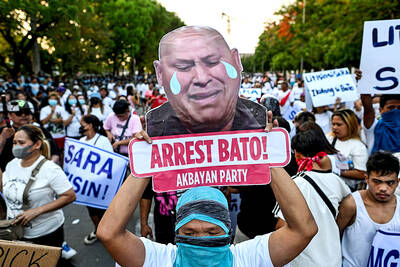
The Philippines said it has asked the country’s Supreme Court to allow it to arrest former Philippine president Rodrigo Duterte’s chief drug war enforcer to stand trial in an international tribunal. The International Criminal Court (ICC) last week unsealed an arrest warrant against Philippine Senator Ronald dela Rosa, accusing him along with Duterte and other “coperpetrators” of the “crime against humanity of murder.” Dela Rosa briefly sought refuge in the Philippine Senate last week while asking the Philippine Supreme Court to stop an ongoing attempt by government agents to arrest him. “By his own conduct, he has placed himself outside the protection of

The researchers in Ireland looked at their computer screen, marveling at a medieval book tracked down in a Roman library. They flipped through its digitized pages and found their sought-after treasure: the oldest surviving English poem. “We were extremely surprised. We were speechless. We couldn’t believe our eyes when we first saw that,” said Elisabetta Magnanti, a visiting research fellow at Trinity College Dublin’s school of English. The poem was also within the main body of Latin text, she said, calling it “extraordinary.” Composed in Old English by a Northumbrian agricultural worker in the 7th century, Caedmon’s Hymn appears within some copies of


 RSS
RSS