


At least one person was killed and 20 injured yesterday in a powerful blast that shook a six-story residential building in the northern Lebanese city of Tripoli, a security official said.
“One man was killed and some 20 people, most of them women and children, were wounded” the official said as rescuers evacuated victims from the site of the 5:30am blast in the Sunni neighborhood of Bab al-Tebbaneh.
It was not yet known what caused the explosion.
An official at Tripoli’s Islamic Charity Hospital said 17 of those wounded were given first aid for light injuries and released while three others were kept in for treatment.
Panicked residents, some still in their pajamas, were seen fleeing the area that has been the scene of recent fierce sectarian clashes. One woman wept as she searched for her daughter.
The explosion destroyed the first floor of the building, along with four apartments and several stores on the ground floor. Cars parked nearby were damaged.
Lebanese troops and police reinforcements were seen deploying in the area.
Residents of Bab al-Tebbaneh who support the Western-backed majority in parliament have clashed repeatedly with Alawites in the nearby Jabal Mohsen District who back the Hezbollah-led opposition supported by Syria and Iran.
Alawites are a secretive offshoot of Shiite Islam and include Syrian President Bashar al-Assad among their number.
Nine people were killed and some 45 wounded in clashes between the two sides last Sunday and Monday.
Two men were also wounded, one of them critically, when a grenade went off late on Friday. An army spokesman said one of the men had his leg torn off by the blast, which may have been accidental.
“Based on our initial investigation, the man who lost his leg was probably holding the grenade when it fell and exploded,” the spokesman said.
The Tripoli clashes have raised fears of a nationwide a security breakdown amid stalled efforts by Prime Minister Fuad Siniora to form a national unity government following a Qatari-brokered deal last month to end an 18-month political crisis.
The accord between the opposition and ruling coalition led to the election of army chief Michel Sleiman as president, ending a six-month vacuum in the top job.
But the initial euphoria that greeted Sleiman’s election has been replaced by a growing sense of foreboding as rival factions continue to bicker over the distribution of key portfolios in the new 30-member government.
The Doha accord calls for the opposition to have veto power over key decisions in the unity Cabinet and the drafting of a new electoral law ahead of legislative elections due next year.
The deal was struck after at least 65 people were killed last month in sectarian clashes that saw Hezbollah stage a spectacular takeover of mainly Sunni areas of west Beirut.
The violence sparked fears that Lebanon, which suffered a 15-year civil war that ended in 1990, was heading toward a new full-blown conflict.
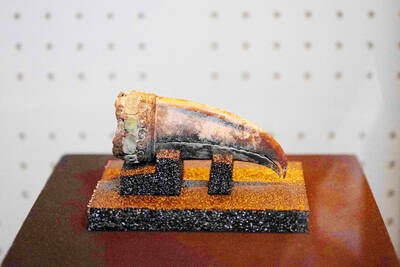
Archeologists in Peru on Thursday said they found the 5,000-year-old remains of a noblewoman at the sacred city of Caral, revealing the important role played by women in the oldest center of civilization in the Americas. “What has been discovered corresponds to a woman who apparently had elevated status, an elite woman,” archeologist David Palomino said. The mummy was found in Aspero, a sacred site within the city of Caral that was a garbage dump for more than 30 years until becoming an archeological site in the 1990s. Palomino said the carefully preserved remains, dating to 3,000BC, contained skin, part of the
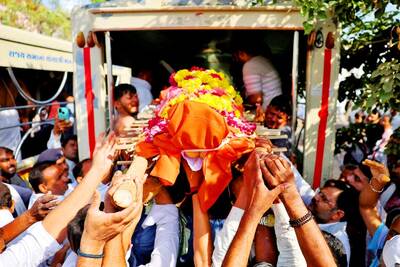
‘WATER WARFARE’: A Pakistani official called India’s suspension of a 65-year-old treaty on the sharing of waters from the Indus River ‘a cowardly, illegal move’ Pakistan yesterday canceled visas for Indian nationals, closed its airspace for all Indian-owned or operated airlines, and suspended all trade with India, including to and from any third country. The retaliatory measures follow India’s decision to suspend visas for Pakistani nationals in the aftermath of a deadly attack by shooters in Kashmir that killed 26 people, mostly tourists. The rare attack on civilians shocked and outraged India and prompted calls for action against their country’s archenemy, Pakistan. New Delhi did not publicly produce evidence connecting the attack to its neighbor, but said it had “cross-border” links to Pakistan. Pakistan denied any connection to

TRUMP EFFECT: The win capped one of the most dramatic turnarounds in Canadian political history after the Conservatives had led the Liberals by more than 20 points Canadian Prime Minister Mark Carney yesterday pledged to win US President Donald Trump’s trade war after winning Canada’s election and leading his Liberal Party to another term in power. Following a campaign dominated by Trump’s tariffs and annexation threats, Carney promised to chart “a new path forward” in a world “fundamentally changed” by a US that is newly hostile to free trade. “We are over the shock of the American betrayal, but we should never forget the lessons,” said Carney, who led the central banks of Canada and the UK before entering politics earlier this year. “We will win this trade war and

Armed with 4,000 eggs and a truckload of sugar and cream, French pastry chefs on Wednesday completed a 121.8m-long strawberry cake that they have claimed is the world’s longest ever made. Youssef El Gatou brought together 20 chefs to make the 1.2 tonne masterpiece that took a week to complete and was set out on tables in an ice rink in the Paris suburb town of Argenteuil for residents to inspect. The effort overtook a 100.48m-long strawberry cake made in the Italian town of San Mauro Torinese in 2019. El Gatou’s cake also used 350kg of strawberries, 150kg of sugar and 415kg of


 RSS
RSS