


The proliferation of jellyfish in oceans around the world, driven by over-fishing and climate change, is a sign of ecosystems out of kilter, experts warn.
“Jellyfish are an excellent bellwether for the environment,” said Jacqueline Goy, of the Oceanographic Institute of Paris.
“The more jellyfish, the stronger the signal that something has changed,” Goy said.
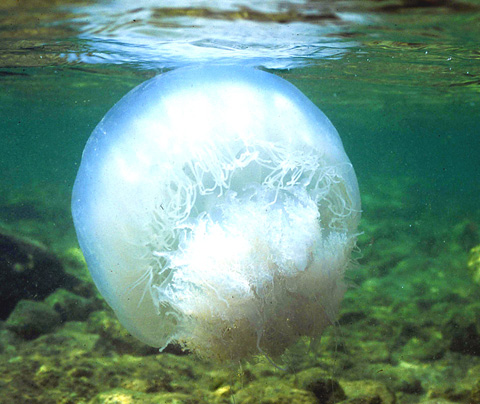
PHOTO: AFP
Brainless creatures composed almost entirely of water, the primitive animals have quietly filled a vacuum created by the voracious human appetite for fish.
HERE TO STAY
And marine biologists say dislodging them will be difficult.
“Jellyfish have come to occupy the place of many other species,” said Ricardo Aguilar, research director for Oceana, an international conservation organization.
Nowhere is the sting of these poorly understood invertebrates felt more sharply than the Mediterranean basin, where their exploding numbers have devastated native marine species and threaten seaside tourism.
And while much about the lampshade-like creatures remains unknown, scientists are in agreement: Pelagia noctiluca — whose tentacles can paralyze prey and cause burning rashes in humans — will once again besiege Mediterranean coastal waters this summer.
That, in itself, is not unusual. It is the frequency and persistence of these appearances that worry scientists.
Two centuries of data show that jellyfish populations naturally swell every 12 years, remain stable four or six years, and then subside.
This year, however, will be the eighth consecutive year that medusae, as they are also known, will be present in massive numbers.
OVER-EXPLOITATION
The over-exploitation of ocean resources by man has helped create a near-perfect environment in which these most primitive of ocean creatures can multiply unchecked, scientists say.
“When vertebrates such as fish disappear, then invertebrates — especially jellyfish — appear,” Aguilar says.
The collapse of fish populations boosts this process in two important ways, he added. When predators such as tuna, sharks and turtles vanish, not only do fewer jellyfish get eaten, they have less competition for food.
Jellyfish feed on small fish and zooplankton that get caught up in their dangling tentacles.
“Jellyfish both compete with fish for plankton food, and predate directly on fish,” said Andrew Brierley from the University of St Andrews in Scotland. “It is hard, therefore, to see a way back for fish once jellyfish have become established, even if commercial fishing is reduced.”
Which is why Brierley and other experts were not surprised to find a huge surge in the number of jellyfish off the coast of Namibia in the Atlantic, one of the most intensely fished oceans in the world.
CLIMATE CHANGE
Climate change has also been a boon to these domed gelatinous creatures in so far as warmer waters prolong their reproductive cycles.
But just how many millions, or billions, of jellyfish roam the seas is nearly impossible to know, said scientists. For one thing, the boneless, translucent animals — even big ones grouped in large swarms — are hard to spot in satellite images or sonar soundings, unlike schools of fish.
They also resist study in captivity, which means few studies.
“There are only 20 percent of species of jellyfish for which we know the life cycle,” Goy said.
The fact that jellyfish are not commercially exploited, with the exception of a few species eaten by gastronomes in East Asia, has also added to this benign neglect.
But the impact of these stinging beasts on beach-based tourism along the Mediterranean has begun to spur interest in these peculiar creatures whose growing presence points to dangerous changes in the world’s oceans.

‘IN A DIFFERENT PLACE’: The envoy first visited Shanghai, where he attended a Chinese basketball playoff match, and is to meet top officials in Beijing tomorrow US Secretary of State Antony Blinken yesterday arrived in China on his second visit in a year as the US ramps up pressure on its rival over its support for Russia while also seeking to manage tensions with Beijing. The US diplomat tomorrow is to meet China’s top brass in Beijing, where he is also expected to plead for restraint as Taiwan inaugurates president-elect William Lai (賴清德), and to raise US concerns on Chinese trade practices. However, Blinken is also seeking to stabilize ties, with tensions between the world’s two largest economies easing since his previous visit in June last year. At the

UNSETTLING IMAGES: The scene took place in front of TV crews covering the Trump trial, with a CNN anchor calling it an ‘emotional and unbelievably disturbing moment’ A man who doused himself in an accelerant and set himself on fire outside the courthouse where former US president Donald Trump is on trial has died, police said yesterday. The New York City Police Department (NYPD) said the man was declared dead by staff at an area hospital. The man was in Collect Pond Park at about 1:30pm on Friday when he took out pamphlets espousing conspiracy theories, tossed them around, then doused himself in an accelerant and set himself on fire, officials and witnesses said. A large number of police officers were nearby when it happened. Some officers and bystanders rushed

Beijing is continuing to commit genocide and crimes against humanity against Uyghurs and other Muslim minorities in its western Xinjiang province, U.S. Secretary of State Antony Blinken said in a report published on Monday, ahead of his planned visit to China this week. The State Department’s annual human rights report, which documents abuses recorded all over the world during the previous calendar year, repeated language from previous years on the treatment of Muslims in Xinjiang, but the publication raises the issue ahead of delicate talks, including on the war in Ukraine and global trade, between the top U.S. diplomat and Chinese
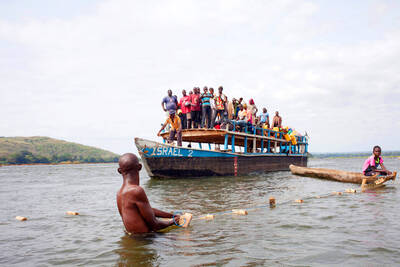
RIVER TRAGEDY: Local fishers and residents helped rescue people after the vessel capsized, while motorbike taxis evacuated some of the injured At least 58 people going to a funeral died after their overloaded river boat capsized in the Central African Republic’s (CAR) capital, Bangui, the head of civil protection said on Saturday. “We were able to extract 58 lifeless bodies,” Thomas Djimasse told Radio Guira. “We don’t know the total number of people who are underwater. According to witnesses and videos on social media, the wooden boat was carrying more than 300 people — some standing and others perched on wooden structures — when it sank on the Mpoko River on Friday. The vessel was heading to the funeral of a village chief in


 RSS
RSS