


US Democratic candidate Senator Barack Obama capitalized on the public’s weariness with George W. Bush’s presidency, pushing a plan to eliminate tax cuts for the wealthy and praising the Supreme Court decision to allow detainees at Guantanamo Bay to challenge their imprisonment in federal courts.
Obama’s head-to-head battle with Republican rival Senator John McCain began in earnest this week, following Senator Hillary Rodham Clinton’s departure from the Democratic race. Obama has repeatedly sought to discredit his opponent by tying him to Bush’s unpopular policies, focusing on fiscal issues, the war in Iraq and on Saturday, Guantanamo.
Taking audience questions in Pennsylvania, Obama praised Thursday’s Supreme Court decision to allow detainees at Guantanamo Bay to challenge their imprisonment in US federal courts.
Enforcing such rights, he said, is “the essence of who we are.”
Even when Nazis’ atrocities became known in the 1940s, he said, “we still gave them a day in court” at the Nuremberg trials.
“That taught the entire world about who we are,” he said.
The court’s ruling was a repudiation of Bush’s ambitious and hugely controversial schemes to hold terror suspects from different countries outside the protections of US law.
McCain sharply criticized the Supreme Court decision, saying it would hamper the war on terrorism.
But while disapproval of such issues as Guantanamo and the war in Iraq has deepened among the public, McCain still is seen as having the upper hand on issues of national security and foreign policy, given his more than 20 years of experience in the Senate.
Instead, Obama is perceived as the one best able to handle the economy, and has repeatedly shifted the debate in that direction.
In Pennsylvania, a key battleground in the fall campaign, Obama said he would take a much more hands-on approach than would McCain.
He again criticized McCain’s proposal for a temporary halt in the federal gasoline tax.
It would “actually do real harm,” Obama said, by reducing revenue for road and bridge construction even as oil companies make record profits.
Speaking to about 200 people in Wayne, a Philadelphia suburb, Obama made no new proposals but emphasized earlier ones in light of rising gas prices, inflation and job losses. They include tax cuts for most working families and poor elderly people.
Obama said he could pay for his programs by eliminating the Bush administration’s tax cuts for the wealthy, winding down the Iraq war and spending more on alternative energy programs that eventually will save money.
He also vowed to spend US$150 billion over 10 years to establish a “green energy sector.”
It would require greater fuel efficiency in cars and devote more money to solar, wind, and biodiesel energy.
McCain spokesman Tucker Bounds said on Saturday that Obama was railing against “the very energy policy that he voted for.”
Obama told the Wayne audience that he voted for an energy bill “that was far from perfect” because “it contained the largest investment in renewable sources of energy in our nation’s history.”
McCain is seeking to frame an economic policy that defends extending Bush’s tax cuts but embraces quick measures that the president opposes. He has said that in extending Bush’s reductions, he would spur economic activity that would actually raise government revenue.
Democrats have carried Pennsylvania in the last four presidential elections, although narrowly at times. Obama lost badly to Clinton in the primary there, and he is struggling to attract white working-class voters who heavily favored her.
McCain, meanwhile, also has been reaching out to women and Clinton’s backers, and sent a well-known female supporter, former Hewlett-Packard chief executive Carly Fiorina, to campaign in Ohio and Pennsylvania.
“I respect and admire the campaign she ran,” McCain said on Saturday on a telephone town hall meeting. “Every place I go, I’m told that Senator Clinton inspired millions of young women in this country. And not necessarily young women; she inspired a whole generation of young people in this country.”
Later on Saturday, Obama visited the flooded Midwest, helping volunteers in Quincy, Illinois, fill sandbags that are being trucked to reinforce levees on both sides of the Mississippi River, less than a mile away. Authorities expected the river at Quincy to reach a near-record level of 9.75m by Wednesday. Severe flooding already has hit Cedar Rapids, Iowa, northwest of Quincy.
“Since I’ve been involved in public office we’ve not seen this kind of devastation,” Obama said as he used a shovel to fill bags being held by local resident Dylan Muldoon, 10.
He vowed to push the federal and state governments to provide needed aid to the stricken areas.
Obama and McCain are battling over Iowa, which provided a crucial Democratic caucus win for Obama in January. Obama had planned to campaign in Cedar Falls last Wednesday, but the flooding forced him to go elsewhere. Aides said Obama chose to avoid Iowa this weekend because he did not want to draw government resources from the efforts to help flood victims and prevent further flooding in areas still above water.
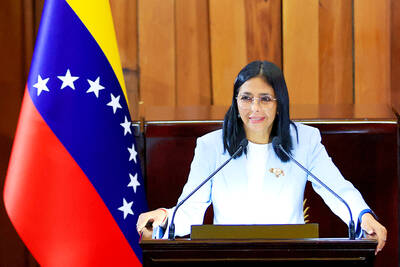
VAGUE: The criteria of the amnesty remain unclear, but it would cover political violence from 1999 to today, and those convicted of murder or drug trafficking would not qualify Venezuelan Acting President Delcy Rodriguez on Friday announced an amnesty bill that could lead to the release of hundreds of prisoners, including opposition leaders, journalists and human rights activists detained for political reasons. The measure had long been sought by the US-backed opposition. It is the latest concession Rodriguez has made since taking the reins of the country on Jan. 3 after the brazen seizure of then-Venezuelan president Nicolas Maduro. Rodriguez told a gathering of justices, magistrates, ministers, military brass and other government leaders that the ruling party-controlled Venezuelan National Assembly would take up the bill with urgency. Rodriguez also announced the shutdown
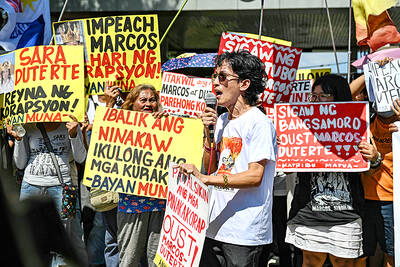
Civil society leaders and members of a left-wing coalition yesterday filed impeachment complaints against Philippine Vice President Sara Duterte, restarting a process sidelined by the Supreme Court last year. Both cases accuse Duterte of misusing public funds during her term as education secretary, while one revives allegations that she threatened to assassinate former ally Philippine President Ferdinand Marcos Jr. The filings come on the same day that a committee in the House of Representatives was to begin hearings into impeachment complaints against Marcos, accused of corruption tied to a spiraling scandal over bogus flood control projects. Under the constitution, an impeachment by the
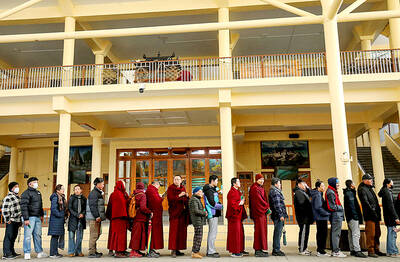
Exiled Tibetans began a unique global election yesterday for a government representing a homeland many have never seen, as part of a democratic exercise voters say carries great weight. From red-robed Buddhist monks in the snowy Himalayas, to political exiles in megacities across South Asia, to refugees in Australia, Europe and North America, voting takes place in 27 countries — but not China. “Elections ... show that the struggle for Tibet’s freedom and independence continues from generation to generation,” said candidate Gyaltsen Chokye, 33, who is based in the Indian hill-town of Dharamsala, headquarters of the government-in-exile, the Central Tibetan Administration (CTA). It
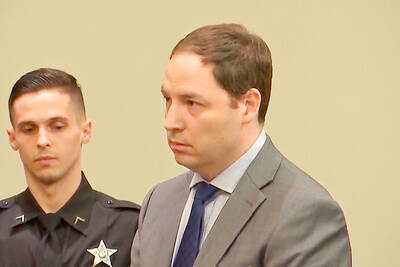
A Virginia man having an affair with the family’s Brazilian au pair on Monday was found guilty of murdering his wife and another man that prosecutors say was lured to the house as a fall guy. Brendan Banfield, a former Internal Revenue Service law enforcement officer, told police he came across Joseph Ryan attacking his wife, Christine Banfield, with a knife on the morning of Feb. 24, 2023. He shot Ryan and then Juliana Magalhaes, the au pair, shot him, too, but officials argued in court that the story was too good to be true, telling jurors that Brendan Banfield set


 RSS
RSS