


After a mayor waited five years in vain for Filipino politicians to make good on a promise to build a badly needed health clinic in Calbayog, US Navy Seabees helped local troops construct it — in just 30 days.
The Seabees, the Navy’s construction units, arrived weeks ahead of the hospital ship USNS Mercy, which visited impoverished Calbayog for the second time on Saturday after treating thousands of people for free in 1987.
When the huge, white-hulled Mercy — a converted oil tanker — steamed back to Calbayog, on central Samar Island, a boy who underwent surgery aboard the ship 21 years ago to correct a foot deformity waited on shore. Now a nurse, he wanted to give a little payback to the Americans.
“I offered to become a medical volunteer as a way of thanking them. I can walk now because of the Mercy, I can even play basketball,” an excited Carl Nino Rosalado said.
The Mercy’s gentle diplomacy has won hearts in the Philippines, where the US military has been providing combat training and weapons to the underfunded military since 2002 to stop the poor Southeast Asian country from continuing to be a breeding ground for terrorists and extremist ideologies.
Al-Qaeda-linked Abu Sayyaf militants in the south have been weakened by US-backed offensives but still plot bombings and kidnappings for ransom. They have been blamed for the June 8 kidnapping of a TV news anchor and her two-man crew on violent Jolo island.
Communist New People’s Army guerrillas have been waging a 40-year bloody insurrection across the sprawling archipelago, including on Samar, about 600km southeast of Manila.
Both insurgent groups, blacklisted by Washington as terrorist organizations, have targeted Americans in the past.
Wrapping up a monthlong medical and civic mission in the Philippines — the first stop in a five-nation Asia-Pacific humanitarian tour — the Mercy’s staff, Seabees, US Ambassador Kristie Kenney and other US officials were given a rousing tribute on Saturday by Calbayog, a laid-back coconut-growing and fishing city.
Hundreds of elementary and high school students — in their school uniforms on a day without classes — lined roads, yelling and waving small US and Philippine flags as Kenney’s convoy passed by. A local army brass band welcomed her at the airport and cultural dancers, including a group of villagers dressed as roosters, regaled the Americans in two farewell performances.
Kenney got out of her van a number of times, shaking the hands of well-wishers and giving them high-fives. She later inaugurated a nine-room health center partly built by 20 Seabees, which Calbayog Mayor Mel Sarmiento said would boost a local government campaign against tropical diseases, dengue and tuberculosis.
Calbayog already has one public and three private hospitals, but its six government doctors are overwhelmed by the poor, who make up nearly half of the 164,000 residents, he said.
“If we have enough medical services, medicine for the sick and free consultations, maybe the rebels will come down from the mountains,” said Lucena Mendoza, a mother of four who waited in line nine hours for treatment for blurred vision from a US volunteer ophthalmologist.
She left beaming with new reading glasses.
Reaching out to the rural poor entails risks for Mercy’s medical workers.
In Calbayog, near mountains where communist guerrillas lurk, heavily armed soldiers and police kept watch over the Americans.
In an earlier stop in the south, one of the Mercy’s four MH-60 Knighthawk support helicopters was hit by gunfire although it is not certain it was targeted or accidentally hit in a region where Muslim rebels and criminal gangs also are active.
Nobody was injured. The helicopter was grounded for safety checks and only one civic activity was canceled. The Mercy’s mission went on.
During a 2006 visit, the Mercy anchored far from southern Jolo Iisland, where Abu Sayyaf extremist militants are active, for security reasons. Police said at the time they had learned of a plan by the militants to bomb the ship, which was given 24-hour heavy security.
While many in predominantly Muslim Jolo still harbor bitter memories of bloody battles between their forefathers and US colonizers in the early 1900s, it was hard to find anyone in Calbayog who could recite similar fighting on Samar.
In 1901, Filipino insurgents attacked and killed several US occupation troops in Samar’s Balangiga township, near Calbayog. The so-called “Balangiga massacre” — and the heavy-handed US reprisal that followed — represented one of the lowest points in the history of the two nations, which would later become strong military allies.
After stopping in Manila for another medical mission yesterday, the Mercy will travel to Vietnam, East Timor, Papua New Guinea and Micronesia, US Navy Captain James Rice said.
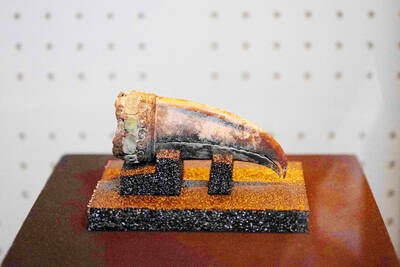
Archeologists in Peru on Thursday said they found the 5,000-year-old remains of a noblewoman at the sacred city of Caral, revealing the important role played by women in the oldest center of civilization in the Americas. “What has been discovered corresponds to a woman who apparently had elevated status, an elite woman,” archeologist David Palomino said. The mummy was found in Aspero, a sacred site within the city of Caral that was a garbage dump for more than 30 years until becoming an archeological site in the 1990s. Palomino said the carefully preserved remains, dating to 3,000BC, contained skin, part of the

TRUMP EFFECT: The win capped one of the most dramatic turnarounds in Canadian political history after the Conservatives had led the Liberals by more than 20 points Canadian Prime Minister Mark Carney yesterday pledged to win US President Donald Trump’s trade war after winning Canada’s election and leading his Liberal Party to another term in power. Following a campaign dominated by Trump’s tariffs and annexation threats, Carney promised to chart “a new path forward” in a world “fundamentally changed” by a US that is newly hostile to free trade. “We are over the shock of the American betrayal, but we should never forget the lessons,” said Carney, who led the central banks of Canada and the UK before entering politics earlier this year. “We will win this trade war and
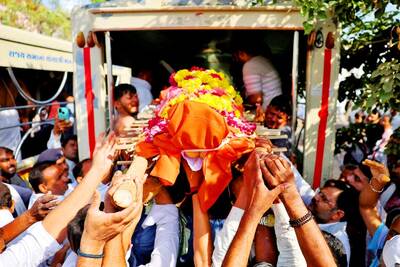
‘WATER WARFARE’: A Pakistani official called India’s suspension of a 65-year-old treaty on the sharing of waters from the Indus River ‘a cowardly, illegal move’ Pakistan yesterday canceled visas for Indian nationals, closed its airspace for all Indian-owned or operated airlines, and suspended all trade with India, including to and from any third country. The retaliatory measures follow India’s decision to suspend visas for Pakistani nationals in the aftermath of a deadly attack by shooters in Kashmir that killed 26 people, mostly tourists. The rare attack on civilians shocked and outraged India and prompted calls for action against their country’s archenemy, Pakistan. New Delhi did not publicly produce evidence connecting the attack to its neighbor, but said it had “cross-border” links to Pakistan. Pakistan denied any connection to

Armed with 4,000 eggs and a truckload of sugar and cream, French pastry chefs on Wednesday completed a 121.8m-long strawberry cake that they have claimed is the world’s longest ever made. Youssef El Gatou brought together 20 chefs to make the 1.2 tonne masterpiece that took a week to complete and was set out on tables in an ice rink in the Paris suburb town of Argenteuil for residents to inspect. The effort overtook a 100.48m-long strawberry cake made in the Italian town of San Mauro Torinese in 2019. El Gatou’s cake also used 350kg of strawberries, 150kg of sugar and 415kg of


 RSS
RSS