

Pakistani Premier Yousuf Raza Gilani said the government would freeze defense spending in the upcoming budget, state media reported yesterday, as the country tries to tackle growing economic problems.
Nuclear-armed Pakistan, a key ally in the US-led “war on terror,” spent 275 billion rupees (US$4.1 billion) on defense during the current fiscal year ending on June 30, up from 250 billion rupees in the previous year.
“The government has decided to freeze the allocation for defense in the next national budget as a measure of Pakistan’s tangible display to seek peace with neighbors,” Gilani told parliament late on Monday according to state media.
Gilani said that in effect the defense budget would be “reduced in the context of inflation and rupee-dollar parity,” the official Associated Press of Pakistan news agency reported.
Without actually naming neighboring nuclear rival India, he said that he expected a “reciprocal gesture from our neighbor for the sake of peace and prosperity of the region.”
India and Pakistan, who have fought three major wars since independence from Britain in 1947, launched a slow-moving peace process in 2004.
Gilani added that “the defense ministry and the chief of army staff have fully endorsed the revised format of the defense services budget estimates.”
Pakistan has witnessed strong growth in recent years, backed by an influx of US aid, but global economic issues coupled with domestic political turmoil over the fate of President Pervez Musharraf have hit hard this year.
The state bank raised interest rates 1.5 points to 12 percent in May in a bid to curb soaring inflation. The bank said inflation was set to hit 11 percent this year, double the target of 6.5 percent.
Anger is mounting among the country’s 160 million people over shortages of food and other commodities, coupled with frequent power outages, factors that contributed to the defeat of Musharraf’s backers in February.
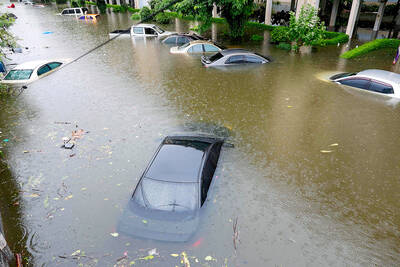
Several areas of Thailand’s capital city Bangkok were inundated by continuous rain from Thursday afternoon to yesterday morning that has disrupted traffic and forced some residents to evacuate. Major canals in Bangkok filled with accumulated rainfall exceeding 20cm, officials said yesterday. Floodwaters spread across the city, particularly in the central and eastern parts, blocking roads and stopping traffic. The Thai Meteorological Department warned that the heavy rain would continue in most parts of the country through today, citing a strong low-pressure system over the central region and strengthening southwest monsoon conditions. More than 84,000 people in 21 provinces nationwide were
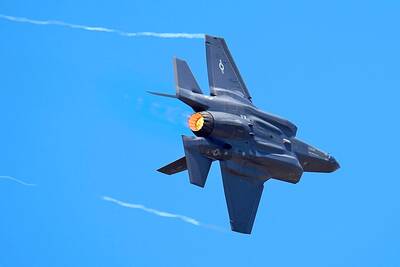
BAD TIMING: The disclosure of the incident, which is under investigation by at least two congressional committees, comes as Xi was to meet with Trump The Pentagon is investigating how parts of the US’ most advanced fighter jet ended up in Hong Kong, with a news outlet on Wednesday reporting that China has obtained the F-35 equipment. The F-35 Joint Program Office said in a statement that it and the US Department of Defense are aware of “a shipment issue” with F-35 components. “We are actively working with US authorities and industry partners to retrieve these components, investigate the incident and place safeguards to avoid a future occurrence,” the office said. UPS was shipping a cockpit canopy and weapons-bay door from an Australian military F-35 that was being

Yemen’s Saudi-led coalition early yesterday said it had intercepted two ballistic missiles and two drones launched by the Iran-backed Houthis toward the kingdom. The coalition said in posts on social media that the missiles were headed towards Khamis Mushait and the drones toward the capital, Riyadh, adding that it was monitoring the missile threat and drones launched at the kingdom, without providing further details. The Saudi Civil Defense had sent alerts overnight for Khamis Mushait and Abha, but not for Riyadh. The Houthis, who control the most populous parts of Yemen and much of the north, have been launching attacks

IN DEFENSE: Australia said it takes the protection of classified and export-controlled tech extremely seriously amid concerns over reverse engineering A US House of Representatives committee that oversees defense policy is investigating the diversion of potentially sensitive F-35 jet components this year from Australia to Hong Kong, a spokesperson said. “The committee is aware of this issue and we’ve received multiple briefings on it,” House Committee on Armed Services spokesperson Heather Vaughan said, adding that the group is “continuing to look into the incident and conduct oversight.” The Pentagon’s F-35 program office said in a statement that “we are aware of a shipment issue of unserviceable F-35 components and we are actively working with US authorities and industry partners to retrieve these


 RSS
RSS