


Painted and feathered Indians waving machetes and clubs slashed an official of Brazil’s national electric company on Tuesday during a protest over a proposed hydroelectric dam.
Mobs of Indians from different tribes surrounded Eletrobras engineer Paulo Fernando Rezende minutes after he gave a presentation to a gathering debating the impact of the Belo Monte dam on traditional communities living near this small, remote city in the Amazon region.
Rezende emerged shirtless, with a deep, bloody gash on his shoulder, but said “I’m OK, I’m OK,” as colleagues rushed him to a car.

PHOTO: AP
It was not immediately clear whether Rezende was intentionally slashed or received the cut inadvertently when he was surrounded and pushed to the floor. Police said they were still investigating and no one was in custody.
Tensions were running high at the meeting, where about 1,000 Amazon Indians met activists to protest the proposed dam on the Xingu River.
Environmentalists warn it could destroy the traditional fishing grounds of Indians living nearby and displace as many as 15,000 people.
“He’s lucky he’s still alive,” said Partyk Kayapo, whose uses his tribe’s name as his last. “They want to make a dam and now they know they shouldn’t,” he said.
Following the attack, Kayapo and dozens more members of his tribe danced in celebration with their machetes raised in the air, their faces painted red and wearing little more than shorts and shell necklaces.
The Brazilian government said the proposed US$6.7 billion hydroelectric dam on the Xingu River, which flows into the Amazon, would supply Brazil with an estimated 11,000 megawatts of power and is essential to meet growing energy demand.
Rezende, who was the top government official at the conference, said the dam’s impact would not be as bad as some environmentalists were making it out to be and that it was selected from a number of Xingu dam proposals as being the option that would least affect Indians.
Rezende was booed several times during his presentation, only to be followed by Roquivam Alves da Silva of the Movement of Dam Affected People, who roused the crowd by declaring: “We’ll go to war to defend the Xingu if we have to.”
Da Silva denied that he had incited the attack.
“It’s true it happened right after I spoke, but I don’t think I caused it,” he said. “Tensions were already simmering.”
Wilmar Soares, who heads Altamira’s association of business owners, said residents were demanding increased security at the weeklong protest, scheduled to end tomorrow.
“No one has the right to cut anyone. It was a surprise, but it was preventable,” he said.
Rezende was given stitches at a hospital and released. He then made a statement to authorities and left without speaking to reporters.
The attack recalls a similar meeting in 1989 when Indians held a machete to the face of another Eletrobras engineer during protests against a series of proposed hydroelectric dams on the Xingu river.
Following that incident, the World Bank canceled loans to Brazil for the dam.

Hungarian authorities temporarily detained seven Ukrainian citizens and seized two armored cars carrying tens of millions of euros in cash across Hungary on suspicion of money laundering, officials said on Friday. The Ukrainians were released on Friday, following their detention on Thursday, but Hungarian officials held onto the cash, prompting Ukraine to accuse Hungary’s Russia-friendly government of illegally seizing the money. “We will not tolerate this state banditism,” Ukrainian Minister of Foreign Affairs Andrii Sybiha said. The seven detained Ukrainians were employees of the Ukrainian state-owned Oschadbank, who were traveling in the two armored cars that were carrying the money between Austria and

Kosovar President Vjosa Osmani on Friday after dissolving the Kosovar parliament said a snap election should be held as soon as possible to avoid another prolonged political crisis in the Balkan country at a time of global turmoil. Osmani said it is important for Kosovo to wrap up the upcoming election process and form functional institutions for political stability as the war rages in the Middle East. “Precisely because the geopolitical situation is that complex, it is important to finish this electoral process which is coming up,” she said. “It is very hard now to imagine what will happen next.” Kosovo, which declared

MORE BANS: Australia last year required sites to remove accounts held by under-16s, with a few countries pushing for similar action at an EU level and India considering its own ban Indonesia on Friday said it would ban social media access for children under 16, citing threats from online pornography, cyberbullying, online fraud and Internet addiction. “Accounts belonging to children under 16 on high-risk platforms will start to be deactivated, beginning with YouTube, TikTok, Facebook, Instagram, Threads, X, Bigo Live and Roblox,” Indonesian Minister of Communications and Digital Meutya Hafid said. “The government is stepping in so that parents no longer have to fight alone against the giants of the algorithm. Implementation will begin on March 28, 2026,” she said. The social media ban would be introduced in stages “until all platforms fulfill their
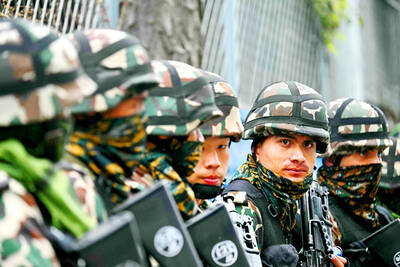
Counting was under way in Nepal yesterday, after a high-stakes parliamentary election to reshape the country’s leadership following protests last year that toppled the government. Key figures vying for power include former Nepalese prime minister K. P. Sharma Oli, rapper-turned-mayor Balendra Shah, who is bidding for the youth vote, and newly elected Nepali Congress party leader Gagan Thapa. In Kathmandu’s tea shops and city squares, people were glued to their phones, checking results as early trends flashed up — suggesting Shah’s centrist Rastriya Swatantra Party (RSP) was ahead. Nepalese Election Commission spokesman Prakash Nyupane said the counting was ongoing “in a peaceful manner”


 RSS
RSS