


Georgians voted yesterday in parliamentary elections seen as a test of the pro-Western government’s democratic credentials at a time of dangerously fraught tensions with neighboring Russia.
The election, which polls forecast will be won by Georgian President Mikheil Saakashvili’s United National Movement, opened under sunny skies in the strategic former Soviet republic’s ancient capital Tbilisi.
But dark political clouds gathered over this mountainous country of just under 5 million people as the election stoked internal tensions and a row over Russia’s support for separatist rebels in two regions gathered momentum.
At a polling station next to Tbilisi’s Soviet-era parliament building, Anya, 56, said she had voted for Saakashvili’s party “because I believe that he is doing what’s best for our country.”
But opposition supporters have already denounced the vote as a fraud.
“I voted for the opposition, but it doesn’t matter because they are going to throw out my vote anyway,” Vano Zurabishvili, 34, said after casting his ballot. “We have no democracy in this country.”
Diplomats and analysts have warned that the vote will have to be conducted fairly if Georgia is to get Western support in a row over two separatist regions backed by Russia: Abkhazia and South Ossetia.
On the eve of the vote, Saakashvili made an appeal for national unity, saying Russia would take advantage of any unrest.
“We have to realize how important tomorrow’s elections are. Our enemy wants tomorrow’s elections to turn into turmoil and internal confrontation,” he said in a televised address.
Tensions between Moscow and Tbilisi soared ahead of the election, with Saakashvili saying earlier this month that the two countries had come close to war and Russia sending extra troops to Abkhazia.
Last week a senior Georgian minister said that war in Abkhazia had only been avoided thanks to a phone call by France’s foreign minister to his Russian counterpart.
Georgia’s opposition has already called its supporters to take to the streets yesterday night. Opposition leader Levan Gachechiladze said he would call on supporters to force their way into the electoral commission office if authorities “do not release the real results of the vote.”
“The people have every right to protect their votes,” he said.
The main Western election monitoring body, the Organization for Security and Cooperation in Europe (OSCE), has sent 550 observers to monitor the polling and is to deliver a verdict today.
A country of soaring mountain peaks, wine and ancient churches, Georgia has suffered through civil wars, the breakaway of two regions and sustained political turmoil since gaining independence with the 1991 collapse of the Soviet Union.
Saakashvili has won praise for economic reforms since coming to power in 2004 after the peaceful Rose Revolution and supporters describe his government as a beacon of democracy in the often corrupt and authoritarian former Soviet Union.
But his goal of joining NATO has set him sharply at odds with Russia, which sees enlargement of the alliance as encroachment on its sphere of influence.
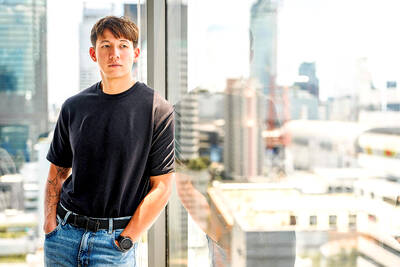
SPEAKING OUT: After Siranudh Scott’s allegations surfaced, celebrities and public figures took to social media to share their own experiences of sexual misconduct and abuse A high-profile alleged sexual abuse case within a wealthy Thai beer brewing family has prompted a wave of painful accounts from survivors of unconnected abuse in the conservative nation. Siranudh Scott, a member of the billionaire Thai family that founded the ubiquitous Singha beer brand, posted an emotional video this month accusing his elder brother Sunit of repeatedly abusing him when he was a teenager. Sunit, who is in his 30s, later denied the allegations in a video posted online, but Singha parent Boonrawd dismissed him from his executive role with the company on Tuesday last week. “I felt I needed to speak
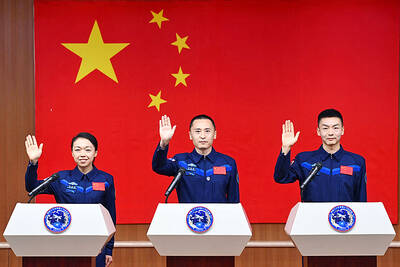
A Hong Kong astronaut is to join a Chinese space mission for the first time as part of a three-person crew launching today, as Beijing edges closer to its goal of landing people on the moon. The Tiangong space station — crewed by teams of three astronauts that are typically rotated every six months — is the crown jewel of China’s space program, boosted by billions in state investment in a bid to catch up with the US and Russia. The Shenzhou-23 mission is to blast off at 11:08pm from the Jiuquan Satellite Launch Center in northwestern China, carrying three astronauts to
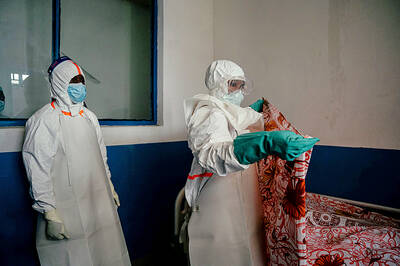
UPGRADED ALERT: The risk inside DR Congo is now considered ‘very high,’ while neighboring countries face a ‘high’ threat as the outbreak continues, the WHO said Ebola is spreading faster than responders can track it in eastern Congo, where health workers managed to follow up with barely one in five identified contacts in a single day. Authorities in the Democratic Republic of the Congo (DR Congo) reported 83 confirmed infections, 746 suspected cases and 1,603 identified contacts as of Thursday, but health workers were able to follow up on only 342 contacts that day — about 21 percent of the total under monitoring — data released by the DR Congo Ministry of Public Health on Friday showed. The figures suggest the response is falling behind the outbreak itself,

SEEKING ORDER: Rodrigo Paz said that ‘anyone who wants to destroy the nation will have to deal with this president and the full force of the constitution’ Bolivian President Rodrigo Paz on Wednesday said that the nation was at a “breaking point” after nearly a month of protests that have caused shortages of food, fuel and medicine. Paz, who took office six months ago amid the worst economic crisis there in four decades, is battling a groundswell of fury over his policies. The political capital, La Paz, has been besieged by low-income workers and members of the indigenous majority calling for his resignation. “The country needs order and is reaching breaking point,” the 58-year-old said at a public event in La Paz, renewing his appeal for dialogue. On Tuesday, the Bolivian


 RSS
RSS