


Dressed in white, sometimes wearing the traditional red fez cap, a faint smile on his lips, Morocco’s King Mohammed VI looks majestically out of countless photographs hanging in shops, banks and restaurants in the capital.
The monarch, who seems to watch incessantly over his 33 million subjects, is far from being a European-style royal figurehead with hardly any power and constant prying into his private life.
Moroccans know little of what goes on behind the walls of the royal residence, but none of them fails to be aware of the enormous power wielded by the 44-year-old king, whose Alawite dynasty has ruled the north African country since the 17th century.
Not only do the media keep up a respectful coverage of royal activities, but almost any conversation on politics or economics soon turns to the king, whose will rules over that of the government, and whom many ordinary people see as an almost mythical figure.
“The king is good,” said Karima, a 30-year-old teacher of autistic children. “He helps the poor.”
That view, in a country where open criticism of the monarchy can lead to a prison sentence, contrasts with a typical comment from political analysts: “The king is well-intentioned, but he is ill-advised, and the government is corrupt and incompetent.”
Mohammed’s accession to the throne in 1999 raised enormous hopes in Morocco, which his father Hassan II had ruled for 38 years with an iron fist.
Hassan ruthlessly suppressed political opponents and failed to solve problems including rural poverty, urban slums and an illiteracy rate which still surpasses 40 percent.
Mohammed VI became known as “the king of the poor,” driving his own car, launching a royal foundation and a development program to reduce poverty, increasing press freedom and creating a commission to compensate victims of human rights abuses under Hassan’s rule.
The king continues to visit poor areas, launching infrastructure and other projects and distributing gifts such as taxi driving permits, housing and reportedly even money.
He has also begun breaking down the secrecy surrounding the palace, allowing his wife Princess Lalla Salma to play a discreet public role and appearing before the press with her and their two young children.
However, the king’s young advisors have begun giving way to king Hassan’s old guard and other hawks, analysts say.
After suicide bombings in Casablanca killed 45 people in 2003, the threat of Islamist terrorism has contributed to the curtailment of democratic freedoms, with police clashing with demonstrators, newspapers closed and journalists jailed, fined or forced to resign.
Morocco has dozens of political prisoners, including Islamists, Western Saharawi separatists, Berber cultural activists and army officers who denounced corruption in their ranks, the Moroccan Association of Human Rights says.
“Moroccans are disappointed with Mohammed VI,” said columnist Khalid Jamai, one of the few people in Morocco who do not hesitate to criticize the king as a person.
The king’s apparent concern for the poor does not mask the fact that he continues to live in breathtaking luxury. His wealth includes sumptuous palaces around the country and control over large sectors of the economy mainly through the gigantic ONA conglomerate.
The palace also wields the most political power, with the king appointing five key ministers, regional governors and other decisionmakers. The king can veto any government decision, and has launched major agricultural and development programs without even informing the government about them, several sources said.
“Ministries discuss their plans directly with the king without letting parliament know,” said former agriculture and education minister Ismail Alaoui, leader of the Party of Progress and Socialism, which belongs to the ruling coalition.
The power structure centered on the palace is known as the Makhzen, a kind of network of people and lobbies focused on preserving their vested interests rather than on general development.
King Hassan “makhzenized” the political parties with a combination of repression, rewards and divisive tactics, analysts say, domesticating them into what Jamai describes as “empty shells.”
The parties’ lack of credibility has boosted the role of the civil society, favoring the emergence of tens of thousands of human rights, feminist, educational and other associations. Their committees stage demonstrations against high prices, low-quality schools or hospitals and other problems, sometimes obtaining concessions from local authorities.
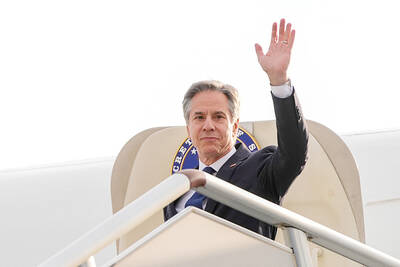
‘IN A DIFFERENT PLACE’: The envoy first visited Shanghai, where he attended a Chinese basketball playoff match, and is to meet top officials in Beijing tomorrow US Secretary of State Antony Blinken yesterday arrived in China on his second visit in a year as the US ramps up pressure on its rival over its support for Russia while also seeking to manage tensions with Beijing. The US diplomat tomorrow is to meet China’s top brass in Beijing, where he is also expected to plead for restraint as Taiwan inaugurates president-elect William Lai (賴清德), and to raise US concerns on Chinese trade practices. However, Blinken is also seeking to stabilize ties, with tensions between the world’s two largest economies easing since his previous visit in June last year. At the

UNSETTLING IMAGES: The scene took place in front of TV crews covering the Trump trial, with a CNN anchor calling it an ‘emotional and unbelievably disturbing moment’ A man who doused himself in an accelerant and set himself on fire outside the courthouse where former US president Donald Trump is on trial has died, police said yesterday. The New York City Police Department (NYPD) said the man was declared dead by staff at an area hospital. The man was in Collect Pond Park at about 1:30pm on Friday when he took out pamphlets espousing conspiracy theories, tossed them around, then doused himself in an accelerant and set himself on fire, officials and witnesses said. A large number of police officers were nearby when it happened. Some officers and bystanders rushed

Beijing is continuing to commit genocide and crimes against humanity against Uyghurs and other Muslim minorities in its western Xinjiang province, U.S. Secretary of State Antony Blinken said in a report published on Monday, ahead of his planned visit to China this week. The State Department’s annual human rights report, which documents abuses recorded all over the world during the previous calendar year, repeated language from previous years on the treatment of Muslims in Xinjiang, but the publication raises the issue ahead of delicate talks, including on the war in Ukraine and global trade, between the top U.S. diplomat and Chinese
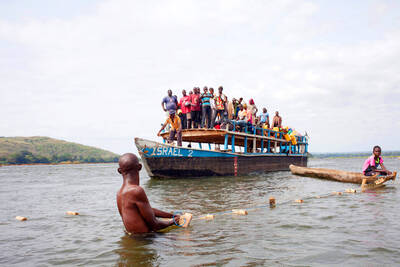
RIVER TRAGEDY: Local fishers and residents helped rescue people after the vessel capsized, while motorbike taxis evacuated some of the injured At least 58 people going to a funeral died after their overloaded river boat capsized in the Central African Republic’s (CAR) capital, Bangui, the head of civil protection said on Saturday. “We were able to extract 58 lifeless bodies,” Thomas Djimasse told Radio Guira. “We don’t know the total number of people who are underwater. According to witnesses and videos on social media, the wooden boat was carrying more than 300 people — some standing and others perched on wooden structures — when it sank on the Mpoko River on Friday. The vessel was heading to the funeral of a village chief in


 RSS
RSS