


One man describes a harrowing dash through a mine field, his pregnant wife in tow, as they raced to escape from the very rebels who were supposed to be protecting them.
Another talks of unmarried pregnant women and unwed mothers, including rape victims, being held in a special prison for adulterers — ostensibly to protect them from relatives bent on redeeming the family’s honor.
The stories, recounted by five Western Saharan refugees on a Moroccan-sponsored trip the US, cast a new spotlight on a largely ignored three-decade-old conflict between the rebel Polisario Front and Morocco over a mineral-rich region to which both lay claim.
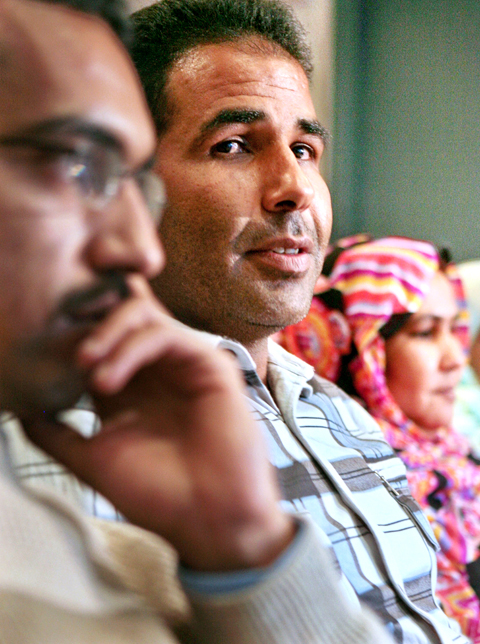
PHOTO: AP
But in a war for independence that has gone largely unnoticed outside of the region, the testimonies also represent the latest salvo in a battle where propaganda increasingly plays a greater role than bullets.
“There is no future under the Polisario. There is no freedom of movement. There is no freedom of speech,” Said Abderahman said in an interview. He is one of the refugees whose trip to the US was sponsored by the lobbying group, Moroccan American Center for Policy.
“If you dare to talk they take you and put you in jail, and they bring you to a public place and they accuse you of being a thief, in front of society,” he said, speaking through a translator provided by Morocco’s UN mission in New York.
Morocco and Mauritania split Western Sahara when Spanish colonizers left the territory in 1975, but a year later they went to war over it. In 1979, Mauritania pulled out and Morocco took over the whole Western Sahara. But fighting continued between the estimated 15,000 Polisario guerrillas and Morocco’s US-equipped army, leaving thousands dead.
A UN-negotiated truce in 1991 called for a referendum on the region’s future, but that vote never happened because the two sides could not agree on voting lists. The stalemate has been monitored by UN peacekeepers.
Over the years, Morocco has pressed the UN and the world community to allow it to annex the territory, promising considerable it autonomy and a share in its mineral wealth. The autonomy offer is backed by the US and France. More than 50 countries, however, recognize the government-in-exile of the Sahrawi Arab Democratic Republic.
In March, the two sides ended a fourth round of talks under UN auspices, blaming each other for their standoff, but agreeing to consider easing restrictions against people traveling by road to visit family in the disputed territory.
Tens of thousands of residents who fled the fighting remain displaced, living in camps in Algeria.

SPEAKING OUT: After Siranudh Scott’s allegations surfaced, celebrities and public figures took to social media to share their own experiences of sexual misconduct and abuse A high-profile alleged sexual abuse case within a wealthy Thai beer brewing family has prompted a wave of painful accounts from survivors of unconnected abuse in the conservative nation. Siranudh Scott, a member of the billionaire Thai family that founded the ubiquitous Singha beer brand, posted an emotional video this month accusing his elder brother Sunit of repeatedly abusing him when he was a teenager. Sunit, who is in his 30s, later denied the allegations in a video posted online, but Singha parent Boonrawd dismissed him from his executive role with the company on Tuesday last week. “I felt I needed to speak

SEEKING ORDER: Rodrigo Paz said that ‘anyone who wants to destroy the nation will have to deal with this president and the full force of the constitution’ Bolivian President Rodrigo Paz on Wednesday said that the nation was at a “breaking point” after nearly a month of protests that have caused shortages of food, fuel and medicine. Paz, who took office six months ago amid the worst economic crisis there in four decades, is battling a groundswell of fury over his policies. The political capital, La Paz, has been besieged by low-income workers and members of the indigenous majority calling for his resignation. “The country needs order and is reaching breaking point,” the 58-year-old said at a public event in La Paz, renewing his appeal for dialogue. On Tuesday, the Bolivian
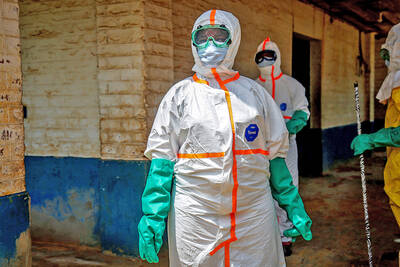
COMMUNITY CONFLICT: Concerns about disease spread from corpses has run up against friends and families’ desire to bury their dead as infection spreads in the area Angry residents of a town at the epicenter of the Ebola outbreak in the Democratic Republic of the Congo (DR Congo) attacked and burned a tent that was part of a health center where people are being treated for the virus, the staff there said Saturday. It was the second such attack in the region in a week. No one was hurt in the attack, according to reports but as patients ran out to escape the fire, 18 people with suspected Ebola infections fled the facility and are unaccounted for, a hospital director said. Angry residents arrived at the clinic in the

Forecasters in Europe yesterday warned of exceptional heat as record temperatures driven by a “heat dome” push temperatures well above seasonal norms across the continent. The surge follows a record-breaking Monday, with France logging its hottest day in the month of May on record, its weather agency said, and the UK also posting unprecedented highs. A so-called “heat dome” of warm air from northern Africa trapped under a high-pressure system over western Europe is behind the high temperatures not usually seen until high summer. Restrictions on outdoor work were imposed in parts of Italy, beaches in southwest France filled earlier than usual and


 RSS
RSS