


Having survived the cyclone, the struggle now is for survival. First there is the scramble for fresh water, with long lines all over Yangon to buy it by the bucketload at three times the price that it was before Cyclone Nargis.
Then there is the hunt for shelter among the debris in a city where more homes are now without roofs than with them, and as desperation grows, there are reports of looting in some markets.
Huge lines snake from those gasoline stations still functioning. Fuel has doubled in price.
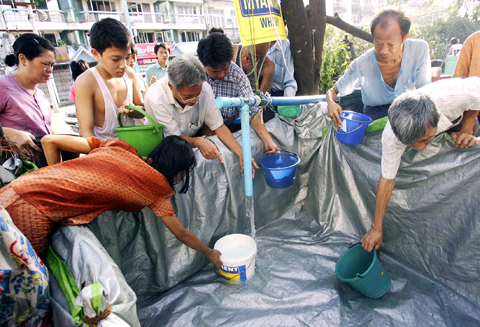
PHOTO: AP
In Shwe Pauk Kan township in Yangon most of the houses have been largely or totally destroyed. People are crammed into the few remaining large buildings, including a school housing 600 children, 450 women and 250 men.
The head, U Maung Maung Aye, opened it to anyone who could make it. He shows off a well and a small generator allowing clean water to be pumped. But without assistance, he said, he didn’t know how long he could feed people.
“I have 1,300 refugees who have lost their homes and have nothing left and needed a place to sleep, gather their small belongings, and a place to dry them. I am providing them with two meals out of the generosity of donors. I have two pregnant ladies and they are soon due,” he said.
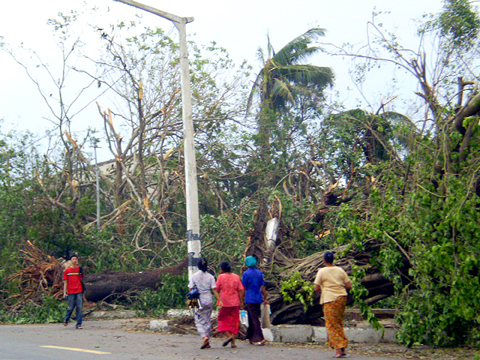
PHOTO: AP
Few were prepared for what happened. The authorities said the cyclone would hit much further north but as the rains intensified, the meteorological department warned that it was changing course and heading for Yangon.
Despite the warning, most people went to bed with little idea of what to expect. By midnight on Friday the 200kph winds were whipping Yangon as the cyclone began its crawl through the city. It was not only the power of the storm that terrified; its staying power was deadly.
It felt like it went on for ever.By Saturday afternoon, when the wind and rain had finally stopped, Yangon was a wreck. 100-year-old trees had been uprooted, lampposts twisted, electricity poles snapped.
The once green city and its magnificent banian and teak trees and mangoes were gone for good. The landscape had been transformed into an unrecognizable gray mess.
Only on Sunday did the police, fire brigade and military start clearing the main roads. Equipped with machetes and small saws, their task looked almost impossible.
Meanwhile, hundreds of Buddhist monks have picked up axes to help residents clear trees and debris, as the nation’s 400,000-strong military is criticized for only belatedly joining the relief effort.
Chunks of roof ripped off homes lie on the pavements, draped by downed power lines.
“We are now relying on monks to clear this road,” said one middle-aged woman who lives in a neighborhood in western Yangon, speaking on condition of anonymity for fear of reprisal from the government.
“Of course we were hoping the authorities would come, but they haven’t shown up yet. These monks came after the storm to help the people to clear the streets and to remove the trees,” she said.
Witnesses say few soldiers or police joined the relief effort, while one embassy worker said there was anger at the slowness of the official response.
“We didn’t see any military at all, just police in armored cars. On Saturday afternoon, we did see some vans, but most of the guys were standing around smoking,” said 32-year-old Pip Paton, who was traveling in Yangon with her family when the cyclone struck.
“Military came out with big chainsaws in one or two areas, but mainly the locals were out chopping up trees themselves,” she said.
“There is comment already on the streets of Yangon about how quick the military were to come out of barracks last year and how slow they seem to be this year with these events,” Sean Turnell, a Myanmar analyst at Macquarie University in Australia, said in Bangkok.
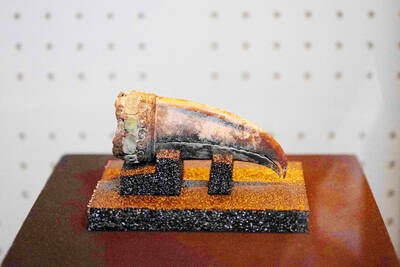
Archeologists in Peru on Thursday said they found the 5,000-year-old remains of a noblewoman at the sacred city of Caral, revealing the important role played by women in the oldest center of civilization in the Americas. “What has been discovered corresponds to a woman who apparently had elevated status, an elite woman,” archeologist David Palomino said. The mummy was found in Aspero, a sacred site within the city of Caral that was a garbage dump for more than 30 years until becoming an archeological site in the 1990s. Palomino said the carefully preserved remains, dating to 3,000BC, contained skin, part of the

TRUMP EFFECT: The win capped one of the most dramatic turnarounds in Canadian political history after the Conservatives had led the Liberals by more than 20 points Canadian Prime Minister Mark Carney yesterday pledged to win US President Donald Trump’s trade war after winning Canada’s election and leading his Liberal Party to another term in power. Following a campaign dominated by Trump’s tariffs and annexation threats, Carney promised to chart “a new path forward” in a world “fundamentally changed” by a US that is newly hostile to free trade. “We are over the shock of the American betrayal, but we should never forget the lessons,” said Carney, who led the central banks of Canada and the UK before entering politics earlier this year. “We will win this trade war and

‘WATER WARFARE’: A Pakistani official called India’s suspension of a 65-year-old treaty on the sharing of waters from the Indus River ‘a cowardly, illegal move’ Pakistan yesterday canceled visas for Indian nationals, closed its airspace for all Indian-owned or operated airlines, and suspended all trade with India, including to and from any third country. The retaliatory measures follow India’s decision to suspend visas for Pakistani nationals in the aftermath of a deadly attack by shooters in Kashmir that killed 26 people, mostly tourists. The rare attack on civilians shocked and outraged India and prompted calls for action against their country’s archenemy, Pakistan. New Delhi did not publicly produce evidence connecting the attack to its neighbor, but said it had “cross-border” links to Pakistan. Pakistan denied any connection to

Armed with 4,000 eggs and a truckload of sugar and cream, French pastry chefs on Wednesday completed a 121.8m-long strawberry cake that they have claimed is the world’s longest ever made. Youssef El Gatou brought together 20 chefs to make the 1.2 tonne masterpiece that took a week to complete and was set out on tables in an ice rink in the Paris suburb town of Argenteuil for residents to inspect. The effort overtook a 100.48m-long strawberry cake made in the Italian town of San Mauro Torinese in 2019. El Gatou’s cake also used 350kg of strawberries, 150kg of sugar and 415kg of


 RSS
RSS