


It took just minutes for the blaze at a mattress factory in the Moroccan city of Casablanca to turn into an inferno, killing 55 people who could not jump from the windows to safety.
Another 12 people were seriously injured in the fire, the city’s deadliest, which apparently broke out on the ground floor of the factory in Lissasfa industrial district of southwest Casablanca.
“I was working on the first floor as an upholsterer. The smoke came up from the ground floor where the foam rubber, wood and glue are stored,” Omar Elaaz, 20, said in a city hospital.
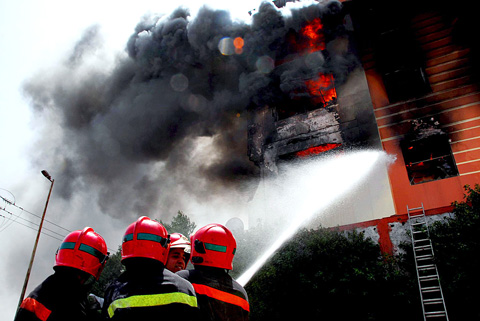
PHOTO: EPA
“I used a gas bottle to break the wire mesh that protects every window,” he said.
Witnesses said the four-story Rosamor Furniture plant looked like a deadly prison, especially for the female workers trapped inside who did not dare jump from the upper floors.
“I jumped from the third floor with four other colleagues while the women, who didn’t dare to follow us, perished in the inferno,” said 31-year-old upholsterer Hakim Hakki from his hospital bed.
“God saved me but I’ll never forget those who died,” he said.
Thirty-five women were among the dead, a forensic police officer said, adding “we’ll need DNA tests to identify the many charred bodies.”
Another survivor, Ismail Benaahel, 19, recalled his desperate attempts and those of his colleagues to try and escape the suffocating smoke and fire.
“With a few girls, we climbed to the fourth floor to escape from the smoke and the horrible smell but there was no emergency exit,” he said. “They didn’t dare move. I went down again to the second [floor] and grabbed an empty extinguisher to smash the window.”
About 100 people were working at the plant on Saturday morning and “the people who died were either asphyxiated or burned,” a firefighter said.
After the blaze died down, veiled women from the slums and surrounding countryside gathered weeping in front of the gutted building which stank of chemicals and charred bodies.
Authorities are expected to question the plant’s owner and his manager son about the blaze as prosecutors opened an investigation into the cause.
Both survivors and relatives of the victims denounced the working conditions and lack of safety measures in the factory.
“The owner was more worried about protecting his mattresses and his material than the lives of his workers,” sobbed Fawza Badr, 70, who lost her 20-year-old daughter Hadida.
The father of Abdelazziz Darif, 19, who died in the blaze, said his son “was paid the meager sum of 250 dirhams [US$34] a week and had no social cover.”
Former employee Fadila Khadija, 28, said that “there was no emergency exit, the extinguishers were empty and the working conditions were difficult.”
Moroccan King Mohammed VI ordered the authorities “to take all necessary measures to help the victims,” including mobilizing burn units at hospitals nationwide.
The elite military hospital in Rabat was one of the hospitals to lend a hand.
Moroccan Interior Minister Chakib Benmoussa, at the scene, called the inferno “catastrophic” and promised an “in-depth and transparent inquiry.”
He said prosecutors had asked the judicial police to look into “the circumstances of this disaster and to examine the working conditions [at the plant] with a view to establishing responsibility.”

SPEAKING OUT: After Siranudh Scott’s allegations surfaced, celebrities and public figures took to social media to share their own experiences of sexual misconduct and abuse A high-profile alleged sexual abuse case within a wealthy Thai beer brewing family has prompted a wave of painful accounts from survivors of unconnected abuse in the conservative nation. Siranudh Scott, a member of the billionaire Thai family that founded the ubiquitous Singha beer brand, posted an emotional video this month accusing his elder brother Sunit of repeatedly abusing him when he was a teenager. Sunit, who is in his 30s, later denied the allegations in a video posted online, but Singha parent Boonrawd dismissed him from his executive role with the company on Tuesday last week. “I felt I needed to speak

SEEKING ORDER: Rodrigo Paz said that ‘anyone who wants to destroy the nation will have to deal with this president and the full force of the constitution’ Bolivian President Rodrigo Paz on Wednesday said that the nation was at a “breaking point” after nearly a month of protests that have caused shortages of food, fuel and medicine. Paz, who took office six months ago amid the worst economic crisis there in four decades, is battling a groundswell of fury over his policies. The political capital, La Paz, has been besieged by low-income workers and members of the indigenous majority calling for his resignation. “The country needs order and is reaching breaking point,” the 58-year-old said at a public event in La Paz, renewing his appeal for dialogue. On Tuesday, the Bolivian
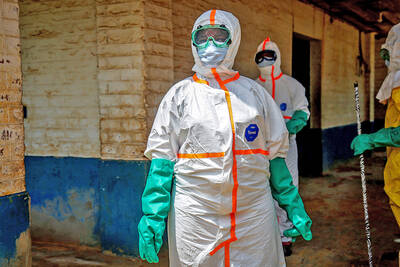
COMMUNITY CONFLICT: Concerns about disease spread from corpses has run up against friends and families’ desire to bury their dead as infection spreads in the area Angry residents of a town at the epicenter of the Ebola outbreak in the Democratic Republic of the Congo (DR Congo) attacked and burned a tent that was part of a health center where people are being treated for the virus, the staff there said Saturday. It was the second such attack in the region in a week. No one was hurt in the attack, according to reports but as patients ran out to escape the fire, 18 people with suspected Ebola infections fled the facility and are unaccounted for, a hospital director said. Angry residents arrived at the clinic in the

Forecasters in Europe yesterday warned of exceptional heat as record temperatures driven by a “heat dome” push temperatures well above seasonal norms across the continent. The surge follows a record-breaking Monday, with France logging its hottest day in the month of May on record, its weather agency said, and the UK also posting unprecedented highs. A so-called “heat dome” of warm air from northern Africa trapped under a high-pressure system over western Europe is behind the high temperatures not usually seen until high summer. Restrictions on outdoor work were imposed in parts of Italy, beaches in southwest France filled earlier than usual and


 RSS
RSS