


It’s the butt of jokes and the source of choice curses, but the donkey is an integral part of Mediterranean culture, and friends on Cyprus are working to protect one of the world’s last wild colonies from extinction.
Using a Facebook group and e-mail, hundreds of young Turkish Cypriots and a handful of Greek Cypriots have mobilized to “Save the Cyprus Donkey” after 10 of the rare brown animals were found shot dead at the end of last month.
“The enemy of nature is the enemy of humans,” read a banner unfurled by a small group of demonstrators at a sandy beach near Rizokarpaso village on the panhandle of Cyprus that has for decades been a donkey sanctuary.
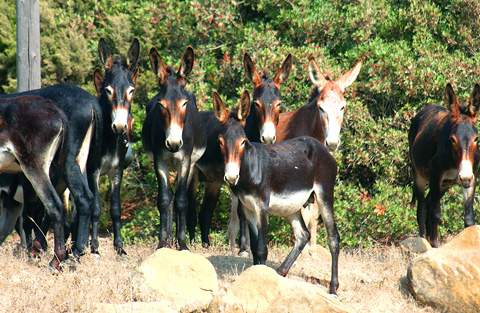
PHOTO: AFP
Deniz Direkci, a 20-year-old primary school employee who addressed the rally, said the main suspects in the unsolved donkey deaths were farmers angered by crop damage.
But fingers have also been pointed at hunters and developers eager to exploit the Karpas peninsula, one of the last unspoilt parts of a holiday island where construction is booming on both sides of a UN-patrolled Green Line.
The phenomenon is mirrored on the northwest coast’s Akamas peninsula, where plans for a national park are under threat and farmers have shot a number of mouflons, protected wild sheep.
As a group of donkeys kept their distance on a hillside above the dunes, Aysun Yucel, 19, a law student from north Nicosia, was saddened and baffled by the killings.
“It’s so cruel. We used to come here for summer vacations and you would hear the donkeys passing by your bungalow as you slept. Now it’s sad, that doesn’t happen any more,” Yucel said.
Ironically, the Karpas donkey colony is a legacy of the 1974 Turkish invasion of the island’s northern third. The vast majority of the area’s Greek Cypriot farmers fled south during the fighting, abandoning their animals.
And as agriculture declined amid the growing urbanization, the “liberated” donkeys were replaced by tractors, pickups and SUVs.
A 2003 study found that about 800 donkeys were roaming the olive orchards, wheat fields and along the beaches of the rugged Karpas landscape.
As some 15 vehicles with peaceful eco-warriors formed a funeral procession to drive 50km to the site of the demonstration, farmers on tractors looked on bemused and little girls along the roadside sold posies of wild flowers to the mourners.
Police were out in force, preventing non-Turkish Cypriots from playing any vocal part in the rally.
Writer and poet Jenan Selchuk said it was not just about donkeys, it was about preserving traditions and a way of life.
“They are bringing big electricity lines to the area, over which we have also held protests. They have development plans for luxury villas rather than any national park idea. As for the donkeys, they are seen as an obstacle to progress,” he said.
Antique dealer Tanju Nasir said the authorities were short-sighted in failing to protect the donkey “which is a symbol of the island and a tourism draw.”
Only half in jest, Tony Angastiniotis, a Greek documentary filmmaker, says an intercommunal effort to preserve an ancient way of life could even help resolve the island’s decades-old division.
“Maybe the donkeys will be the way to peace. They are the only true Cypriots anyway,” he said.
Iraqi poet and philosopher Raad Abdul Jawad also bemoans the fate of donkeys abandoned to their fate along the Turkish-Iraqi border and in mountains between Ras al-Khaimah and Fujairah in the United Arab Emirates.
He warns they are growing “rarer and rarer,” having been overtaken by modern life.
Yet “the donkey held the fundamental key to building civilization, carrying water and food, and construction materials, whereas the horse was used for killing,” he said.
Often referred to jokingly as “the sheikh of donkeys,” Abdul Jawad aims to raise funds to build a regional organization to protect the species.
The idea would be to build on the success of an association in Egypt and groups such as the Donkey Party in Iraqi Kurdistan.
“But it will not be easy; too many people laugh at the idea,” he said.

As the sun sets on another scorching Yangon day, the hot and bothered descend on the Myanmar city’s parks, the coolest place to spend an evening during yet another power blackout. A wave of exceptionally hot weather has blasted Southeast Asia this week, sending the mercury to 45°C and prompting thousands of schools to suspend in-person classes. Even before the chaos and conflict unleashed by the military’s 2021 coup, Myanmar’s creaky and outdated electricity grid struggled to keep fans whirling and air conditioners humming during the hot season. Now, infrastructure attacks and dwindling offshore gas reserves mean those who cannot afford expensive diesel

Does Argentine President Javier Milei communicate with a ghost dog whose death he refuses to accept? Forced to respond to questions about his mental health, the president’s office has lashed out at “disrespectful” speculation. Twice this week, presidential spokesman Manuel Adorni was asked about Milei’s English Mastiff, Conan, said to have died seven years ago. Milei, 53, had Conan cloned, and today is believed to own four copies he refers to as “four-legged children.” Or is it five? In an interview with CNN this month, Milei referred to his five dogs, whose faces and names he had engraved on the presidential baton. Conan,

French singer Kendji Girac, who was seriously injured by a gunshot this week, wanted to “fake” his suicide to scare his partner who was threatening to leave him, prosecutors said on Thursday. The 27-year-old former winner of France’s version of The Voice was found wounded after police were called to a traveler camp in Biscarrosse on France’s southwestern coast. Girac told first responders he had accidentally shot himself while tinkering with a Colt .45 automatic pistol he had bought at a junk shop, a source said. On Thursday, regional prosecutor Olivier Janson said, citing the singer, that he wanted to “fake” his suicide
Indian Prime Minister Narendra Modi reaffirmed his pledge to replace India’s religion-based marriage and inheritance laws with a uniform civil code if he returns to office for a third term, a move that some minority groups have opposed. In an interview with the Times of India listing his agenda, Modi said his government would push for making the code a reality. “It is clear that separate laws for communities are detrimental to the health of society,” he said in the interview published yesterday. “We cannot be a nation where one community is progressing with the support of the Constitution while the other


 RSS
RSS