


Every evening Roya Amin sits down with her husband and two-year-old daughter in front of the television and they sigh in relief when their favorite Indian soap opera starts.
Indian dramas are wildly popular among Afghans, but the government is trying to ban them as “un-Islamic” and for interfering with children’s schoolwork — a sign of growing tensions between religious conservatives and liberals in the post-Taliban era.
The Ministry of Information and Culture delivered written orders to four TV stations to take five Indian soaps off the air by April 14. Only Noorin TV suspended its soap, Waiting, so the ministry issued a second deadline that ended on Tuesday.
Then Ariana TV caved in after the second letter, ending broadcasts of Kum Kum, a drama about the tangled love life of a widow who is wooed by her childhood sweetheart but ends up taking her dead husband’s brother as her second husband.
The ministry is now threatening legal action against the other networks who accuse the democratic government of trying to re-Talibanize Afghanistan.
“We think broadcasting Indian serials is in accordance with the law, so we will continue to broadcast them,” said Saad Mohseni, the owner of Tolo TV. “Millions of people watch these shows every night.”
The Indian series have become prime-time favorites since private TV stations flourished during the six years after the fall of the hard-line Taliban regime, which had banned TV altogether.
But religious conservatives often bristle over the content, complaining about female news announcers and music videos of women singers.
Last month, Tolo TV came under fire for airing a dance number featuring men and women together.
At the same time, the ministry and other conservatives in the government came down on the soaps — citing a ruling from the Council of Clerics, known as the Ulema.
“The Ulema Council has emphasized that it is against Afghan culture and it’s un-Islamic,” said Ali Ahmad Fakor, deputy director of the commission for media law violations, which took part in a meeting with the clerics and the ministry about the Indian soaps.
Fakor said Afghans could be corrupted by scenes showing Hindu idols and plots involving women who divorce and remarry.
Fakor said the commission has received hundreds of phone calls from parents complaining that their children are wasting their time on TV.
“We are against Talibanization, but as an Islamic country it is our obligation to prevent such programs that keep our children from their studies,” he said.
Afghani Information Ministry spokesman Hameed Nasery warned that networks that resisted its orders would be taken to court.
But Tolo TV — which has been ordered to stop showing two soaps — was still airing them on Tuesday.
Mohseni said Afghans have been avid viewers of Indian entertainment for decades. A handful of people complaining is not a good gauge of public opinion, he said.
“We are seeing the re-Talibanization of Afghanistan ... We can feel it, we can smell it, we can taste it. The mood in the government is changing,” Mohseni said.
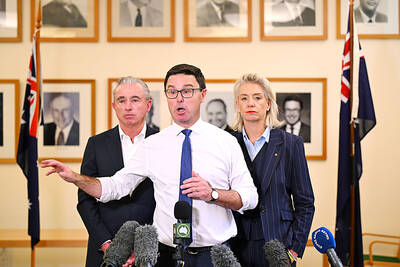
BACKLASH: The National Party quit its decades-long partnership with the Liberal Party after their election loss to center-left Labor, which won a historic third term Australia’s National Party has split from its conservative coalition partner of more than 60 years, the Liberal Party, citing policy differences over renewable energy and after a resounding loss at a national election this month. “Its time to have a break,” Nationals leader David Littleproud told reporters yesterday. The split shows the pressure on Australia’s conservative parties after Prime Minister Anthony Albanese’s center-left Labor party won a historic second term in the May 3 election, powered by a voter backlash against US President Donald Trump’s policies. Under the long-standing partnership in state and federal politics, the Liberal and National coalition had shared power

CONTROVERSY: During the performance of Israel’s entrant Yuval Raphael’s song ‘New Day Will Rise,’ loud whistles were heard and two people tried to get on stage Austria’s JJ yesterday won the Eurovision Song Contest, with his operatic song Wasted Love triumphing at the world’s biggest live music television event. After votes from national juries around Europe and viewers from across the continent and beyond, JJ gave Austria its first victory since bearded drag performer Conchita Wurst’s 2014 triumph. After the nail-biting drama as the votes were revealed running into yesterday morning, Austria finished with 436 points, ahead of Israel — whose participation drew protests — on 357 and Estonia on 356. “Thank you to you, Europe, for making my dreams come true,” 24-year-old countertenor JJ, whose

NO EXCUSES: Marcos said his administration was acting on voters’ demands, but an academic said the move was emotionally motivated after a poor midterm showing Philippine President Ferdinand Marcos Jr yesterday sought the resignation of all his Cabinet secretaries, in a move seen as an attempt to reset the political agenda and assert his authority over the second half of his single six-year term. The order came after the president’s allies failed to win a majority of Senate seats contested in the 12 polls on Monday last week, leaving Marcos facing a divided political and legislative landscape that could thwart his attempts to have an ally succeed him in 2028. “He’s talking to the people, trying to salvage whatever political capital he has left. I think it’s

A documentary whose main subject, 25-year-old photojournalist Fatima Hassouna, was killed in an Israeli airstrike in Gaza weeks before it premiered at Cannes stunned viewers into silence at the festival on Thursday. As the cinema lights came back on, filmmaker Sepideh Farsi held up an image of the young Palestinian woman killed with younger siblings on April 16, and encouraged the audience to stand up and clap to pay tribute. “To kill a child, to kill a photographer is unacceptable,” Farsi said. “There are still children to save. It must be done fast,” the exiled Iranian filmmaker added. With Israel


 RSS
RSS