


Short-term exposure to smog, or ozone, is clearly linked to premature deaths that should be taken into account when measuring the health benefits of reducing air pollution, a National Academy of Sciences review said.
The findings contradict arguments made by White House officials that the connection between smog and premature death is not clear and that the number of saved lives should not be calculated in determining clean air benefits.
The report released yesterday by a panel of the academy’s National Research Council said that government “should give little or no weight” to such arguments.
“The committee has concluded from its review of health-based evidence that short-term exposure to ambient ozone is likely to contribute to premature deaths,” the 13-member panel said.
It said that “studies have yielded strong evidence that short-term exposure to ozone can exacerbate lung conditions, causing illness and hospitalization and can potentially lead to death.”
The panel examined short-term exposure — up to 24 hours — to high levels of ozone, but said more studies were needed on long-term chronic exposure where the risk of premature death “may be larger than those observed in acute effects studies alone.”
Ground-level ozone is formed from nitrogen oxide and organic compounds created by burning fossil fuels and is demonstrated often by the yellow haze or smog that lingers in the air. Ozone exposure is a leading cause of respiratory illnesses and especially affects the elderly, those with respiratory problems and children.
While premature deaths from ozone exposure is greater among individuals with lung and heart disease, the report said such deaths are not restricted to people who are at a high risk of death within a few days.
The scientists said they could not determine, based on a review of health studies, whether there is a threshold below which no fatalities can be assured from ozone exposure. If there is such a point, it is below the ozone levels allowed for public health.
Environmentalists and health advocates have argued that a string of health studies and surveys show that exposure to smoggy air not only aggravates respiratory problems, but annually causes thousands of deaths.
But in a number of instances the US Environmental Protection Agency and the White House Office of Management and Budget (OMB), which reviews regulations, have been at odds over the certainty of a link.
The academy’s report “could have important consequences” on such future disputes, said attorney Vicky Patton of the advocacy group Environmental Defense.
She said the OMB in a number of air pollution regulations has sought to minimize the link between pollution and premature deaths, resulting in a lower calculation of health benefits from pollution reductions.

Former Nicaraguan president Violeta Chamorro, who brought peace to Nicaragua after years of war and was the first woman elected president in the Americas, died on Saturday at the age of 95, her family said. Chamorro, who ruled the poor Central American country from 1990 to 1997, “died in peace, surrounded by the affection and love of her children,” said a statement issued by her four children. As president, Chamorro ended a civil war that had raged for much of the 1980s as US-backed rebels known as the “Contras” fought the leftist Sandinista government. That conflict made Nicaragua one of
COMPETITION: The US and Russia make up about 90 percent of the world stockpile and are adding new versions, while China’s nuclear force is steadily rising, SIPRI said Most of the world’s nuclear-armed states continued to modernize their arsenals last year, setting the stage for a new nuclear arms race, the Stockholm International Peace Research Institute (SIPRI) said yesterday. Nuclear powers including the US and Russia — which account for about 90 percent of the world’s stockpile — had spent time last year “upgrading existing weapons and adding newer versions,” researchers said. Since the end of the Cold War, old warheads have generally been dismantled quicker than new ones have been deployed, resulting in a decrease in the overall number of warheads. However, SIPRI said that the trend was likely

NUCLEAR WARNING: Elites are carelessly fomenting fear and tensions between nuclear powers, perhaps because they have access to shelters, Tulsi Gabbard said After a trip to Hiroshima, US Director of National Intelligence Tulsi Gabbard on Tuesday warned that “warmongers” were pushing the world to the brink of nuclear war. Gabbard did not specify her concerns. Gabbard posted on social media a video of grisly footage from the world’s first nuclear attack and of her staring reflectively at the Hiroshima Peace Memorial. On Aug. 6, 1945, the US obliterated Hiroshima, killing 140,000 people in the explosion and by the end of the year from the uranium bomb’s effects. Three days later, a US plane dropped a plutonium bomb on Nagasaki, leaving abut 74,000 people dead by the
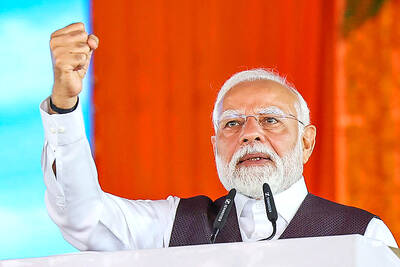
Indian Prime Minister Narendra Modi is to visit Canada next week, his first since relations plummeted after the assassination of a Canadian Sikh separatist in Vancouver, triggering diplomatic expulsions and hitting trade. Analysts hope it is a step toward repairing ties that soured in 2023, after then-Canadian prime minister Justin Trudeau pointed the finger at New Delhi’s involvement in murdering Hardeep Singh Nijjar, claims India furiously denied. An invitation extended by new Canadian Prime Minister Mark Carney to Modi to attend the G7 leaders summit in Canada offers a chance to “reset” relations, former Indian diplomat Harsh Vardhan Shringla said. “This is a


 RSS
RSS