


Myanmar's junta chief insisted yesterday that he is not power hungry and intended to hand control of the government to the winners of elections in 2010.
Senior General Than Shwe made the comments in a nationally televised speech to mark Armed Forces Day, an annual holiday that celebrates the military's might.
Foreign media were denied visas to cover this year's event, which falls on the six-month anniversary of the junta's deadly crackdown on Buddhist monks and pro-democracy protesters.
The September crackdown sparked global outcry and revived demands for the junta, which has been in power since 1988, to make democratic reforms.
During a 15-minute speech, Than Shwe made several references to the junta's announcement last month that it would hold a constitutional referendum later this year, followed by a long-awaited general election in 2010. The junta calls the process its "roadmap to democracy."
"The draft constitution has been completed and the constitutional referendum will be held in May," Than Shwe said, speaking in a weak voice under the glaring tropical sun. "Handing over of state power can be done after multiparty elections ... in 2010."
The 75-year-old Than Shwe did not address rumors of his declining health, although he appeared steady as he stood inside a moving convertible to review 13,000 troops assembled at a massive parade ground in Naypyitaw, the remote administrative capital the junta relocated government offices to in 2005.
He said the junta has "a sincere aim for developing the country without any cravings for power," and he called on his troops to ensure a smooth transition when it comes time for a transfer of power.
He also urged the armed forces to "join hands with the people to crush internal and external destructive elements sabotaging stability and progress of the state."
The gathering included the military's top brass, diplomats and local journalists.
Critics have denounced the junta's draft constitution as designed to cement military rule.
The drafting process did not include detained opposition leader Aung San Suu Kyi, who is often accused by the junta of trying to destabilize the country, an accusation also directed at Western nations
The military seized power in 1962, ending an experiment in democracy and leading the resource-rich nation toward isolation and economic ruin.
The current junta took power in 1988 after brutally crushing a pro-democracy uprising. Two years later it refused to hand over power when Aung San Suu Kyi's National League for Democracy won a landslide election victory.
Armed Forces Day is held every March 27 to commemorate the day in 1945 when the Myanmar army rose up against Japanese occupation forces.
Initially called Resistance Day, the name was dropped in 1974 to avoid offending Japan -- Myanmar's top aid donor in the 1970s.
In recent years, the commemoration speeches have refrained from mentioning the fight against the Japanese.
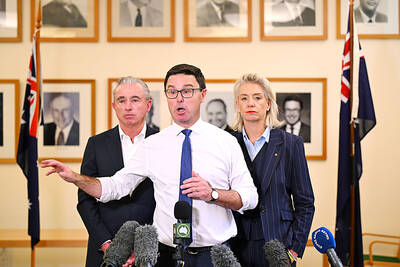
BACKLASH: The National Party quit its decades-long partnership with the Liberal Party after their election loss to center-left Labor, which won a historic third term Australia’s National Party has split from its conservative coalition partner of more than 60 years, the Liberal Party, citing policy differences over renewable energy and after a resounding loss at a national election this month. “Its time to have a break,” Nationals leader David Littleproud told reporters yesterday. The split shows the pressure on Australia’s conservative parties after Prime Minister Anthony Albanese’s center-left Labor party won a historic second term in the May 3 election, powered by a voter backlash against US President Donald Trump’s policies. Under the long-standing partnership in state and federal politics, the Liberal and National coalition had shared power

A Croatian town has come up with a novel solution to solve the issue of working parents when there are no public childcare spaces available: pay grandparents to do it. Samobor, near the capital, Zagreb, has become the first in the country to run a “Grandmother-Grandfather Service,” which pays 360 euros (US$400) a month per child. The scheme allows grandparents to top up their pension, but the authorities also hope it will boost family ties and tackle social isolation as the population ages. “The benefits are multiple,” Samobor Mayor Petra Skrobot told reporters. “Pensions are rather low and for parents it is sometimes

CONTROVERSY: During the performance of Israel’s entrant Yuval Raphael’s song ‘New Day Will Rise,’ loud whistles were heard and two people tried to get on stage Austria’s JJ yesterday won the Eurovision Song Contest, with his operatic song Wasted Love triumphing at the world’s biggest live music television event. After votes from national juries around Europe and viewers from across the continent and beyond, JJ gave Austria its first victory since bearded drag performer Conchita Wurst’s 2014 triumph. After the nail-biting drama as the votes were revealed running into yesterday morning, Austria finished with 436 points, ahead of Israel — whose participation drew protests — on 357 and Estonia on 356. “Thank you to you, Europe, for making my dreams come true,” 24-year-old countertenor JJ, whose

A documentary whose main subject, 25-year-old photojournalist Fatima Hassouna, was killed in an Israeli airstrike in Gaza weeks before it premiered at Cannes stunned viewers into silence at the festival on Thursday. As the cinema lights came back on, filmmaker Sepideh Farsi held up an image of the young Palestinian woman killed with younger siblings on April 16, and encouraged the audience to stand up and clap to pay tribute. “To kill a child, to kill a photographer is unacceptable,” Farsi said. “There are still children to save. It must be done fast,” the exiled Iranian filmmaker added. With Israel


 RSS
RSS