


Sitting in his office beneath a portrait of himself, Zimbabwean President Robert Mugabe cut a lonely, pitiful figure in his first in-depth interview in nearly 30 years, moved to tears at the memory of his lamented friendship with Britain's Queen Elizabeth. Moments later, however, his eyes sparked with anger, betraying his vengeful nature.
The 84-year-old Mugabe was talking to author Heidi Holland and her resulting "psycho-biography" depicts a deluded leader who still has the power to bring everything right for his country -- on condition that he gets a phone call from Downing Street.
"His issue is with Britain," said Holland, whose book, Dinner With Mugabe, has just been published by Penguin South Africa. "Even today, he sees the white farmers as British. Given the history and the behavior of Britain, there is logic -- a twisted logic -- to his thinking. It's all very well for Britain to say he is beneath contempt. But it is they who have to talk to him if the crisis is to end."
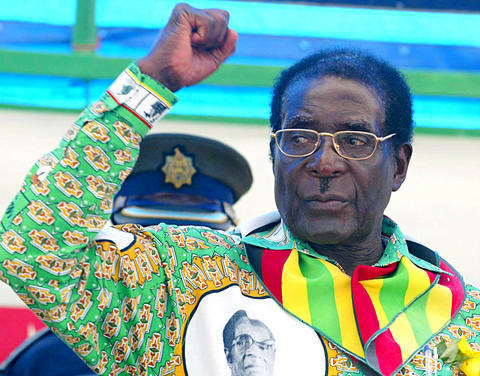
PHOTO: EPA
Holland, a white Zimbabwean living in South Africa, spent 18 months lobbying for the interview, which she finally obtained in December thanks to a Roman Catholic priest close to Mugabe.
"I had been waiting in Harare for five weeks and had been vetted and grilled. In the end I received a call telling me I should be at State House in half an hour. I arrived at 10am and three hours later His Excellency -- `HE' as everyone calls him -- received me," she said.
Holland's only previous meeting with Mugabe was in 1975 when she cooked chicken for him at a clandestine dinner in Salisbury (now Harare). When he left her house, it was to go to Mozambique to lead guerrillas fighting Rhodesian white rule. He became prime minister in 1980.
"I think meeting me [again] was a searing experience for him. He is a loner with no friends who has constructed a bubble around himself because he does not want to confront his failure," she said.
For the entire two-and-a-half hour interview, Mugabe sat behind his desk on a swivel chair.
"There are comfy chairs in the office, but he preferred the safety of his desk," she said.
To write her book, which includes interviews with British and Zimbabwean friends and foes of the president, Holland sought the help of three psychologists.
"I needed help to understand how events in Mugabe's life, including his childhood, had impacted on his internal narrative," she said.
By the age of 10 his father had left the family home and his older brother had died. It was a joyless childhood, cut short.
"Mugabe has a thin skin and a shaky self-image. He has unrealistic expectations of people. When he is rejected or humiliated, he turns to revenge. His relationship with the British government has the intensity of a family feud," she said.
Holland saw evidence of Mugabe's ire whenever her questioning hit on controversial subjects such as the Gukurahundi (the killing of up to 30,000 Ndebeles in the 1980s).
"Gukurahundi, what was it? You had a party with a guerrilla force that wanted to reverse democracy. And action was taken. And yes, there might have been excesses, on both sides. There is no regret about the fact that we had to defend the country. But excess, where it happened, yes. Any death that should not have happened is a cause for regret," Mugabe said.
Some interviewees told Holland that the land invasions that began in 2000 and have deprived hundreds of whites of their farms may have been initially supported by Mugabe but got out of hand.
"He denies this, of course," Holland said. "But what is most interesting is that ... he really thought the British government would do something."
But Britain, under former prime minister Tony Blair, proved the equivalent of a disappointing parent, quick to scold and unwilling to listen. When the Labour government made it clear it felt no obligation to subsidize further programs of land acquisition because previous compensation had been misused, Mugabe went ballistic.
"He was nearly crying when he told me that Blair `even poisoned Prince Charles and the Queen against me,'" Holland said.
"I think he granted me the interview because he feels he is getting old and it's time to put certain things on the record. But he expects to win the election and probably will," she said.
Asked how he would like to be remembered, Mugabe told Holland: "Just as the son of a peasant family who, alongside others, felt he had a responsibility to fight for his country and was grateful for the honor that the people gave him in leading them to victory over British imperialism."
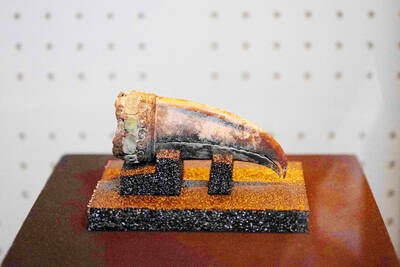
Archeologists in Peru on Thursday said they found the 5,000-year-old remains of a noblewoman at the sacred city of Caral, revealing the important role played by women in the oldest center of civilization in the Americas. “What has been discovered corresponds to a woman who apparently had elevated status, an elite woman,” archeologist David Palomino said. The mummy was found in Aspero, a sacred site within the city of Caral that was a garbage dump for more than 30 years until becoming an archeological site in the 1990s. Palomino said the carefully preserved remains, dating to 3,000BC, contained skin, part of the

TRUMP EFFECT: The win capped one of the most dramatic turnarounds in Canadian political history after the Conservatives had led the Liberals by more than 20 points Canadian Prime Minister Mark Carney yesterday pledged to win US President Donald Trump’s trade war after winning Canada’s election and leading his Liberal Party to another term in power. Following a campaign dominated by Trump’s tariffs and annexation threats, Carney promised to chart “a new path forward” in a world “fundamentally changed” by a US that is newly hostile to free trade. “We are over the shock of the American betrayal, but we should never forget the lessons,” said Carney, who led the central banks of Canada and the UK before entering politics earlier this year. “We will win this trade war and

‘BODIES EVERYWHERE’: The incident occurred at a Filipino festival celebrating an anti-colonial leader, with the driver described as a ‘lone suspect’ known to police Canadian police arrested a man on Saturday after a car plowed into a street party in the western Canadian city of Vancouver, killing a number of people. Authorities said the incident happened shortly after 8pm in Vancouver’s Sunset on Fraser neighborhood as members of the Filipino community gathered to celebrate Lapu Lapu Day. The festival, which commemorates a Filipino anti-colonial leader from the 16th century, falls this year on the weekend before Canada’s election. A 30-year-old local man was arrested at the scene, Vancouver police wrote on X. The driver was a “lone suspect” known to police, a police spokesperson told journalists at the

North Korean leader Kim Jong-un has unveiled a new naval destroyer, claiming it as a significant advancement toward his goal of expanding the operational range and preemptive strike capabilities of his nuclear-armed military, state media said yesterday. North Korea’s state-run Korean Central News Agency (KCNA) said Kim attended the launching ceremony for the 5,000-tonne warship on Friday at the western port of Nampo. Kim framed the arms buildup as a response to perceived threats from the US and its allies in Asia, who have been expanding joint military exercises amid rising tensions over the North’s nuclear program. He added that the acquisition


 RSS
RSS