


The flagship newspaper of the Chinese Communist Party called yesterday for efforts to "resolutely crush" anti-government protests by Tibetans, while US presidential hopeful John McCain criticized Beijing's actions as "not acceptable."
McCain's comments added to a rising international chorus of concern over Beijing's crackdown -- criticisms that Beijing has met with its own campaign to portray the protests as having been instigated by supporters of the exiled Tibetan leader, the Dalai Lama.
Meanwhile, Beijing's official death toll from the rioting in the Tibetan capital of Lhasa rose to 22, with Xinhua news agency reporting that five more civilians and a police officer died. The Dalai Lama's government-in-exile has said 99 Tibetans have been killed -- 80 in Lhasa and 19 in Gansu Province.
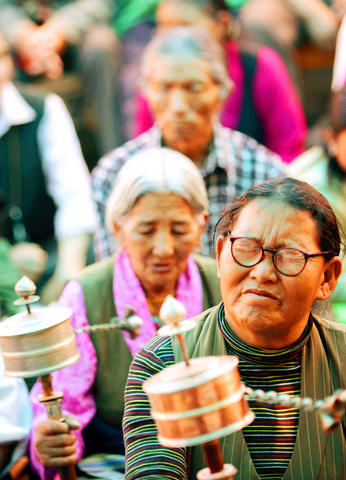
PHOTO: AP
The protests, which started in Lhasa on the March 10 anniversary of a failed uprising against Chinese rule, turned violent four days later and touched off demonstrations among Tibetans in three other provinces. It has become the largest challenge to China's control of Tibet since the 1959 uprising.
Beijing has responded by smothering Tibetan areas with troops and publishing a "most wanted" list of 21 protesters, appealing to people to turn them in.
"We must see through the secessionist forces' evil intentions, uphold the banner of maintaining social stability ... and resolutely crush the `Tibet independence' forces' conspiracy," the People's Daily said in an editorial.
During a visit to Paris on Friday, McCain said China's crackdown "is not correct" and, after a meeting with French President Nicolas Sarkozy, expressed hope Beijing would seek a peaceful resolution.
"The people there are being subjected to mistreatment that is not acceptable with the conduct of a world power, which China is," McCain said in response to a question by a Chinese reporter.
"There must be respect for human rights, and I would hope that the Chinese are actively seeking a peaceful resolution to this situation that exists which harms not only the human rights of the people there but also the image of China in the world," he said.
The crackdown has drawn attention to China's human rights record, threatening to overshadow Beijing's attempts to project an image of unity and prosperity ahead of the Aug. 8 to Aug. 24 Olympics.
On Friday, US Speaker of the House of Representatives Nancy Pelosi lent her support to the Tibetan cause on a visit to the Dalai Lama at his headquarters in India, calling China's crackdown "a challenge to the conscience of the world."
Pelosi, long a fierce critic of China, called for an investigation and dismissed Beijing's claim that the Dalai Lama was behind the fighting as making "no sense."
The Dalai Lama, who received the 1989 Nobel Peace Prize, says he does not seek independence but wants genuine autonomy to protect Tibet's unique Buddhist culture.
Fighting back against the rising criticism, Beijing has begun releasing tallies of statements of support from foreign governments and trying to get its version of events before the international community.
"It is a clear proof that the international community is on the side of China", foreign ministry spokesman Qin Gang (
Without mentioning Pelosi by name, Qin said China opposes "any encouragement and support for the secessionist schemes of the Dalai clique."
On Friday, authorities intensified a manhunt for people accused of violence, posting photos taken from video cameras and security footage on Internet portals.
The 21 people are accused of endangering national security, and cited for beating, smashing, looting and arson.
One suspect was shown wielding a long sword and another was a mustached man who had been shown on news programs slashing another with a long blade.
Xinhua said two of the 21 suspects were arrested and a third turned himself in. Authorities offered rewards for information and promised anonymity to tipsters.
Police have arrested 24 people and another 183 turned themselves in, Xinhua said.
Outside of Lhasa, Beijing has deployed troops across a wide swath of western China, where more than half of China's 5.4 million Tibetans live.
Moving from town to town, police set up blockades and checkpoints to keep Tibetans in and journalists out.
The mobilization was helping authorities reassert control after demonstrations flared in Sichuan, Qinghai and Gansu provinces, inspired by monks in the Tibetan capital of Lhasa.
In Lhasa on Friday, residents said police patrolled the streets but people were free to go where they wanted as long as they had identity cards. In ethnic Tibetan areas of Sichuan and Gansu, residents said security forces set up armed encampments and hundreds of troops were patrolling towns.
State television, in its first footage of the confrontation between protesters and police last Sunday in the Tibetan town of Aba, showed dozens of crimson-robed monks charging at a line of police standing behind plastic riot shields.
Crowds of ordinary people threw rocks and one threw a Molotov cocktail as cars burned in the streets.
Also see: BEIJING 2008: Live Tiananmen Square broadcasts under threat
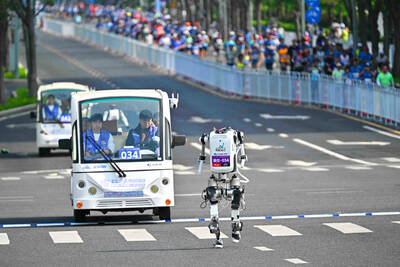
A humanoid robot that won a half-marathon race for robots in Beijing on Sunday ran faster than the human world record in a show of China’s technological leaps. The winner from Honor, a Chinese smartphone maker, completed the 21km race in 50 minutes and 26 seconds, said a WeChat post by the Beijing Economic-Technological Development Area, also known as Beijing E-Town, where the race began. That was faster than the human world record holder, Ugandan Jacob Kiplimo, who finished the same distance in about 57 minutes in March at the Lisbon road race. The performance by the robot marked a significant step forward
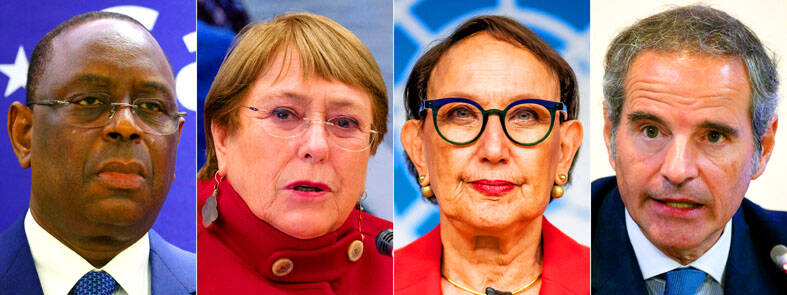
Four contenders are squaring up to succeed Antonio Guterres as secretary-general of the UN, which faces unprecedented global instability, wars and its own crushing budget crisis. Chile’s Michelle Bachelet, Argentina’s Rafael Grossi, Costa Rica’s Rebeca Grynspan and Senegal’s Macky Sall are each to face grillings by 193 member states and non-governmental organizations for three hours today and tomorrow. It is only the second time the UN has held a public question-and-answer, a format created in 2016 to boost transparency. Ultimately the five permanent members of the UN’s top body, the Security Council, hold the power, wielding vetoes over who leads the
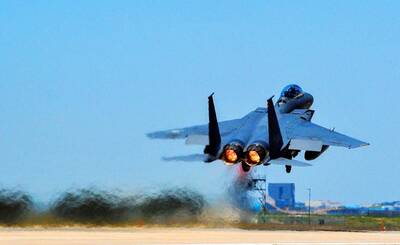
South Korea’s air force yesterday apologized for a 2021 midair collision involving two fighter jets, a day after auditors said the pilots were taking selfies and filming during the flight and held them responsible for the accident. “We sincerely apologize to the public for the concern caused by the accident that occurred in 2021,” an air force spokesman told a news conference, adding that one of the pilots involved had been suspended from flying duties, received severe disciplinary action and has since left the military. The apology followed a report released on Wednesday by the South Korean Board of Audit and Inspection,
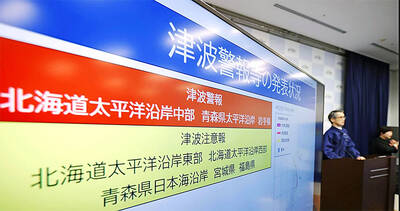
An earthquake registering a preliminary magnitude of 7.7 off northern Japan on Monday prompted a short-lived tsunami alert and the advisory of a higher risk of a possible mega-quake for coastal areas there. The Cabinet Office and the Japan Meteorological Agency said there was a 1% chance for a mega-quake, compared to a 0.1% chance during normal times, in the next week or so following the powerful quake near the Chishima and Japan trenches. Officials said the advisory was not a quake prediction but urged residents in 182 towns along the northeastern coasts to raise their preparedness while continuing their daily lives. Prime


 RSS
RSS