


To the villagers who survived the My Lai massacre and many of the Americans who fought in the Vietnam War, all the anniversaries of the atrocity are important.
But commemorations yesterday, 40 years after the event, seem especially urgent to many of the Americans who have traveled to Vietnam to attend. Some see parallels between what happened here on March 16, 1968, and events in Iraq, the site of another controversial war that has drawn US troops to a faraway corner of the globe.
"We're supposed to learn from the mistakes of history, but we keep making the same mistakes," said Lawrence Colburn, whose helicopter landed in My Lai in the midst of the massacre. "That's what makes My Lai more important today than ever before."

PHOTO: AFP
US troops landed in My Lai on a "search and destroy" mission, looking for Vietcong guerrillas. Although there were no reports of enemy fire, the troops began mowing down villagers and setting fire to homes, killing as many as 504 villagers, including unarmed women, children and elderly. The incident shocked Americans and undermined support for the war.
A memorial will be held today at a museum about the massacre.
Yesterday morning, Buddhists monks led a group prayer at the massacre site, burning incense and praying for the souls of those who died. Among the mourners was Do Thi Buong, 67, who fled from the marauding troops and whose mother was shot to death.
"We just want peace," she said. "We don't want this sort of thing to happen again anywhere else in the world. Every year when this day arrives, I always feel terrible sadness, and I always remember my mother."
Colburn and Hugh Thompson, who was piloting their helicopter, landed between the soldiers and terrified villagers and are credited with stopping the slaughter by talking to their fellow troops.
Mike Boehm, another veteran in My Lai for the commemoration, said the slaughter reminded him of the 2005 scandal that emerged from the Abu Ghraib prison in Iraq, where US guards abused and sexually humiliated Muslim prisoners and photographed their actions.
"If you follow the war in Iraq," Boehm said, "you can see nothing has changed. At both My Lai and Abu Ghraib, there was a dehumanization of our enemy and a dehumanization of our own soldiers."

As the sun sets on another scorching Yangon day, the hot and bothered descend on the Myanmar city’s parks, the coolest place to spend an evening during yet another power blackout. A wave of exceptionally hot weather has blasted Southeast Asia this week, sending the mercury to 45°C and prompting thousands of schools to suspend in-person classes. Even before the chaos and conflict unleashed by the military’s 2021 coup, Myanmar’s creaky and outdated electricity grid struggled to keep fans whirling and air conditioners humming during the hot season. Now, infrastructure attacks and dwindling offshore gas reserves mean those who cannot afford expensive diesel

Does Argentine President Javier Milei communicate with a ghost dog whose death he refuses to accept? Forced to respond to questions about his mental health, the president’s office has lashed out at “disrespectful” speculation. Twice this week, presidential spokesman Manuel Adorni was asked about Milei’s English Mastiff, Conan, said to have died seven years ago. Milei, 53, had Conan cloned, and today is believed to own four copies he refers to as “four-legged children.” Or is it five? In an interview with CNN this month, Milei referred to his five dogs, whose faces and names he had engraved on the presidential baton. Conan,

French singer Kendji Girac, who was seriously injured by a gunshot this week, wanted to “fake” his suicide to scare his partner who was threatening to leave him, prosecutors said on Thursday. The 27-year-old former winner of France’s version of The Voice was found wounded after police were called to a traveler camp in Biscarrosse on France’s southwestern coast. Girac told first responders he had accidentally shot himself while tinkering with a Colt .45 automatic pistol he had bought at a junk shop, a source said. On Thursday, regional prosecutor Olivier Janson said, citing the singer, that he wanted to “fake” his suicide
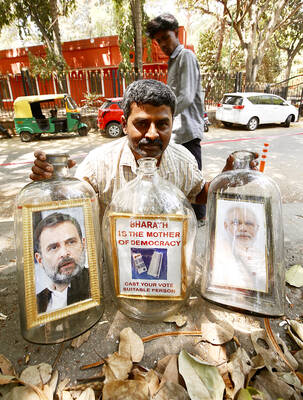
Indian Prime Minister Narendra Modi reaffirmed his pledge to replace India’s religion-based marriage and inheritance laws with a uniform civil code if he returns to office for a third term, a move that some minority groups have opposed. In an interview with the Times of India listing his agenda, Modi said his government would push for making the code a reality. “It is clear that separate laws for communities are detrimental to the health of society,” he said in the interview published yesterday. “We cannot be a nation where one community is progressing with the support of the Constitution while the other


 RSS
RSS