


China's legislature re-elected Hu Jintao (
The National People's Congress (NPC) appointed Xi Jinping (習近平), a top Chinese Communist Party (CCP) leader and the son of a revolutionary, as vice president. Xi, No. 6 in the party hierarchy, is widely seen as Hu's apparent heir and has risen quickly through the party's ranks in just six months.
It also approved a plan to reshuffle the Cabinet by founding five "super ministries" and a ministerial-level energy commission.
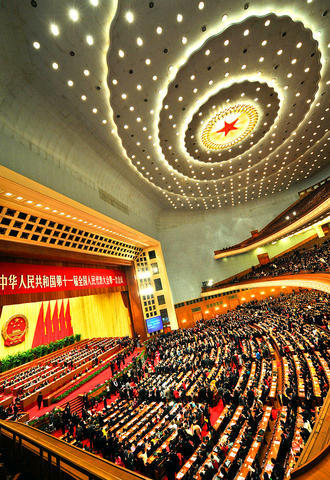
PHOTO: AFP
Both men received virtually unanimous support from the nearly 3,000 NPC delegates, known to unfailingly carry out decisions made by the party's top leadership.
There were no other candidates for the positions, reflecting the one-party state's stress on consensus and outer harmony.
As the results were announced, each man stood and bowed from the dais of the Great Hall of the People. Neither addressed the body.
Under Hu, China's economy has continued to grow rapidly while its international profile has steadily risen, a development embodied by Beijing's hosting of the Olympic Games in August.
Hu and Premier Wen Jiabao (溫家寶), who heads the government administration, are generally well supported among middle class urban Chinese, who see the two leaders as competent and sympathetic to their concerns over housing woes, inflation, medical care and education.
In a sign of Xi's rise to prominence, he has been placed in charge of preparations for the Olympics, an event generating enormous national pride and regarded by the leadership as a chance to show off a dynamic new China to the world.
But Hu and his team of advisers face stiff challenges during his second term. Soaring food costs have driven inflation to its highest level in nearly 12 years. Snowstorms this winter brought many parts of China to a halt, highlighting transportation weaknesses, power infrastructure and government planning.
Deadly anti-Chinese riots in Tibet this week have underscored the lack of progress in tamping down unrest among the country's minority groups.
The vice presidency, though devoid of real power, offers Xi an opportunity to nudge his profile higher through official travel and public appearances at state events. Like all would-be successors in rank-conscious China, Xi is careful to talk up his boss, telling officials to study Hu's speeches and follow his orders.
Hu is believed to favor the party's seventh-ranking official, Li Keqiang (李克強), to succeed him. Li has failed to receive the same level of support from ranking cadres as Xi, who has taken an unusually visible role since vaulting from leader of Shanghai to the CCP's inner sanctum last October.
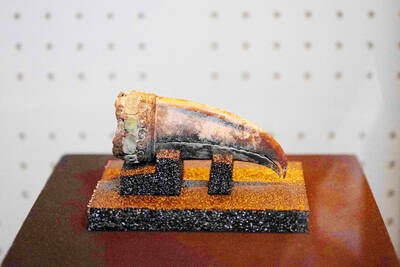
Archeologists in Peru on Thursday said they found the 5,000-year-old remains of a noblewoman at the sacred city of Caral, revealing the important role played by women in the oldest center of civilization in the Americas. “What has been discovered corresponds to a woman who apparently had elevated status, an elite woman,” archeologist David Palomino said. The mummy was found in Aspero, a sacred site within the city of Caral that was a garbage dump for more than 30 years until becoming an archeological site in the 1990s. Palomino said the carefully preserved remains, dating to 3,000BC, contained skin, part of the

TRUMP EFFECT: The win capped one of the most dramatic turnarounds in Canadian political history after the Conservatives had led the Liberals by more than 20 points Canadian Prime Minister Mark Carney yesterday pledged to win US President Donald Trump’s trade war after winning Canada’s election and leading his Liberal Party to another term in power. Following a campaign dominated by Trump’s tariffs and annexation threats, Carney promised to chart “a new path forward” in a world “fundamentally changed” by a US that is newly hostile to free trade. “We are over the shock of the American betrayal, but we should never forget the lessons,” said Carney, who led the central banks of Canada and the UK before entering politics earlier this year. “We will win this trade war and

‘BODIES EVERYWHERE’: The incident occurred at a Filipino festival celebrating an anti-colonial leader, with the driver described as a ‘lone suspect’ known to police Canadian police arrested a man on Saturday after a car plowed into a street party in the western Canadian city of Vancouver, killing a number of people. Authorities said the incident happened shortly after 8pm in Vancouver’s Sunset on Fraser neighborhood as members of the Filipino community gathered to celebrate Lapu Lapu Day. The festival, which commemorates a Filipino anti-colonial leader from the 16th century, falls this year on the weekend before Canada’s election. A 30-year-old local man was arrested at the scene, Vancouver police wrote on X. The driver was a “lone suspect” known to police, a police spokesperson told journalists at the
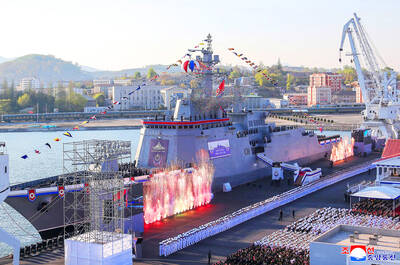
North Korean leader Kim Jong-un has unveiled a new naval destroyer, claiming it as a significant advancement toward his goal of expanding the operational range and preemptive strike capabilities of his nuclear-armed military, state media said yesterday. North Korea’s state-run Korean Central News Agency (KCNA) said Kim attended the launching ceremony for the 5,000-tonne warship on Friday at the western port of Nampo. Kim framed the arms buildup as a response to perceived threats from the US and its allies in Asia, who have been expanding joint military exercises amid rising tensions over the North’s nuclear program. He added that the acquisition


 RSS
RSS