


US Democratic presidential hopeful Hillary Clinton sidestepped questions on Monday about the sex scandal engulfing Eliot Spitzer, her home state governor and political ally.
"I don't have any comment on that. Obviously I am sending my best wishes and thoughts to the governor and to his family," Clinton said, opening her first campaign swing through Pennsylvania, which holds its presidential primary on April 22.
Spitzer apologized on Monday after he was accused of paying for sex with a call girl. Authorities say he was caught on a federal wiretap arranging a tryst with the woman at a Washington hotel room.
It was a blow to Clinton, who recently intensified her criticism of rival Barack Obama's relationship with Antoin Rezko, a political patron on trial in federal court in Obama's hometown of Chicago for alleged fraud and corruption.
While not personally close, Clinton and Spitzer have been friendly colleagues ever since the former first lady first ran for a US Senate in New York in 2000.
Her aides said Clinton deeply respected Spitzer's work during his two terms as state attorney general, during which he became a national crusader against corporate corruption and Wall Street investment excesses.
Spitzer faced pressure to resign yesterday as well as questions about whether he would be prosecuted.
A New York Times report said he hired a US$1,000-an-hour prostitute and was caught on a wiretap at least six times on Feb. 12 and Feb. 13 arranging to meet her.
Spitzer, a married 48-year-old who investigated prostitution as attorney general, apologized for what he described as a "private matter," but said nothing about resigning.
He neither confirmed nor denied the report.
Spitzer was slow to endorse Clinton's White House bid and has not been among her more forceful surrogates. But he is one of her all-important superdelegates, elected officials and party leaders who could play a decisive role in determining who becomes the presidential nominee.
If Spitzer resigns, he would not be replaced as a superdelegate, meaning Clinton would lose one, according to the Democratic National Committee. Lieutenant Governor David Paterson would become governor and he is already a superdelegate supporting Clinton.
Clinton declined to say whether she believed Spitzer could survive the scandal.
The New York Times said in an editorial that Spitzer's insistence it was a "private matter" displayed arrogance.
"He did not just betray his family in a private matter. He betrayed the public and it is hard to see how he will recover from this mess and go on to lead the reformist agenda on which he was elected to office," the paper said.
News of the scandal rocked Wall Street, where brokers resented Spitzer's high-profile inquiries into financial cases when he was the state's chief prosecutor.
The Wall Street Journal said Spitzer had shown his lack of restraint in overly aggressive tactics as attorney general, making "extraordinary threats" to entire firms and to those who criticized his pursuit of high-profile Wall Street figures.
"The stupendously deluded belief that the sitting Governor of New York could purchase the services of prostitutes was merely the last act of a man unable to admit either the existence of, or need for, limits," the Journal wrote in an editorial about what it said was almost a Shakespearean fall.
"Governor Spitzer, who made his career by specializing in not just the prosecution, but the ruin, of other men, is himself almost certainly ruined," the paper said.
Indirectly, Spitzer caused Clinton a significant political headache late last year when he proposed a plan to provide illegal immigrants with drivers' licenses.
During a debate, Clinton tripped over a question about whether she supported the proposal, prompting criticism that she was being evasive.

Through the noise of rushing papers and whirring belts at a print factory in Kyoto, two creators watch their photo essay come to life in broadsheet form — part of an effort to win new audiences in the age of artificial intelligence (AI). Despite the decline of the publishing industry, self-publication and handmade “zine” magazines are growing in popularity in Japan, reflecting the nation’s enduring love of paper in the digital era. While speaking to Agence France-Presse at the plant, his hands black with ink, one of the creators, Kazuma Obara, said: “I think [paper] is a medium that engages all five

‘CROSSING THE LINE’: China’s embassy in Seoul criticized US Forces Korea Commander General Xavier Brunson, asking if his ‘hostile’ remarks were authorized by Washington South Korea and the US are in talks over recent public remarks by the commander of US Forces Korea, Seoul’s presidential office said yesterday, after the comments drew sharp criticism from China. In a recent podcast interview, US Forces Korea Commander General Xavier Brunson described South Korea as “the dagger in the heart of Asia” from China’s east coast, prompting the Chinese embassy in Seoul to say that he had “truly crossed the line.” The interview came amid growing speculation that Washington might seek to expand the role of US Forces Korea in countering the growing regional influence of China, a key

Australian researchers have trained lab-grown brain cells on a silicon computer chip to play the 1990s shooter game Doom and said they are just scratching the surface of what the neurons could be capable of doing. It is the science-fiction work of biotech boffins at Cortical Labs, who researched and developed the technology that harnesses the workings of the brain’s networking system. Each so-called “biological computer” contains about 200,000 living human brain cells, grown from stem cells that were harvested from blood donations. Having mastered the simple computer game Pong, where a paddle is moved up and down to send a ball
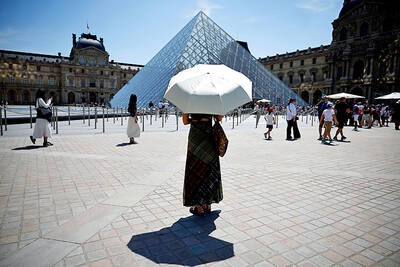
France experienced its hottest spring on record, the French weather service said on Tuesday, after an exceptional early heat wave that also broke highs for the season in England and Wales. Meteo-France said the average nationwide temperature over March to May was 13.8°C — about 1.7°C above the norm, and surpassing records set in 2011 and 2020. “The warmest spring since records began in 1900,” it said in a bulletin. All three months were warmer than average, but the onset of an “unprecedented heatwave” late last month pushed the mercury to highs typically seen at the height of the summer. “Our country had never


 RSS
RSS