


A judge is trying to bankrupt a former reporter with daily fines as much as US$5,000 for refusing to disclose her sources for stories about the 2001 anthrax attacks, press advocates said on Saturday.
They also said the case involving Toni Locy shows why Congress should pass a federal shield law for reporters.
US District Judge Reggie Walton denied on Friday a request from Locy to stay payment of fines for a contempt citation pending an appeal and ruled she must "personally bear the responsibility of paying the fine the court imposed."
While at USA Today, Locy wrote about a former Army scientist, Steven Hatfill, whom the Justice Department identified in 2002 as a "person of interest" in the anthrax attacks.
They killed five and sickened 17 others weeks after the terrorist attacks of Sept. 11, 2001.
Hatfill has denied any involvement in the anthrax attacks and sued the government for violating his privacy by discussing the investigation with reporters. No one was charged in the attacks.
Lucy Dalglish, executive director of the Reporters Committee for the Freedom of the Press, said Walton appears to be trying to bankrupt Locy, a former Associated Press reporter who is now a professor at West Virginia University's journalism school.
"What he's doing is essentially saying, `Toni Locy I am going to destroy your life.'" she said. "This is just plain crazy. I know you're not supposed to call a federal judge arrogant, but this is arrogant."
The judge pointed to statements Hatfill's lawyers made in court papers in explaining his rationale. Hatfill's legal team said that while Locy's reporting was conducted "within the scope of her employment for USA Today, her contempt was not. It began long after she left the employment of USA Today."
Starting at midnight tomorrow, Locy was ordered to pay fines of US$500 a day for the first week, US$1,000 a day for the second week and US$5,000 subsequently.
In his opinion, Walton frequently cited the case of a former nuclear weapons scientist, Lee Wen-ho (
In 2004, US District Judge Thomas Penfield Jackson fined five reporters US$500 a day each for refusing to identify their sources for stories about Lee.
After Jackson postponed the fines pending appeals, news organizations, including the AP, eventually agreed to pay Lee US$750,000 as part of a US$1.6 million settlement of his privacy suit against the government.
Dalglish said forcing reporters to reveal sources in the face of monetary fines is in some ways more chilling than threats of jail, which come about in contempt orders issued in criminal cases. Dalglish and others are also worried about the government using civil cases to force reporters to reveal sources.
"There's not a national security interest at peril in this case," she said. "This is all about reporters being able to do what they do every day."
Congress is considering passage of a federal shield law that would protect reporters from revealing their sources. Such laws are in place in 33 states. A bill passed the House of Representatives but has stalled in the Senate since last year.
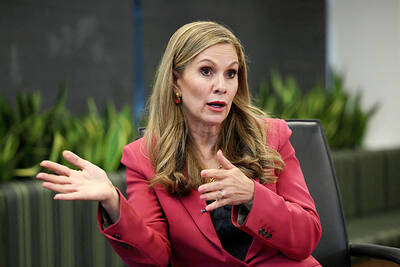
Australians were downloading virtual private networks (VPNs) in droves, while one of the world’s largest porn distributors said it was blocking users from its platforms as the country yesterday rolled out sweeping online age restriction. Australia in December became the first country to impose a nationwide ban on teenagers using social media. A separate law now requires artificial intelligence (AI)-powered chatbot services to keep certain content — including pornography, extreme violence and self-harm and eating disorder material — from minors or face fines of up to A$49.5 million (US$34.6 million). The country also joined Britain, France and dozens of US states requiring
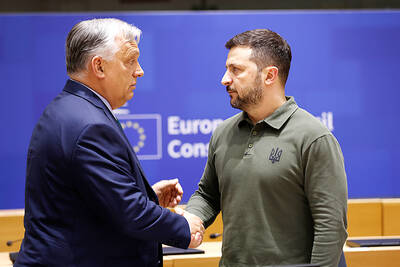
Hungarian authorities temporarily detained seven Ukrainian citizens and seized two armored cars carrying tens of millions of euros in cash across Hungary on suspicion of money laundering, officials said on Friday. The Ukrainians were released on Friday, following their detention on Thursday, but Hungarian officials held onto the cash, prompting Ukraine to accuse Hungary’s Russia-friendly government of illegally seizing the money. “We will not tolerate this state banditism,” Ukrainian Minister of Foreign Affairs Andrii Sybiha said. The seven detained Ukrainians were employees of the Ukrainian state-owned Oschadbank, who were traveling in the two armored cars that were carrying the money between Austria and
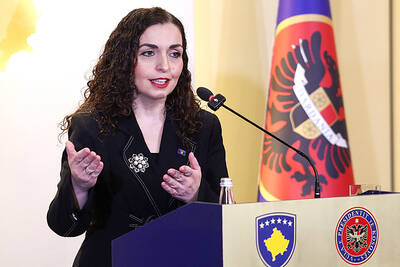
Kosovar President Vjosa Osmani on Friday after dissolving the Kosovar parliament said a snap election should be held as soon as possible to avoid another prolonged political crisis in the Balkan country at a time of global turmoil. Osmani said it is important for Kosovo to wrap up the upcoming election process and form functional institutions for political stability as the war rages in the Middle East. “Precisely because the geopolitical situation is that complex, it is important to finish this electoral process which is coming up,” she said. “It is very hard now to imagine what will happen next.” Kosovo, which declared

MORE BANS: Australia last year required sites to remove accounts held by under-16s, with a few countries pushing for similar action at an EU level and India considering its own ban Indonesia on Friday said it would ban social media access for children under 16, citing threats from online pornography, cyberbullying, online fraud and Internet addiction. “Accounts belonging to children under 16 on high-risk platforms will start to be deactivated, beginning with YouTube, TikTok, Facebook, Instagram, Threads, X, Bigo Live and Roblox,” Indonesian Minister of Communications and Digital Meutya Hafid said. “The government is stepping in so that parents no longer have to fight alone against the giants of the algorithm. Implementation will begin on March 28, 2026,” she said. The social media ban would be introduced in stages “until all platforms fulfill their


 RSS
RSS