


A team of German and Peruvian archeologists said they discovered the oldest known monument in Peru: a 5,500-year-old ceremonial plaza near Peru's north-central coast.
Carbon dating of material discovered at the site revealed it was built between 3500BC and 3000BC, Peter Fuchs, a German archeologist who headed the excavation team, said by telephone on Monday.
The discovery was further evidence that civilization thrived in Peru at about the same time as it did in what is now the Middle East and South Asia, said Ruth Shady, a prominent Peruvian archeologist who led the team that discovered the ancient city of Caral in 2001.

PHOTO: REUTERS
Shady serves as a senior adviser to Peru's National Culture Institute and was not involved in the project.
QUESTIONS
The find also raises questions about what prompted "civilizations to form throughout the planet at more or less the same time," Shady said.
The circular, sunken plaza, built of stones and adobe, is part of the Sechin Bajo archeological complex in Andes foothills, 330km northwest of Lima, where Fuchs and fellow German archeologist Renate Patzschke have been working since 1992.
It predates similar monuments and plazas found in Caral, which nonetheless remains the oldest known city in the Americas dating back to 2627BC.
The plaza served as a social and ritual space where ancient peoples celebrated their "thoughts about the world, their place within it, and images of their world and themselves," Fuchs said.
ICONIC
In an adjacent structure, built around 1800BC, Fuchs' team uncovered a 3,600-year-old adobe frieze -- 2m tall -- depicting the iconic image of a human sacrificer "standing with open arms, holding a ritual knife in one hand and a human head in the other," Fuchs said.
The mythic image was also found in the celebrated Moche Lords of Sipan tombs, discovered on Peru's northern coast in the late 1980s.
Walter Alva, the Peruvian archeologist who uncovered the Lords of Sipan tombs, said the plaza found in Fuchs' dig was probably utilized by an advanced civilization with economic stability, a necessary condition to construct such a ceremonial site.
DIGS
The excavation was the fourth in a series of digs at the Sechin Bajo complex that Fuchs and Patzschke began on behalf of the University of Berlin in 1992.
Deutsche Forschung Gemeinschaft, a German state agency created to sponsor scientific investigations, has financed the most recent three digs.
The find "shows the world that in America too, human beings of the New World had the same capacity to create civilization as those in the Old World," Shady said.
Her discovery, Caral, made headlines in 2001 when researchers carbon-dated material from the city back to 2627BC, proving that a complex urban center in the Americas thrived as a contemporary to ancient Mesopotamia and Egypt.
This put such activity in the Americas 1,500 years earlier than previously believed.
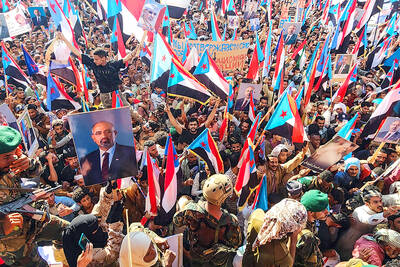
Yemen’s separatist leader has vowed to keep working for an independent state in the country’s south, in his first social media post since he disappeared earlier this month after his group briefly seized swathes of territory. Aidarous al-Zubaidi’s United Arab Emirates (UAE)-backed Southern Transitional Council (STC) forces last month captured two Yemeni provinces in an offensive that was rolled back by Saudi strikes and Riyadh’s allied forces on the ground. Al-Zubaidi then disappeared after he failed to board a flight to Riyadh for talks earlier this month, with Saudi Arabia accusing him of fleeing to Abu Dhabi, while supporters insisted he was

The Chinese Embassy in Manila yesterday said it has filed a diplomatic protest against a Philippine Coast Guard spokesman over a social media post that included cartoonish images of Chinese President Xi Jinping (習近平). Philippine Coast Guard spokesman Jay Tarriela and an embassy official had been trading barbs since last week over issues concerning the disputed South China Sea. The crucial waterway, which Beijing claims historic rights to despite an international ruling that its assertion has no legal basis, has been the site of repeated clashes between Chinese and Philippine vessels. Tarriela’s Facebook post on Wednesday included a photo of him giving a

‘MOBILIZED’: While protesters countered ICE agents, Minnesota Governor Tim Walz activated the state’s National Guard to ‘support the rights of Minnesotans’ to assemble Hundreds of counterprotesters drowned out a far-right activist’s attempt to hold a small rally in support of US President Donald Trump’s latest immigration crackdown in Minneapolis, Minnesota, on Saturday, as the governor’s office announced that National Guard troops were mobilized and ready to assist law enforcement, although not yet deployed to city streets. There have been protests every day since the US Department of Homeland Security (DHS) ramped up immigration enforcement in the Twin Cities of Minneapolis and Saint Paul by bringing in more than 2,000 federal officers. Conservative influencer Jake Lang organized an anti-Islam, anti-Somali and pro-US Immigration and Customs Enforcement
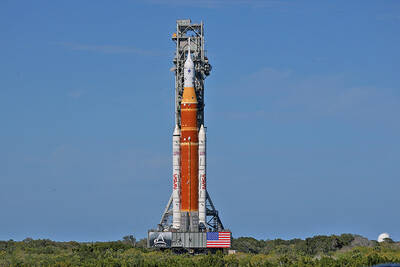
NASA on Saturday rolled out its towering Space Launch System (SLS) rocket and Orion spacecraft as it began preparations for its first crewed mission to the Moon in more than 50 years. The maneuver, which takes up to 12 hours, would allow the US space agency to begin a string of tests for the Artemis 2 mission, which could blast off as early as Feb. 6. The immense orange and white SLS rocket, and the Orion vessel were slowly wheeled out of the Vehicle Assembly Building at the Kennedy Space Center in Florida, and painstakingly moved 6.5km to Launch Pad 39B. If the


 RSS
RSS