


Senator Hillary Rodham Clinton was working to get her campaign on track after two more victories by rival Barack Obama made her quest for the Democratic presidential nomination appear increasingly unreachable.
Meanwhile, presumptive Republican candidate Senator John McCain dismissed as a "smear campaign" published reports that questioned his relationship with a Washington lobbyist. He was to address the issue at a news conference yesterday, aides said.
Obama's victories in Wisconsin and Hawaii, his 9th and 10th in a row, have forced the former first lady into a virtual must-win scenario in the next Democratic nominating contests, including Ohio and Texas on March 4.
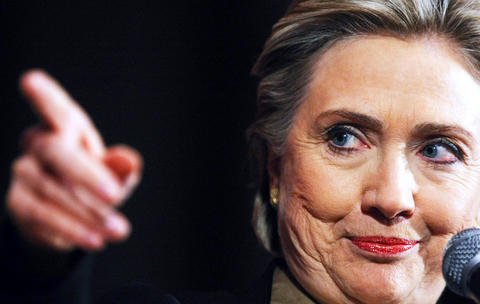
PHOTO: AFP
Once deemed the nearly inevitable Democratic nominee, Clinton must now win 57 percent of the remaining primary and caucus delegates to erase Obama's lead, a daunting task requiring landslide-sized victories.
Obama's victories on Tuesday left him with 1,351 delegates in The AP count, compared with 1,262 for Clinton. It takes 2,025 to win the nomination.
The total counts superdelegates -- party insiders who can choose whichever candidate they want at the Democratic convention in August and with whom Clinton has so far had an edge. When counting only the delegates picked in primaries and caucuses, Obama leads Clinton by 154 delegates.
Another 1,025 delegates remain to be awarded, most of them in contests in 14 states, Guam and Puerto Rico.
Obama, seeking to become the first black US president, has won a wave of support on his message of hope and change. He has brushed off criticism from Clinton and McCain that he lacks substance and as a first-term senator does not have enough experience to lead the US.
"The change we seek is still months and miles away," Obama told a boisterous crowd in Houston in a speech in which he also pledged to end the war in Iraq in his first year in office.
Obama has also been outpacing Clinton on fundraising. Counting her debts, including US$5 million she lent her campaign, Clinton ended January with about US$1.5 million while Obama sat comfortably atop a sum more than 10 times bigger.
Clinton, who hopes to become the US' first woman president, fired off a fresh salvo on Wednesday, dismissing Obama as leading a movement with little to show for his eloquence and promises. She depicted his candidacy as a "campaign about a campaign" while casting herself as a champion of the middle class.
The Clinton campaign has built a large operation in Texas, opening 20 offices around the state and counting 100,000 volunteers, and she has continued to take Obama on directly.
"If she wins in Texas and Ohio, I think she'll be the nominee," former president Bill Clinton said on Wednesday during a speech to his wife's supporters in Beaumont, Texas. "If you don't deliver for her, I don't think she can be."
Obama has steadily encroached on her support among women and white working class voters. In Wisconsin, he split the support of white women almost evenly with her and also ran well among working class voters.
Helping keep her afloat is her thin lead among nearly 800 superdelegates, made up largely of party and elected Democratic officials who can vote however they choose -- but at least four of those who once backed her switched to Obama on Wednesday. When superdelegates are added to the AP count, Obama's lead over Clinton narrows to 89 delegates.
And on Wednesday, he picked up the support of the 1.4 million-member Teamsters, his fourth labor endorsement in a week. Union support is expected to be key in the upcoming Ohio and Pennsylvania races.
Furthermore, in a strategy that must rankle the Clinton team, all-but-sure Republican nominee McCain is now speaking as if it were a foregone conclusion that he will be running against Obama in the fall, contrasting his own national security experience with "an eloquent but empty call for change."
While both campaigns agree Obama is the leader in the delegate race, they differ on the significance.
"The only way in this system to amass delegates is to win by big margins. Close races result in close delegate distribution," David Plouffe, Obama's campaign manager, told reporters in a conference call.
"The only way she can do it is winning states like Ohio 65-35, Texas 65-35, Pennsylvania, you know, 70-30. and you go on and on and on. She'd have to win pretty much all the states, even states where we're considered to have some strength," he added.
Clinton's top aides said Plouffe was deliberately trying to set unrealistically high expectations for the New York senator.
"We expect to do well in both those states," said Harold Ickes, speaking of Texas and Ohio, which hold primaries on March 4.
"But 65 percent is a far reach and there is no expectation here that we're going to hit that number," he said.
"We're in the neighborhood of about 75 delegates behind, that is less that 3 percent of the total number of delegates who have been elected. We expect to narrow that gap substantially by the end of this process," he added.
With the votes counted in all but one of Wisconsin's 3,570 precincts, Obama won 58 percent of the vote to 41 percent for Clinton.
With 100 percent of the vote counted in Hawaii, Obama had 76 percent to Clinton's 24 percent.
Wisconsin offered 74 national convention delegates. There were 20 delegates at stake in Hawaii, where Obama spent much of his youth.
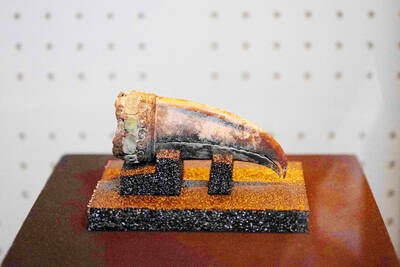
Archeologists in Peru on Thursday said they found the 5,000-year-old remains of a noblewoman at the sacred city of Caral, revealing the important role played by women in the oldest center of civilization in the Americas. “What has been discovered corresponds to a woman who apparently had elevated status, an elite woman,” archeologist David Palomino said. The mummy was found in Aspero, a sacred site within the city of Caral that was a garbage dump for more than 30 years until becoming an archeological site in the 1990s. Palomino said the carefully preserved remains, dating to 3,000BC, contained skin, part of the
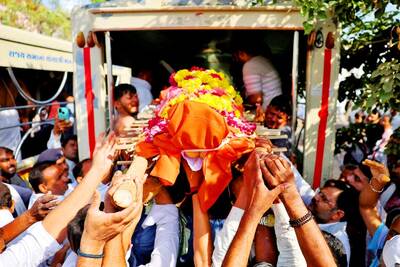
‘WATER WARFARE’: A Pakistani official called India’s suspension of a 65-year-old treaty on the sharing of waters from the Indus River ‘a cowardly, illegal move’ Pakistan yesterday canceled visas for Indian nationals, closed its airspace for all Indian-owned or operated airlines, and suspended all trade with India, including to and from any third country. The retaliatory measures follow India’s decision to suspend visas for Pakistani nationals in the aftermath of a deadly attack by shooters in Kashmir that killed 26 people, mostly tourists. The rare attack on civilians shocked and outraged India and prompted calls for action against their country’s archenemy, Pakistan. New Delhi did not publicly produce evidence connecting the attack to its neighbor, but said it had “cross-border” links to Pakistan. Pakistan denied any connection to

TRUMP EFFECT: The win capped one of the most dramatic turnarounds in Canadian political history after the Conservatives had led the Liberals by more than 20 points Canadian Prime Minister Mark Carney yesterday pledged to win US President Donald Trump’s trade war after winning Canada’s election and leading his Liberal Party to another term in power. Following a campaign dominated by Trump’s tariffs and annexation threats, Carney promised to chart “a new path forward” in a world “fundamentally changed” by a US that is newly hostile to free trade. “We are over the shock of the American betrayal, but we should never forget the lessons,” said Carney, who led the central banks of Canada and the UK before entering politics earlier this year. “We will win this trade war and

Armed with 4,000 eggs and a truckload of sugar and cream, French pastry chefs on Wednesday completed a 121.8m-long strawberry cake that they have claimed is the world’s longest ever made. Youssef El Gatou brought together 20 chefs to make the 1.2 tonne masterpiece that took a week to complete and was set out on tables in an ice rink in the Paris suburb town of Argenteuil for residents to inspect. The effort overtook a 100.48m-long strawberry cake made in the Italian town of San Mauro Torinese in 2019. El Gatou’s cake also used 350kg of strawberries, 150kg of sugar and 415kg of


 RSS
RSS