


Mohamed Al Fayed, the man who claims British Queen Elizabeth II's husband ordered spies to kill his son and Princess Diana, was to take the stand at a coroner's inquest yesterday.
Al Fayed was to get the most public airing for his theories yet in what is expected to be a high point in the inquest that has run for more than four months and cost more than ?2 million (US$3.9 million).
Al Fayed drew his own conclusions within half an hour of his son Dodi's death, said Frank Klein, president of the Ritz Hotel in Paris.
"This is not an accident, this is a plot or an assassination," Fayed said in a telephone conversation, Klein has testified.
"I am in no doubt whatsoever that my son and Princess Diana were murdered by the British security services on the orders of HRH Prince Philip, Duke of Edinburgh," Al Fayed said in a witness statement three years ago.
He has also declared: "I'm the only person who knows exactly what happened."
On Thursday, however, Al Fayed's security chief, John Macnamara, said Al Fayed had no evidence implicating Prince Philip.
Macnamara also said he had no evidence for previous assertions that Diana had telephoned friends with news of an impending engagement, that the British ambassador in Paris ordered her body embalmed to cover up her pregnancy or that the French medical team that treated the dying princess were involved in a murder plot -- all allegations made by his boss.
That's unlikely to dent the confidence of the combative Al Fayed, who worked his way up from a humble birth in Alexandria, Egypt, in 1929 to become one of the richest men in Britain.
Stubbornly rejecting the findings of French and British police that his son died in a simple road accident, he has pursued British, French and US court cases seeking evidence of collusion among security agencies.
Despite owning the Harrods department store in west London, a castle in Scotland and the Fulham FC soccer team, Al Fayed has been a frustrated outsider in his adopted country.
He has been thwarted in his applications for British citizenship and caused a political uproar in 1994 when he disclosed that he had paid two members of the House of Commons to put questions to ministers.
Al Fayed began building his fortune as a furniture dealer and had profitable dealings with his brother-in-law, Adnan Khashoggi, who later became an arms trader.
Al Fayed and his son Dodi, the product of a brief first marriage, moved to England in 1974.
Al Fayed defeated another colorful entrepreneur, Tiny Rowland, to gain control of Harrods in 1985. Five years later, a British government report concluded that Al Fayed and his brother Ali had misrepresented their background and the sources of their wealth when they bought Harrods, but no sanctions were imposed.
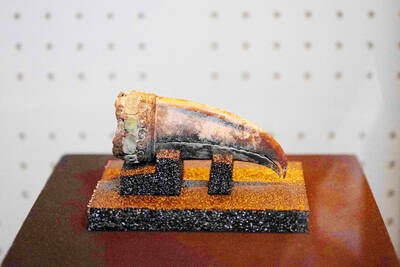
Archeologists in Peru on Thursday said they found the 5,000-year-old remains of a noblewoman at the sacred city of Caral, revealing the important role played by women in the oldest center of civilization in the Americas. “What has been discovered corresponds to a woman who apparently had elevated status, an elite woman,” archeologist David Palomino said. The mummy was found in Aspero, a sacred site within the city of Caral that was a garbage dump for more than 30 years until becoming an archeological site in the 1990s. Palomino said the carefully preserved remains, dating to 3,000BC, contained skin, part of the
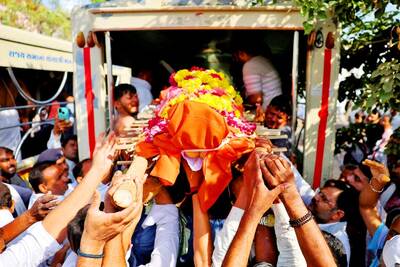
‘WATER WARFARE’: A Pakistani official called India’s suspension of a 65-year-old treaty on the sharing of waters from the Indus River ‘a cowardly, illegal move’ Pakistan yesterday canceled visas for Indian nationals, closed its airspace for all Indian-owned or operated airlines, and suspended all trade with India, including to and from any third country. The retaliatory measures follow India’s decision to suspend visas for Pakistani nationals in the aftermath of a deadly attack by shooters in Kashmir that killed 26 people, mostly tourists. The rare attack on civilians shocked and outraged India and prompted calls for action against their country’s archenemy, Pakistan. New Delhi did not publicly produce evidence connecting the attack to its neighbor, but said it had “cross-border” links to Pakistan. Pakistan denied any connection to

TRUMP EFFECT: The win capped one of the most dramatic turnarounds in Canadian political history after the Conservatives had led the Liberals by more than 20 points Canadian Prime Minister Mark Carney yesterday pledged to win US President Donald Trump’s trade war after winning Canada’s election and leading his Liberal Party to another term in power. Following a campaign dominated by Trump’s tariffs and annexation threats, Carney promised to chart “a new path forward” in a world “fundamentally changed” by a US that is newly hostile to free trade. “We are over the shock of the American betrayal, but we should never forget the lessons,” said Carney, who led the central banks of Canada and the UK before entering politics earlier this year. “We will win this trade war and

Armed with 4,000 eggs and a truckload of sugar and cream, French pastry chefs on Wednesday completed a 121.8m-long strawberry cake that they have claimed is the world’s longest ever made. Youssef El Gatou brought together 20 chefs to make the 1.2 tonne masterpiece that took a week to complete and was set out on tables in an ice rink in the Paris suburb town of Argenteuil for residents to inspect. The effort overtook a 100.48m-long strawberry cake made in the Italian town of San Mauro Torinese in 2019. El Gatou’s cake also used 350kg of strawberries, 150kg of sugar and 415kg of


 RSS
RSS