


China's top climate envoy warned that negotiations on a new treaty to fight global warming will fail if rich nations aren't treated as "the culprits" and developing countries as "the victims."
Ambassador Yu Qingtai (
Yu said this principle of "common but differentiated responsibilities" for developed and developing countries was accepted in the UN Framework Convention on Climate Change, the international treaty that began to consider what to do to reduce global warming.
It is enshrined in the 1997 Kyoto Protocol, which set binding targets on industrial countries to cut emissions of carbon dioxide and other gases believed to cause global warming but exempted developing countries like China and India -- and it must be "the essential foundation" of the agreement that will replace Kyoto when it expires in 2012, he said.
"The developed countries is a grouping of the culprits, the countries who are responsible for the creation of this problem," Yu said in an interview this week on the sidelines of the UN General Assembly debate on climate change. "The developing countries is a grouping of victims ... [that] face the common task of achieving economic and social development so that their people can enjoy a better standard of living."
The Chinese envoy said the agreement by delegates from nearly 190 nations in December at a UN-brokered conference in Bali, Indonesia to adopt a blueprint to control global warming gases before the end of next year reiterated the principle of different responsibilities for rich and poor nations.
This principle must be the basis of a new agreement, he said.
"If this one is discarded, there is no international cooperation," Yu said. "People will just disperse and go their own ways and do their own things. So this principle is the very foundation for international cooperation."
The US and China are the world's biggest emitters of greenhouse gases that scientists say cause global warming.
The US has argued that it shouldn't have to cut its emissions to a level that would hurt the US economy as long as countries like China and India aren't required by a UN treaty to make similar cuts.
Yu vehemently disagreed, calling China "a victim" of climate change and stressing that its economy only started to grow in the last 25 years.
"The United States and the developed states as a whole are the countries that created the problem, caused the problem of climate change in the first place. In my view, that's what a culprit means," he said.
"It's not logical to ask China ... to cap its emissions or reduce its emissions in the same manner as a developed country is supposed to do," Yu said. "If that is the case, there will be no differentiation. The fundamental principal for international cooperation would no longer be there."
While the total amount of emissions in China and the US may be the same, he said China's population of 1.3 billion is four times the population of the US.
"No one can expect China to accept that an American, for no other reason than being born an American, should enjoy an emission entitlement right four times as [large as] the Chinese. That is not right. That is not fair," Yu said.
China on its own, without any international negotiations, has set targets to increase energy efficiency by 20 percent, to increase national forest cover from 18 percent to 20 percent between 2005 and 2010 by planting more trees and to increase the use of renewable sources of energy, especially solar power, from 7.5 percent to 10 percent by 2010, he said.
Meanwhile, he said, "the United States should take the lead to reduce its own emissions and fulfill its obligations as a party to the [Framework] Convention."
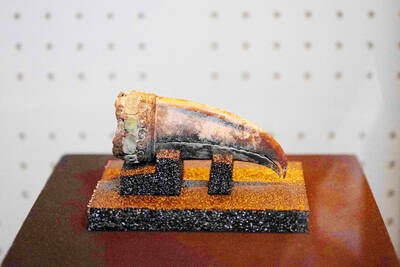
Archeologists in Peru on Thursday said they found the 5,000-year-old remains of a noblewoman at the sacred city of Caral, revealing the important role played by women in the oldest center of civilization in the Americas. “What has been discovered corresponds to a woman who apparently had elevated status, an elite woman,” archeologist David Palomino said. The mummy was found in Aspero, a sacred site within the city of Caral that was a garbage dump for more than 30 years until becoming an archeological site in the 1990s. Palomino said the carefully preserved remains, dating to 3,000BC, contained skin, part of the

TRUMP EFFECT: The win capped one of the most dramatic turnarounds in Canadian political history after the Conservatives had led the Liberals by more than 20 points Canadian Prime Minister Mark Carney yesterday pledged to win US President Donald Trump’s trade war after winning Canada’s election and leading his Liberal Party to another term in power. Following a campaign dominated by Trump’s tariffs and annexation threats, Carney promised to chart “a new path forward” in a world “fundamentally changed” by a US that is newly hostile to free trade. “We are over the shock of the American betrayal, but we should never forget the lessons,” said Carney, who led the central banks of Canada and the UK before entering politics earlier this year. “We will win this trade war and

‘BODIES EVERYWHERE’: The incident occurred at a Filipino festival celebrating an anti-colonial leader, with the driver described as a ‘lone suspect’ known to police Canadian police arrested a man on Saturday after a car plowed into a street party in the western Canadian city of Vancouver, killing a number of people. Authorities said the incident happened shortly after 8pm in Vancouver’s Sunset on Fraser neighborhood as members of the Filipino community gathered to celebrate Lapu Lapu Day. The festival, which commemorates a Filipino anti-colonial leader from the 16th century, falls this year on the weekend before Canada’s election. A 30-year-old local man was arrested at the scene, Vancouver police wrote on X. The driver was a “lone suspect” known to police, a police spokesperson told journalists at the
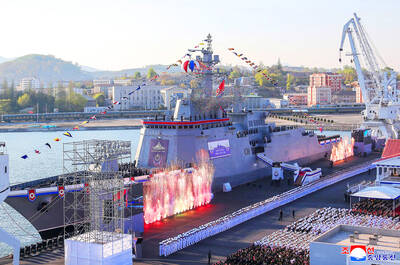
North Korean leader Kim Jong-un has unveiled a new naval destroyer, claiming it as a significant advancement toward his goal of expanding the operational range and preemptive strike capabilities of his nuclear-armed military, state media said yesterday. North Korea’s state-run Korean Central News Agency (KCNA) said Kim attended the launching ceremony for the 5,000-tonne warship on Friday at the western port of Nampo. Kim framed the arms buildup as a response to perceived threats from the US and its allies in Asia, who have been expanding joint military exercises amid rising tensions over the North’s nuclear program. He added that the acquisition


 RSS
RSS