


Vietnamese political activists spanning the generations yesterday bade farewell to onetime senior Communist Party member turned dissident Hoang Minh Chinh, who died in his late 80s earlier this month.
Hundreds of people, many wearing white headbands of mourning, attended the funeral in Hanoi of the leader of the outlawed Democratic Party of Vietnam and founder member of "Bloc 8406," a diverse group of mainly Internet activists named for the date it was established in April 2006.
Several younger political activists, including some who in recent years have been jailed for opposing one-party rule, were among relatives and older friends who paid respects to Chinh. He died on Feb. 7 after suffering from prostate cancer.
"He dedicated all his life to the struggle for democracy and liberty," activist Pham Hong Son, who was released in Aug. 2006, said at the funeral. "I am of the younger generation and I wish to follow his legacy."
Son was arrested in 2002 and then tried after posting a translation of a US State Department article "What is Democracy?" on the Internet. He still lives under police surveillance and some restrictions.
Plainclothes police watched and filmed mourners at yesterday's funeral.
The Southeast Asian country has opened its economy to the world and reduced poverty through high economic growth, but it does not tolerate proponents of a multi-party system.
About 40 activists have been arrested in the past year, according to international human rights groups and Western diplomats. Some have been put on trial and sentenced to between three years and eight years in prison for "spreading propaganda against the state," a criminal offense in Vietnam.
A government spokesman says the defendants, who include lawyers, businessmen and union organizers, were not tried for their political beliefs, only for breaking Vietnam's laws.
Chinh's associates say he became a member of the Communist Party after the 1945 revolution in northern Vietnam, trained in the Soviet Union in the 1950s and was appointed director of the Marxist-Leninist Institute in Hanoi in 1960.
Seven years later he was removed and imprisoned for four years after writing an essay critical of the ruling party.
He was imprisoned at least twice more in the 1980s and 1990s. In 2005, he was allowed to go to the US for medical treatment, but faced abuse on his return after criticizing the Hanoi government while in the US, according to rights groups.
Chinh's casket was accompanied to a cremation ceremony by yellow-robed monks of the outlawed Unified Buddhist Church of Vietnam.
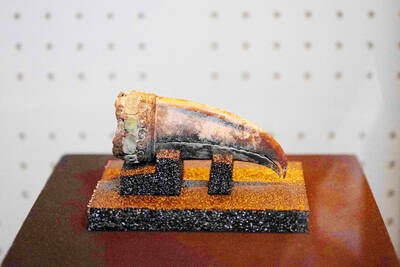
Archeologists in Peru on Thursday said they found the 5,000-year-old remains of a noblewoman at the sacred city of Caral, revealing the important role played by women in the oldest center of civilization in the Americas. “What has been discovered corresponds to a woman who apparently had elevated status, an elite woman,” archeologist David Palomino said. The mummy was found in Aspero, a sacred site within the city of Caral that was a garbage dump for more than 30 years until becoming an archeological site in the 1990s. Palomino said the carefully preserved remains, dating to 3,000BC, contained skin, part of the

TRUMP EFFECT: The win capped one of the most dramatic turnarounds in Canadian political history after the Conservatives had led the Liberals by more than 20 points Canadian Prime Minister Mark Carney yesterday pledged to win US President Donald Trump’s trade war after winning Canada’s election and leading his Liberal Party to another term in power. Following a campaign dominated by Trump’s tariffs and annexation threats, Carney promised to chart “a new path forward” in a world “fundamentally changed” by a US that is newly hostile to free trade. “We are over the shock of the American betrayal, but we should never forget the lessons,” said Carney, who led the central banks of Canada and the UK before entering politics earlier this year. “We will win this trade war and

‘BODIES EVERYWHERE’: The incident occurred at a Filipino festival celebrating an anti-colonial leader, with the driver described as a ‘lone suspect’ known to police Canadian police arrested a man on Saturday after a car plowed into a street party in the western Canadian city of Vancouver, killing a number of people. Authorities said the incident happened shortly after 8pm in Vancouver’s Sunset on Fraser neighborhood as members of the Filipino community gathered to celebrate Lapu Lapu Day. The festival, which commemorates a Filipino anti-colonial leader from the 16th century, falls this year on the weekend before Canada’s election. A 30-year-old local man was arrested at the scene, Vancouver police wrote on X. The driver was a “lone suspect” known to police, a police spokesperson told journalists at the
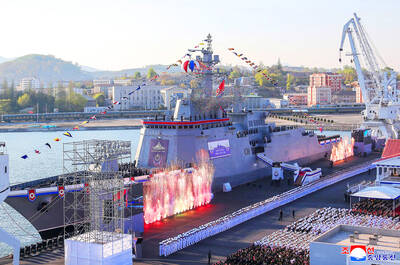
North Korean leader Kim Jong-un has unveiled a new naval destroyer, claiming it as a significant advancement toward his goal of expanding the operational range and preemptive strike capabilities of his nuclear-armed military, state media said yesterday. North Korea’s state-run Korean Central News Agency (KCNA) said Kim attended the launching ceremony for the 5,000-tonne warship on Friday at the western port of Nampo. Kim framed the arms buildup as a response to perceived threats from the US and its allies in Asia, who have been expanding joint military exercises amid rising tensions over the North’s nuclear program. He added that the acquisition


 RSS
RSS