

Australian Prime Minister Kevin Rudd vowed yesterday his nation's troops would stay in East Timor as long as needed, following assassination bids on the president and prime minister this week.
Rudd jetted into Dili for a half-day visit in the wake of Monday's attacks, which critically wounded East Timorese President Jose Ramos-Horta and threw the six-year-old democracy into fresh crisis.
"The purpose of my visit today is to state in clear and loud terms that Australia will stand shoulder-to-shoulder with East Timor into the future in defense of its democratic system of government," Rudd told a press briefing.
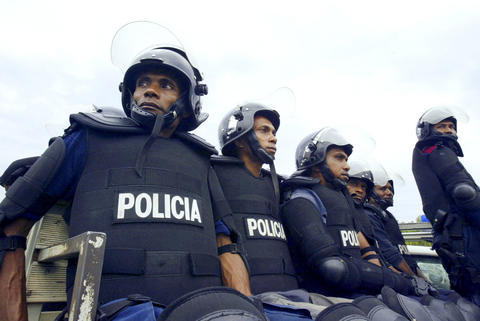
PHOTO: AP
"Australia is here for the good times, the bad times and the difficult times," he said after meeting East Timorese Prime Minister Xanana Gusmao, who was also ambushed on Monday, apparently by renegade soldiers, but survived uninjured.
Asked how long Australian troops -- whose figures were boosted by 350 in the wake of the attacks to some 1,000 -- would stay in the fledgling nation, Rudd said: "So long as they are invited here by the government of East Timor."
"Of course, we want to be partners in peace and long-term security. So we will always be open to our friends here in Dili as to what may be necessary in the future," he said. "It is by the ballot box, not by the barrel of a gun, that decisions of our countries will be made."
East Timor has been under a state of emergency that includes an evening-to-dawn curfew in place and gatherings banned since the attacks blamed on rebels led by Alfredo Reinado, who was killed in the gunfire.
The tiny nation was wracked by deadly unrest involving Reinado in 2006 when he emerged as the leader of a mutinous army faction that complained of ethnic bias, prompting the deployment of the international peacekeepers.
Rudd said he also discussed with Gusmao security and economic cooperation.
"Ensuring young people across Timor-Leste have a job is for business, but also this country's long-term stability," Rudd said, using the nation's official name.
Gusmao said Australia's rapid response was "a sign that our neighbors have great faith in our young democracy, and that the protection of our democracy is central in establishing a climate of peace and stability."
"Our nation is a proud nation," he said. "A bullet can wound the president but can never penetrate the values of democracy."
Rudd also met with acting president Fernando de Araujo and head of the opposition Fretilin party Mari Alkatiri, and toured the base of the Australian-led International Stabilization Forces, before departing.
Araujo thanked Rudd for sending troops and making the visit, and also for providing medical care "to save our president."
He said he had just received an update on the condition of Ramos-Horta, who is recuperating in a Darwin hospital where he was airlifted after the attack.
He had been in an induced coma after three surgeries, but Araujo said he was now able to speak.
"This is a very encouraging sign ... Hopefully, in one or two months he can return and resume his role as president of the republic," he said.
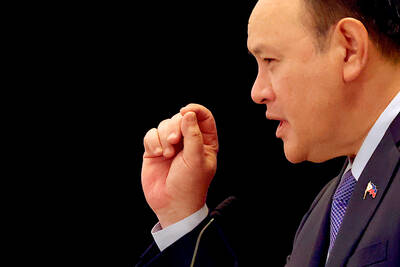
Philippine Secretary of National Defense Gilberto Teodoro Jr on Tuesday hit out at China at an international forum after a memo asserting Beijing’s position over their longstanding maritime dispute was delivered to him while he was speaking on stage. The unusual incident was captured on video at the Seoul Defense Dialogue as the secretary was responding to a question about “gray zone” coercion in the South China Sea. The video shows what appears to be a conference staffer placing it on the table next to him while speaking. “I have a note here, I think this is from China,” he said, describing
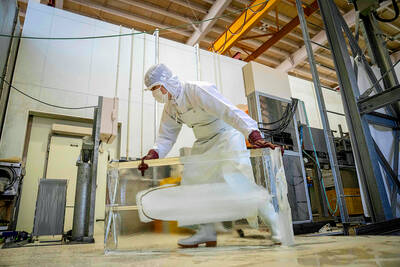
PAINSTAKING PROCESS: Ice makers freeze water for up to 72 hours, replace tainted water with a fresh batch once freezing begins, and are constantly stirring In the historic Japanese city of Kanazawa, craftsmen painstakingly shape and slice blocks of ice destined to chill negronis in some of the world’s trendiest bars. The men work for Kuramoto Ice, a century-old company in Ishikawa on the Sea of Japan coast and one of dozens of Japanese firms producing ultra-clear, premium ice. This luxury product, believed by those in the industry to melt more slowly than regular blocks, is a staple of Japan’s cocktail culture, but its popularity is also spilling over to bars abroad, from the US to Australia, who pay as much as ¥200 (US$1.28) per cube. Kuramoto Ice
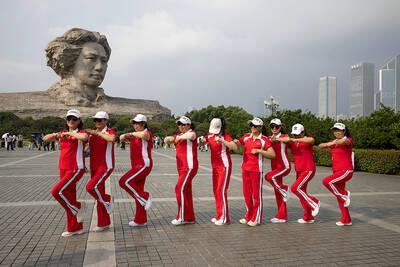
China yesterday marked half a century since the death of Mao Zedong (毛澤東), founder of the People’s Republic, who brought roughly one-quarter of the world’s population under communist rule and whose specter still haunts China’s future. Mao’s death on Sept. 9, 1976, at age 82, mourned by many and welcomed by some who suffered under his nearly three-decade rule, also hastened the end of the Cultural Revolution, a frenzied mass movement he launched in 1966. The party later condemned the Cultural Revolution as a grave error for which Mao bore primary responsibility, but still reveres him, saying his achievements outweigh his mistakes. Mao’s
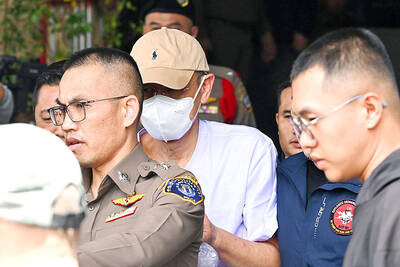
Thai police yesterday said that they arrested a senior Buddhist monk on suspicion of embezzling US$2.8 million intended for his monastery, alongside a suspected female accomplice he was having sex with. The case is the latest scandal to hit the clergy in Buddhist-majority Thailand after a sex and extortion case involving senior monks last year prompted public outrage and calls for greater scrutiny of temple finances. Phra Wachirayan Wi, the 66-year-old abbot of the 14th-century Wat Phutthaisawan in the ancient capital of Ayutthaya, was arrested on Thursday on charges including embezzlement and money laundering, lead police investigator Pattanasak Bupphasuwan said. A 47-year-old woman


 RSS
RSS