


In US military terms, it's gut-check time for NATO in Afghanistan, and French President Nicolas Sarkozy appears ready to answer allies' calls for more force to fight the Taliban and al-Qaeda.
Sarkozy's top brass is due to present him with a variety of options, from sending special forces to providing more trainers for Afghan troops, a French military official said. He spoke on condition of anonymity, because the decisions will rest with Sarkozy.
Sarkozy was not expected to announce a decision until the NATO summit in early April in Bucharest, Romania, but his choice was being seen as a litmus test of his commitment to the Atlantic alliance, which at times has had a rocky relationship with France.
That checkered past might stop with Sarkozy: He has talked of ending France's semidetached role in the alliance.
For Sarkozy, Afghanistan is a chance to put muscle where his mouth is -- and possibly wrest US concessions to let Europe have a freer hand in strengthening its own defense. The French argue that Western Europe's postwar dependency on the US military partly explains the difficulties NATO faces in mustering extra forces from Europe for campaigns like Afghanistan.
To the French, European military limitations also were dramatically demonstrated by France's recent difficulties in persuading European allies to supply troops for a much-delayed new EU peacekeeping mission on the borders with Darfur.
France has been involved in many NATO operations, but has remained outside the alliance's military structure and planning process.
With France one of the few nations willing to step forward in Afghanistan, now could be an opportune time to resolve such lingering differences.
Sarkozy has indicated he is open to the possibility of France rejoining NATO's military command if France gets a greater say.
The NATO mission -- the International Security Assistance Force (ISAF) -- is strained over Canada's demand for 1,000 troops from another ally to support its 2,500 in Kandahar Province. Ottawa has said it will pull them out when its mandate ends next year if no one answers its call.
France has said it could not meet the Canadian requirement alone. But Sarkozy's hand-raising to boost the French role could give political cover to other, more reluctant allies to chip in, too.
"This is `our war,"' said Francois Heisbourg, head of the state-funded Foundation for Strategic Research think-tank. "It's not like Iraq. This isn't something that the Americans ... dragged their more-or-less willing partners into -- some of them kicking and screaming."
"This is one in which we collectively decided that we have a stake," he said.
The daily Le Figaro reported this week that military planners are looking at four options: Sending more trainers for Afghan soldiers in and around the capital, Kabul; backing up the Canadians in the south; providing reinforcements for Helmand Province and along the border with Iran where criminal groups thrive; and deploying more troops in the volatile tribal areas of eastern Afghanistan, where Taliban and al-Qaeda militants hide along the Pakistan border.
French officials say many options are on the table, and it's far too early to specify what the president will decide.
"For the moment, no decision has been made," French Defense Minister Herve Morin said.
Asked whether the options in Le Figaro were correct, he replied: "No ... not really. We're going to have to look at it closely."
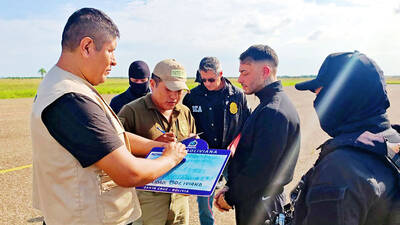
KINGPIN: Marset allegedly laundered the proceeds of his drug enterprise by purchasing and sponsoring professional soccer teams and even put himself in the starting lineups Notorious Latin American narco trafficker Sebastian Marset, who eluded police for years, was handed over to US authorities after his arrest on Friday in Bolivia. Marset, a Uruguayan national who was on the US most-wanted list, was passed to agents of the US Drug Enforcement Administration at Santa Cruz airport in Bolivia, then put on a US airplane, Bolivian state television showed. “The arrest and deportation were carried out pursuant to a court order issued by the US justice system,” Bolivian Minister of Government Marco Antonio Oviedo told reporters. The alleged kingpin was arrested in an upscale neighborhood of Santa
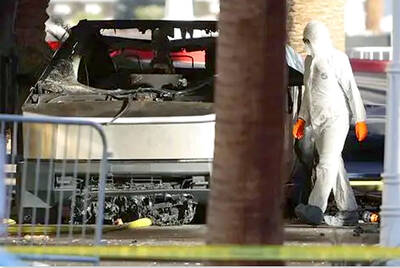
ACTIONABLE ADVICE: The majority of chatbots tested provided guidance on weapons, tactics and target selections, with Perplexity and Meta AI deemed to be the least safe From school shootings to synagogue bombings, leading artificial intelligence (AI) chatbots helped researchers plot violent attacks, according to a study published on Wednesday that highlighted the technology’s potential for real-world harm. Researchers from the nonprofit watchdog Center for Countering Digital Hate and CNN posed as 13-year-old boys in the US and Ireland to test 10 chatbots, including ChatGPT, Google Gemini, Perplexity, Deepseek and Meta AI. Eight of the chatbots assisted the make-believe attackers in more than half the responses, providing advice on “locations to target” and “weapons to use” in an attack, the study said. The chatbots had become a “powerful accelerant for
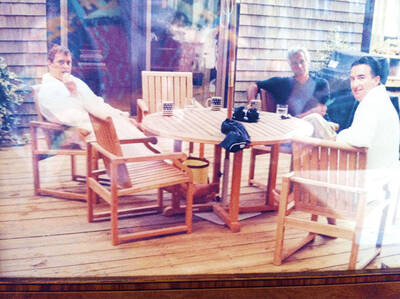
SCANDAL: Other images discovered earlier show Andrew bent over a female and lying across the laps of a number of women, while Mandelson is pictured in his underpants A photograph of former British prince Andrew and veteran politician Peter Mandelson sitting in bathrobes alongside late sex offender Jeffrey Epstein was unearthed on Friday in previously published documents. The image is believed to be the first known photograph of the two men with Epstein. They are currently engulfed in scandal in the UK over their ties to their mutual friend. The undated photograph, first reported by ITV News, shows King Charles III’s disgraced brother and former British ambassador to the US sitting barefoot outside on a wooden deck. They appear to have mugs with a US flag on them
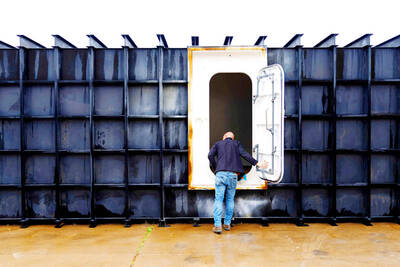
Since the war in the Middle East began nearly two weeks ago, the telephone at Ron Hubbard’s bomb shelter company in Texas has not stopped ringing. Foreign and US clients are rushing to buy his bunkers, seeking refuge in case of air raids, nuclear fallout or apocalypse. With the US and Israel pounding Iran, and Tehran retaliating with strikes across the region, Hubbard has seen demand for his product soar, mostly from Gulf nation customers in Bahrain, Qatar, Kuwait and the United Arab Emirates. “You can imagine how many people are thinking: ‘I wish I had a bomb shelter,’” Hubbard, 63, said in


 RSS
RSS