


Myanmar's surprise announcement that it will hold a vote on a new constitution in May and a general election in 2010 drew little enthusiasm yesterday among the military regime's critics and the public at large.
The announcements late on Saturday of the constitutional referendum and the election were the first moves by the government to set dates for stages of its so-called road map to democracy.
"The time has now come to change from military rule to democratic civilian rule," according to the announcement for the 2010 polls, broadcast on state TV and radio.
Critics say the long-delayed road map is designed to perpetuate military rule, not promote democracy.
The last election in Myanmar took place in 1990, but the military refused to hand over power to the winning party -- the National League for Democracy (NLD) of detained Nobel peace laureate Aung San Suu Kyi, who has been in prison or under house arrest for more than 12 of the past 18 years.
Trevor Wilson, a Myanmar expert at the Australian National University in Canberra, said: "This is certainly a step forward, but it is long overdue and is in itself insufficient to mollify either Burmese opponents of the military regime or the international community."
The international community increased pressure on the junta to hasten political reform after it violently quashed peaceful mass protests last September, killing at least 31 people, according to a UN estimate.
Last week, the US broadened financial sanctions against junta members and their families and friends, blaming the military's poor human rights record and failure to hand power to a democratically elected government.
A statement from the British Foreign Office in London said "a genuine and inclusive process of national reconciliation" was necessary for a transition to democracy and called for the release of Aung San Suu Kyi and other political prisoners.
Aung San Suu Kyi and others have not been consulted on the constitution or the election process.
The democracy icon's party reacted cautiously, noting the lack of detail on how the referendum would be carried out.
"The announcement is vague, incomplete and strange," NLD party spokesman Nyan Win said on Saturday night.
"Even before knowing the results of the referendum, the government has already announced that elections will be held in 2010," he said, implying the government was certain the draft constitution would be approved.
At tea shops in Yangon, where morning news and gossip are traditionally exchanged, many visitors seemed to be unimpressed with the developments.
"I am not interested in their referendum because the results are known already," 48-year old noodle salad seller Mar Mar Aye said.
Several people said they were unsure what a referendum was, noting the language describing it was similar to that used for the stage-managed mass rallies the government holds to show the public supports its policies. Myanmar's last constitutional referendum took place in 1974.
Scheduling the referendum for May makes it difficult for the junta's critics to mount a campaign against it, particularly because most leading pro-democracy activists are in jail, many detained in connection with last year's anti-government demonstrations.
Myanmar has been under military rule since 1962 and has not had a constitution since 1988, when the army brutally put down earlier pro-democracy demonstrations and the current junta took power.
The country has been in a political deadlock since the military refused to recognize the 1990 election results, saying the country first needed a new constitution. It harassed and arrested members of the pro-democracy movement.
Guidelines for the new constitution were adopted by a military-managed convention last year and a government-appointed commission is drafting the document.
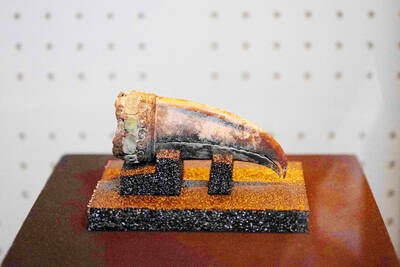
Archeologists in Peru on Thursday said they found the 5,000-year-old remains of a noblewoman at the sacred city of Caral, revealing the important role played by women in the oldest center of civilization in the Americas. “What has been discovered corresponds to a woman who apparently had elevated status, an elite woman,” archeologist David Palomino said. The mummy was found in Aspero, a sacred site within the city of Caral that was a garbage dump for more than 30 years until becoming an archeological site in the 1990s. Palomino said the carefully preserved remains, dating to 3,000BC, contained skin, part of the
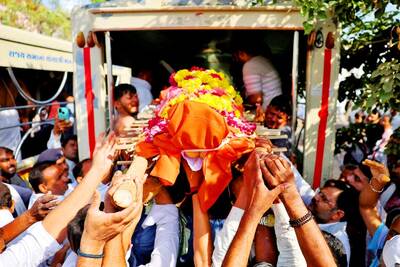
‘WATER WARFARE’: A Pakistani official called India’s suspension of a 65-year-old treaty on the sharing of waters from the Indus River ‘a cowardly, illegal move’ Pakistan yesterday canceled visas for Indian nationals, closed its airspace for all Indian-owned or operated airlines, and suspended all trade with India, including to and from any third country. The retaliatory measures follow India’s decision to suspend visas for Pakistani nationals in the aftermath of a deadly attack by shooters in Kashmir that killed 26 people, mostly tourists. The rare attack on civilians shocked and outraged India and prompted calls for action against their country’s archenemy, Pakistan. New Delhi did not publicly produce evidence connecting the attack to its neighbor, but said it had “cross-border” links to Pakistan. Pakistan denied any connection to

TRUMP EFFECT: The win capped one of the most dramatic turnarounds in Canadian political history after the Conservatives had led the Liberals by more than 20 points Canadian Prime Minister Mark Carney yesterday pledged to win US President Donald Trump’s trade war after winning Canada’s election and leading his Liberal Party to another term in power. Following a campaign dominated by Trump’s tariffs and annexation threats, Carney promised to chart “a new path forward” in a world “fundamentally changed” by a US that is newly hostile to free trade. “We are over the shock of the American betrayal, but we should never forget the lessons,” said Carney, who led the central banks of Canada and the UK before entering politics earlier this year. “We will win this trade war and
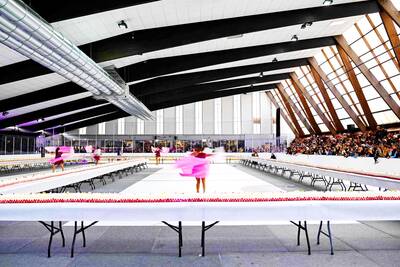
Armed with 4,000 eggs and a truckload of sugar and cream, French pastry chefs on Wednesday completed a 121.8m-long strawberry cake that they have claimed is the world’s longest ever made. Youssef El Gatou brought together 20 chefs to make the 1.2 tonne masterpiece that took a week to complete and was set out on tables in an ice rink in the Paris suburb town of Argenteuil for residents to inspect. The effort overtook a 100.48m-long strawberry cake made in the Italian town of San Mauro Torinese in 2019. El Gatou’s cake also used 350kg of strawberries, 150kg of sugar and 415kg of


 RSS
RSS