


Thailand won praise overseas for its return to civilian rule, but its Cabinet full of newcomers yesterday faced immediate doubts at home over its competence and plans for ousted prime minister Thaksin Shinawatra.
The EU hailed the kingdom's return to democracy, while the US announced a resumption of military aid suspended after the coup in September 2006.
But at home Thai Prime Minister Samak Sundaravej's government faced widespread criticism over a Cabinet that even he described as "ugly" because so many relatively inexperienced figures dominated top positions.
Samak, who led the People Power Party to victory in December elections by openly campaigning as Thaksin's proxy, is also trying to temper expectations that he would quickly grant the exiled billionaire an amnesty to allow his speedy return home.
After the coup, a military installed tribunal banned Thaksin and 110 of his top aides from politics for five years.
Thaksin faces separate corruption charges filed by military backed investigators, which could land him and his wife in prison.
His wife has told a Thai court that he would return home in May to defend himself, but Thaksin has given no firm plans for ending his self-imposed exile in Britain, where he has bought the English Premier League soccer club Manchester City.
Samak said late on Wednesday that he would only consider an amnesty for Thaksin in two years, which he said would allow time for political tensions to ease.
The leaders of anti-Thaksin street protests that precipitated the coup have already threatened to stage fresh demonstrations if the new government interferes with the court cases against Thaksin.
Samak's efforts to put off discussion of an amnesty may help appease those critics, said political analyst Thitinan Pongsudhirak of Chulalongkorn University.
"Samak needs breathing space to actually govern the country. This is a maneuver to keep the pressure away and then to create a working space and time to prove his worth," Thitinan said.
So far the military has indicated that it plans to stay out of politics.
"There should not be any more coups because that would affect our country's credibility," air force chief Chalit Pukbhasuk said yesterday as he announced that the junta has officially dissolved.
"We must have confidence in democratic rule," he told reporters.
Analysts worry that the new Cabinet lacks the political gravitas needed to revive the economy while steering through the minefield of competing interests within Samak's six-party coalition.
Close Thaksin aides were given choice posts -- leading the finance and foreign ministries -- while his brother-in-law was named a deputy prime minister.
Most of them were unknowns before the coup, and Samak has publicly complained about how little say Thaksin's allies allowed him in the naming of the Cabinet.
"It shows that he does not even have the power to select his own Cabinet," said political analyst Prayad Hongthongkam, who lectures at several universities in Bangkok. "Several ministers have no qualifications for their jobs. They got their jobs as political payback."
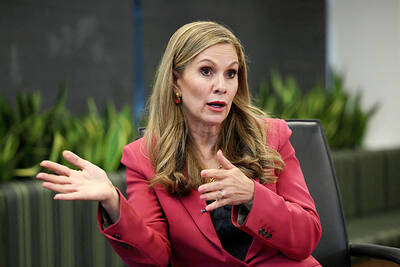
Australians were downloading virtual private networks (VPNs) in droves, while one of the world’s largest porn distributors said it was blocking users from its platforms as the country yesterday rolled out sweeping online age restriction. Australia in December became the first country to impose a nationwide ban on teenagers using social media. A separate law now requires artificial intelligence (AI)-powered chatbot services to keep certain content — including pornography, extreme violence and self-harm and eating disorder material — from minors or face fines of up to A$49.5 million (US$34.6 million). The country also joined Britain, France and dozens of US states requiring
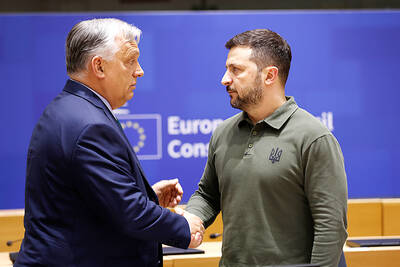
Hungarian authorities temporarily detained seven Ukrainian citizens and seized two armored cars carrying tens of millions of euros in cash across Hungary on suspicion of money laundering, officials said on Friday. The Ukrainians were released on Friday, following their detention on Thursday, but Hungarian officials held onto the cash, prompting Ukraine to accuse Hungary’s Russia-friendly government of illegally seizing the money. “We will not tolerate this state banditism,” Ukrainian Minister of Foreign Affairs Andrii Sybiha said. The seven detained Ukrainians were employees of the Ukrainian state-owned Oschadbank, who were traveling in the two armored cars that were carrying the money between Austria and
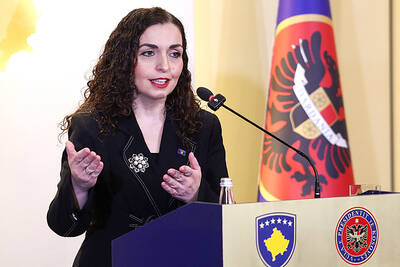
Kosovar President Vjosa Osmani on Friday after dissolving the Kosovar parliament said a snap election should be held as soon as possible to avoid another prolonged political crisis in the Balkan country at a time of global turmoil. Osmani said it is important for Kosovo to wrap up the upcoming election process and form functional institutions for political stability as the war rages in the Middle East. “Precisely because the geopolitical situation is that complex, it is important to finish this electoral process which is coming up,” she said. “It is very hard now to imagine what will happen next.” Kosovo, which declared

MORE BANS: Australia last year required sites to remove accounts held by under-16s, with a few countries pushing for similar action at an EU level and India considering its own ban Indonesia on Friday said it would ban social media access for children under 16, citing threats from online pornography, cyberbullying, online fraud and Internet addiction. “Accounts belonging to children under 16 on high-risk platforms will start to be deactivated, beginning with YouTube, TikTok, Facebook, Instagram, Threads, X, Bigo Live and Roblox,” Indonesian Minister of Communications and Digital Meutya Hafid said. “The government is stepping in so that parents no longer have to fight alone against the giants of the algorithm. Implementation will begin on March 28, 2026,” she said. The social media ban would be introduced in stages “until all platforms fulfill their


 RSS
RSS