


A pair of female suicide bombers blew themselves up yesterday in two Baghdad pet bazaars, killing at least 64 people and wounding dozens, police said.
The attacks were the deadliest in the Iraqi capital since 30,000 more US forces flooded into the center of the country last spring.
In the first attack, a woman detonated explosives hidden under her traditional black Islamic robe in the central al-Ghazl market.
A police colonel also at the scene said the bomber was a young mentally-handicapped woman.
Police said at least 46 people were killed and 82 wounded.
About 20 minutes later, a second female suicide bomber struck another bird market in a predominantly Shiite area in southeastern Baghdad.
That blast killed as many as 18 people and wounded 25, police said.
There were conflicting details about the second blast.
The US military said initial reporting indicated it was a suicide car bombing carried out by a woman, but Iraqi police said the female attacker detonated an explosives belt at the entrance to the bazaar.
Casualty tolls also differed, with the military saying about 10 people were killed and 20 wounded and Iraqi police reporting 18 killed and 25 wounded.
The attack on the al-Ghazl market, which opens only on Fridays and is always crowded, was the second in months.
On Nov. 23, two bombs hidden in boxes exploded simultaneously in the market, leaving 13 people dead.
The attacks came as Iraqi officials reported civilian deaths across Iraq last month fell to a 23-month low.
Combined figures obtained from the defense, interior and health ministries showed that a total of 541 Iraqis -- 463 civilians, 22 soldiers and 56 policemen -- were killed last month.
The figure is down from 568 in December, 606 in November, 887 in October and 840 in September.
US military commanders say attacks of all types are down 62 percent after peaking in June, to levels not seen since before February 2006, when a wave of sectarian violence was unleashed by the bombing of a Shiite shrine in the city of Samarra.
The bloodshed that erupted after the shrine attack spiked in January last year with 1,992 deaths reported by the three ministries.
Iraqi and US officials attribute the drop in violence to a "surge" of an extra 30,000 US troops in Iraq, the formation by Sunni leaders of anti-Qaeda fronts, and Shiite cleric Moqtada al-Sadr's freezing of the activities of his Mahdi Army militia.
But US commanders warn that Iraq is still a dangerous place and that al-Qaeda -- though on the run -- is far from defeated.
While the number of Iraqis killed last month fell, US casualties rose to 39 soldiers killed, up from 23 in December.
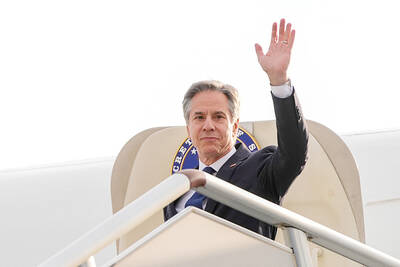
‘IN A DIFFERENT PLACE’: The envoy first visited Shanghai, where he attended a Chinese basketball playoff match, and is to meet top officials in Beijing tomorrow US Secretary of State Antony Blinken yesterday arrived in China on his second visit in a year as the US ramps up pressure on its rival over its support for Russia while also seeking to manage tensions with Beijing. The US diplomat tomorrow is to meet China’s top brass in Beijing, where he is also expected to plead for restraint as Taiwan inaugurates president-elect William Lai (賴清德), and to raise US concerns on Chinese trade practices. However, Blinken is also seeking to stabilize ties, with tensions between the world’s two largest economies easing since his previous visit in June last year. At the
Nearly half of China’s major cities are suffering “moderate to severe” levels of subsidence, putting millions of people at risk of flooding, especially as sea levels rise, according to a study of nationwide satellite data released yesterday. The authors of the paper, published by the journal Science, found that 45 percent of China’s urban land was sinking faster than 3mm per year, with 16 percent at more than 10mm per year, driven not only by declining water tables, but also the sheer weight of the built environment. With China’s urban population already in excess of 900 million people, “even a small portion

UNSETTLING IMAGES: The scene took place in front of TV crews covering the Trump trial, with a CNN anchor calling it an ‘emotional and unbelievably disturbing moment’ A man who doused himself in an accelerant and set himself on fire outside the courthouse where former US president Donald Trump is on trial has died, police said yesterday. The New York City Police Department (NYPD) said the man was declared dead by staff at an area hospital. The man was in Collect Pond Park at about 1:30pm on Friday when he took out pamphlets espousing conspiracy theories, tossed them around, then doused himself in an accelerant and set himself on fire, officials and witnesses said. A large number of police officers were nearby when it happened. Some officers and bystanders rushed
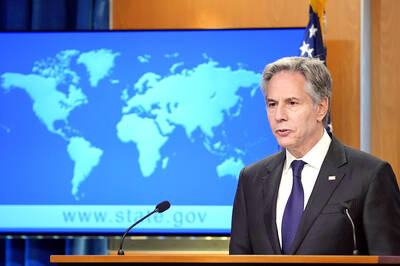
Beijing is continuing to commit genocide and crimes against humanity against Uyghurs and other Muslim minorities in its western Xinjiang province, U.S. Secretary of State Antony Blinken said in a report published on Monday, ahead of his planned visit to China this week. The State Department’s annual human rights report, which documents abuses recorded all over the world during the previous calendar year, repeated language from previous years on the treatment of Muslims in Xinjiang, but the publication raises the issue ahead of delicate talks, including on the war in Ukraine and global trade, between the top U.S. diplomat and Chinese


 RSS
RSS