


Poland's foreign minister said Russian threats have to be considered as his country weighs a proposal from the US to install missile defense interceptors on Polish territory.
In talks with US officials this week, Radek Sikorski is pressing for security aid from the US as part of any deal. Polish officials have suggested that the aid could come in the form of shorter range anti-missile systems that could be used to counter threats from neighboring countries including Russia.
"Poland is a part of both the EU and NATO where we take democratic values, procedures, institutions, respect for human rights for granted, and we border some countries where trends are not necessarily in a direction that we welcome," Sikorski said.
Russia has stridently opposed the missile defense plan and has threatened to retarget nuclear missiles at Poland to counter what it sees as a US attempt to undermine the Russian military deterrent. The US says the proposed system is intended to protect Western countries from missiles fired from Iran and would be impotent against Russia's massive arsenal.
While Sikorski would not elaborate on the Polish negotiating stance ahead of talks with senior US officials including Secretary of State Condoleezza Rice and Defense Secretary Robert Gates yesterday, he indicated that Poland is less fixated on acquiring missile systems as part of a deal than it is in securing greater assurances by the US for Poland's security.
"We are not particularly glued to technical solutions, but we are interested in intensifying cooperation with the US," he said. "The US still, in Poland, has a unique credibility in the defense area."
Poland does not see Russia as an immediate threat, Sikorski said. But he emphasized that missile defense project has risks for Poland.
"It is something that we have to take into account," he said, speaking of the Russian threats. "It is something that is a risk and not just a political risk that is involved in this project."
Earlier on Thursday at a speech given at the American Enterprise Institute, a conservative think tank where he once worked, Sikorski compared Poland's situation to that of a homeowner who is asked by a friendly neighbor to allow a satellite dish to be installed on his roof, then is confronted by another neighbor who insists that the dish will harm his health and threatens violence.
"You and I know, a dish does not make you sick," he said, continuing the metaphor. "The question is, what can we do together to address an unreasonable neighbor?"
Since becoming foreign minister under Polish Prime Minister Donald Tusk, Sikorski has argued for asking more from Washington in exchange for Poland's support in military operations in Iraq and Afghanistan, as well as the missile defense system the administration of US President George W. Bush plans to install in Poland and the neighboring Czech Republic.
Tusk and Sikorski have taken a tougher stance on missile defense since taking office in November than the previous government of former Polish prime minister Jaroslaw Kaczynski, who opened talks early last year and firmly supported the plan.

‘IN A DIFFERENT PLACE’: The envoy first visited Shanghai, where he attended a Chinese basketball playoff match, and is to meet top officials in Beijing tomorrow US Secretary of State Antony Blinken yesterday arrived in China on his second visit in a year as the US ramps up pressure on its rival over its support for Russia while also seeking to manage tensions with Beijing. The US diplomat tomorrow is to meet China’s top brass in Beijing, where he is also expected to plead for restraint as Taiwan inaugurates president-elect William Lai (賴清德), and to raise US concerns on Chinese trade practices. However, Blinken is also seeking to stabilize ties, with tensions between the world’s two largest economies easing since his previous visit in June last year. At the

UNSETTLING IMAGES: The scene took place in front of TV crews covering the Trump trial, with a CNN anchor calling it an ‘emotional and unbelievably disturbing moment’ A man who doused himself in an accelerant and set himself on fire outside the courthouse where former US president Donald Trump is on trial has died, police said yesterday. The New York City Police Department (NYPD) said the man was declared dead by staff at an area hospital. The man was in Collect Pond Park at about 1:30pm on Friday when he took out pamphlets espousing conspiracy theories, tossed them around, then doused himself in an accelerant and set himself on fire, officials and witnesses said. A large number of police officers were nearby when it happened. Some officers and bystanders rushed

Beijing is continuing to commit genocide and crimes against humanity against Uyghurs and other Muslim minorities in its western Xinjiang province, U.S. Secretary of State Antony Blinken said in a report published on Monday, ahead of his planned visit to China this week. The State Department’s annual human rights report, which documents abuses recorded all over the world during the previous calendar year, repeated language from previous years on the treatment of Muslims in Xinjiang, but the publication raises the issue ahead of delicate talks, including on the war in Ukraine and global trade, between the top U.S. diplomat and Chinese
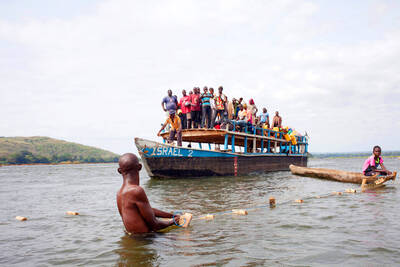
RIVER TRAGEDY: Local fishers and residents helped rescue people after the vessel capsized, while motorbike taxis evacuated some of the injured At least 58 people going to a funeral died after their overloaded river boat capsized in the Central African Republic’s (CAR) capital, Bangui, the head of civil protection said on Saturday. “We were able to extract 58 lifeless bodies,” Thomas Djimasse told Radio Guira. “We don’t know the total number of people who are underwater. According to witnesses and videos on social media, the wooden boat was carrying more than 300 people — some standing and others perched on wooden structures — when it sank on the Mpoko River on Friday. The vessel was heading to the funeral of a village chief in


 RSS
RSS