


Train service was restored yesterday in southern China, thinning the massive crowds waiting to go home after the worst winter storms in half a century hit during the nation's busiest holiday travel season.
Thousands of people squeezed into the massive plaza in front of the Guangzhou train station. Some of the travelers waiting to board trains said they had been standing all night.
The Railway Ministry said the train service had basically returned to normal and extra trains were being put on the schedule.
"We'll transport 400,000 passengers per day in the Guangzhou area," the ministry said.
But many travelers feared they would still have to endure a long wait.
"There is no way I am going to make my train," said Chen Yuejin, a 32-year-old textile factory worker trying to get to Wuhan in central China.
"It looks like I am going to be here for two days waiting to leave," he said.
Train seats were being given on a first-come-first-serve basis.
Crowds at temporary shelters set up in Guangzhou had eased considerably yesterday.
The Canton Fair Exhibition Center, which earlier this week was packed with people seeking temporary shelter as they waited for trains, was mostly empty.
While train service was getting back to normal, the official Xinhua news agency said 12 national highways in six provinces remained impassable because of ice and a lack of snow-clearing equipment.
One student allegedly had a bright idea about how to get home, but was thwarted by police.
The university student from Hubei wanted to return to Wuhan 200km away, the Changjiang Daily said.
"He had a fantastic idea. He hired or borrowed some ski poles, skis ... and got on the highway," the report on www.sina.com.cn said.
But he was spotted by police, who picked him up and took him to a bus station, the newspaper said, without providing details.
Meanwhile, thousands of people stranded in cars and trucks have one less reason to complain -- they don't have to pay road tolls.
Guangxi's traffic bureau said it had allowed more than 3,000 cars to enter the region "free" to ease the traffic on a trunk road, Xinhua said yesterday.
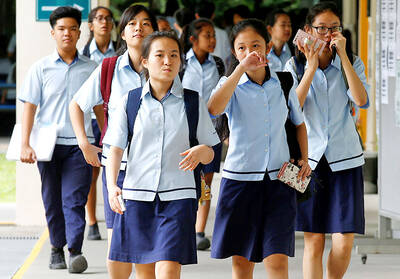
School bullies in Singapore are to face caning under new guidelines, but the education minister on Tuesday said it would be meted out only as a last resort with strict safeguards. Human rights groups regularly criticize Singapore for the use of corporal punishment, which remains part of the school and criminal justice systems, but authorities have defended it as a deterrent to crime and serious misconduct. Caning was discussed in the parliament after legislators asked how it would be used in relation to bullying in schools. The debate followed stricter guidelines on serious student misconduct, including bullying, unveiled by the Singaporean Ministry of

As evening falls in Fiji’s capital, a steady stream of people approaches a makeshift clinic that is a first line of defense against one of the world’s fastest-growing HIV epidemics. In the South Pacific nation — a popular tourist destination of just under a million people — more than 2,000 new HIV cases were recorded last year, a 26 percent increase from 2024. The government has declared an HIV outbreak and described it as a national crisis. “It’s spreading like wildfire,” said Siteri Dinawai, 46, who came to be tested. The Moonlight Clinic, a converted minibus parked in a suburban cul-de-sac in Suva, is

Jailed media entrepreneur Jimmy Lai (黎智英) has been awarded Deutsche Welle’s (DW) freedom of speech award for his contribution to Hong Kong’s pro-democracy movement. The German public broadcaster on Thursday said Lai would be presented in absentia with the 12th iteration of the award on June 23 at the DW Global Media Forum in Bonn. Deutsche Welle director-general Barbara Massing praised the 78-year-old founder of the now-shuttered news outlet Apple Daily for standing “unwaveringly for press freedom in Hong Kong at great personal risk.” “With Apple Daily, he gave journalists a platform for free reporting and a voice to the democracy movement in

A MESSAGE: Japan’s participation in the Balikatan drills is a clear deterrence signal to China not to attack Taiwan while the US is busy in the Middle East, an analyst said The Japan Self-Defense Forces yesterday fired a Type 88 anti-ship missile during a joint maritime exercise with US, Australian and Philippine forces, hitting a decommissioned Philippine Navy ship in waters facing the disputed South China Sea, in drills that underscore Tokyo’s rising willingness to project military power on China’s doorstep. The drill took place as Manila and Tokyo began talks on a potential defense equipment transfer, made possible by Japan’s decision to scrap restrictions on military exports. The discussions include the possible early transfer of Abukuma-class destroyers and TC-90 aircraft to the Philippines, Japanese Minister of Defense Shinjiro Koizumi said. Philippine Secretary of


 RSS
RSS