


Afghanistan risks sliding into a failed state and becoming the "forgotten war" because of deteriorating international support and a growing violent insurgency, an independent study said.
The assessment, co-chaired by retired US Marine Corps General James Jones and former US ambassador to the UN Thomas Pickering, serves as a warning to the administration of US President George W. Bush at a time military and congressional officials are debating how best to juggle stretched war-fighting resources.
The administration wants to re-energize anti-terror efforts in Afghanistan and Pakistan, where al-Qaeda and the Taliban militia are regenerating. But the US still remains heavily invested in Iraq, and officials are sending strong signals that troop reductions would slow or stop altogether this summer.
"Afghanistan stands at a crossroads," said the study, an advance copy of which was obtained by the Associated Press.
"The progress achieved after six years of international engagement is under serious threat from resurgent violence, weakening international resolve, mounting regional challenges and a growing lack of confidence on the part of the Afghan people about the future direction of their country," it said.
A major issue has been trying to win the war with "too few military forces and insufficient economic aid," the study said.
Among the group's nearly three dozen recommendations: increase NATO force levels and military equipment sent to Afghanistan; decouple US management of the Iraq and Afghanistan wars; establish a special envoy to coordinate all US policy on Afghanistan; and champion a unified strategy among partner nations to stabilize the country in five years.
US Defense Secretary Robert Gates said he was not familiar with the study's findings, but he struck a more optimistic tone on Afghanistan's future.
"I would say that the security situation is good," Gates said. "We want to make sure it gets better, and I think there's still a need to coordinate civil reconstruction, the economic development side of it."
Gates said more troops are needed in Afghanistan, but "certainly not ours."
When asked how many more NATO troops might be needed, he said that number should be determined by ground commanders.
The Jones-Pickering assessment, set for public release yesterday, says the US should rethink its military and economic strategy in Afghanistan in large part because of deteriorating support among voters in NATO countries.
If international forces are pulled, the fragile Afghan government would "likely fall apart," the report warns.
The study was a voluntary effort coordinated by the Center for the Study of the Presidency, a nonpartisan organization in Washington, as a follow-on to the Iraq Study Group. That study group was a congressionally mandated blue-ribbon panel, the first major bipartisan assessment on the Iraq war since the 2003 invasion.
While the Afghanistan study has not created the same buzz as the Iraq assessment, the center's latest findings still probably will wield political clout because of those involved.
Last year, Jones led a high profile study on Iraqi security forces, which was used by lawmakers to challenge Bush's own assessments.
Most recently, the retired Marine Corps general, known for his outspoken independence, was tapped to advise US Secretary of State Condoleezza Rice on security aspects of the new Israeli-Palestinian peace talks.
Pickering was a longtime US ambassador and a former undersecretary of state.
The study's panel members include Charles Robb, a former Democratic senator who served on the Iraq Study Group, and David Abshire, who helped organize the Iraq study. Abshire is president of the Center for the Study of the Presidency.
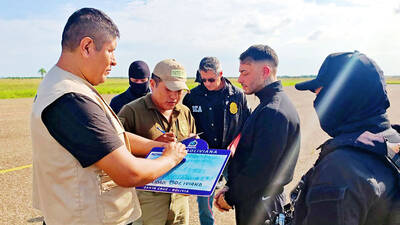
KINGPIN: Marset allegedly laundered the proceeds of his drug enterprise by purchasing and sponsoring professional soccer teams and even put himself in the starting lineups Notorious Latin American narco trafficker Sebastian Marset, who eluded police for years, was handed over to US authorities after his arrest on Friday in Bolivia. Marset, a Uruguayan national who was on the US most-wanted list, was passed to agents of the US Drug Enforcement Administration at Santa Cruz airport in Bolivia, then put on a US airplane, Bolivian state television showed. “The arrest and deportation were carried out pursuant to a court order issued by the US justice system,” Bolivian Minister of Government Marco Antonio Oviedo told reporters. The alleged kingpin was arrested in an upscale neighborhood of Santa
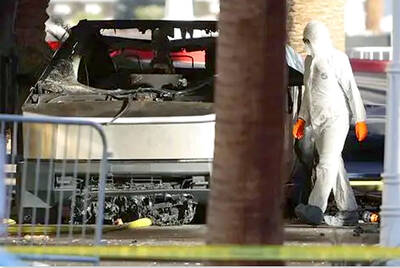
ACTIONABLE ADVICE: The majority of chatbots tested provided guidance on weapons, tactics and target selections, with Perplexity and Meta AI deemed to be the least safe From school shootings to synagogue bombings, leading artificial intelligence (AI) chatbots helped researchers plot violent attacks, according to a study published on Wednesday that highlighted the technology’s potential for real-world harm. Researchers from the nonprofit watchdog Center for Countering Digital Hate and CNN posed as 13-year-old boys in the US and Ireland to test 10 chatbots, including ChatGPT, Google Gemini, Perplexity, Deepseek and Meta AI. Eight of the chatbots assisted the make-believe attackers in more than half the responses, providing advice on “locations to target” and “weapons to use” in an attack, the study said. The chatbots had become a “powerful accelerant for
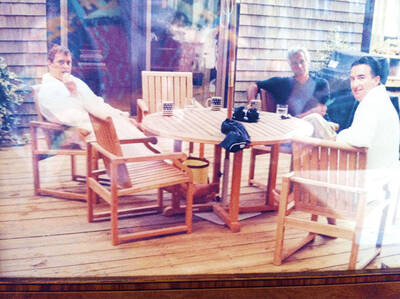
SCANDAL: Other images discovered earlier show Andrew bent over a female and lying across the laps of a number of women, while Mandelson is pictured in his underpants A photograph of former British prince Andrew and veteran politician Peter Mandelson sitting in bathrobes alongside late sex offender Jeffrey Epstein was unearthed on Friday in previously published documents. The image is believed to be the first known photograph of the two men with Epstein. They are currently engulfed in scandal in the UK over their ties to their mutual friend. The undated photograph, first reported by ITV News, shows King Charles III’s disgraced brother and former British ambassador to the US sitting barefoot outside on a wooden deck. They appear to have mugs with a US flag on them
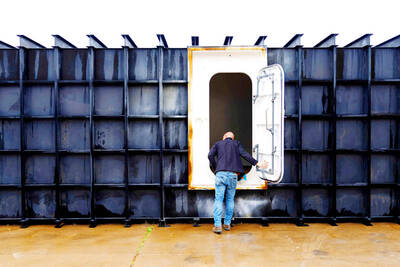
Since the war in the Middle East began nearly two weeks ago, the telephone at Ron Hubbard’s bomb shelter company in Texas has not stopped ringing. Foreign and US clients are rushing to buy his bunkers, seeking refuge in case of air raids, nuclear fallout or apocalypse. With the US and Israel pounding Iran, and Tehran retaliating with strikes across the region, Hubbard has seen demand for his product soar, mostly from Gulf nation customers in Bahrain, Qatar, Kuwait and the United Arab Emirates. “You can imagine how many people are thinking: ‘I wish I had a bomb shelter,’” Hubbard, 63, said in


 RSS
RSS